
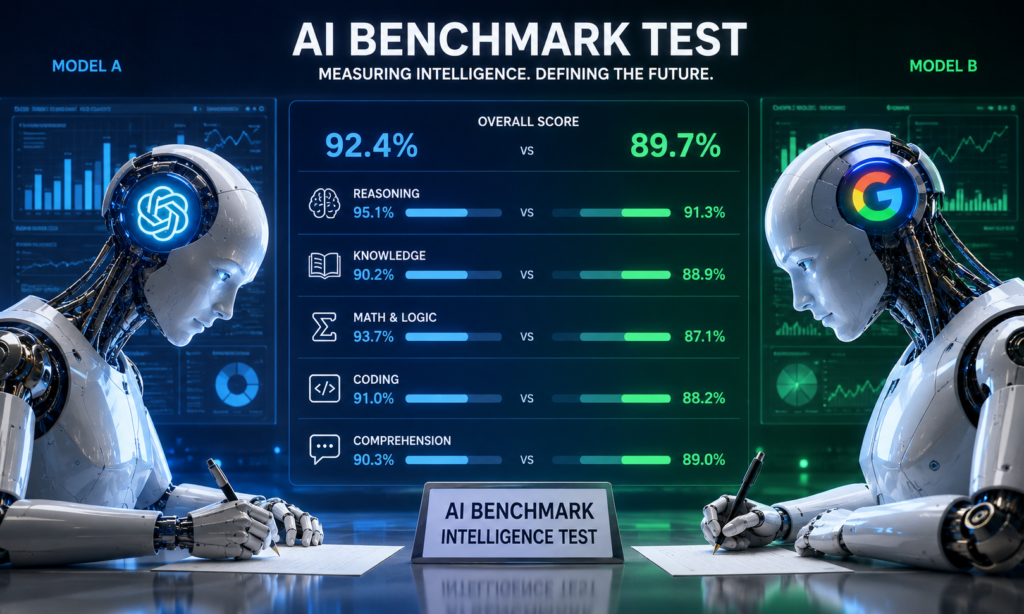
AI models are doing amazing things on the various reasoning, mathematics, coding, language and multimodal benchmarks. The impression of very fast progress can be given by the fact that each new generation seems to improve upon the previous generations. But an intriguing question is coming to the fore: Do AI models really become smarter or do they just get better at passing standardized tests?
AI benchmarks offer a way to quantify the performances of various systems, allowing researchers, businesses, and users to evaluate and contrast them. However, when performance is benchmarked it is not necessarily general intelligence. Question formats to which the models are already accustomed, optimization of the questions according to benchmarks, contamination of training data and tests that focus on very specific features may all help.
The increasing disparity between the benchmark results and the actual intelligence of AI models has raised concerns about an AI benchmark bubble, in which outstanding results could sometimes overestimate the performance of AI models in real-world settings.
How AI Benchmark Scores can be Exaggerations of True Intelligence
AI benchmarks continue to be valuable metrics to track progress, but they should be taken with a grain of salt. High scores on one evaluation do not necessarily indicate a high score on the other evaluations, or on the overall scale of the evaluation.
- Optimizing a benchmark does not provide the same level of real world intelligence.
- The models might have an advantage when questions were presented before in the training.
- Narrow assessments focus on specific skills and not on general adaptability.
- As a test case becomes more common, a benchmark for it becomes more easily optimized.
- Competition leads companies to focus more on the impressive and measurable benchmark improvements.
High scores can’t represent all aspects of intelligence.
Making correct answers is a far cry from human intelligence. Individuals recognize problems, interpret situations that are ambiguous, adjust strategies, recognize when something is wrong and know when information is not adequate. Often the traditional benchmarks are clear with questions that have a single correct answer, and therefore are helpful but insufficient measures.
The same model that performs exceptionally well on a familiar problem, might not perform as well when faced with the same concepts in a new problem. This distinction is especially significant as flexibility and adaption play a key role in the ability to be practical and intelligent.
The key take-away message is that a good benchmark score should be interpreted in terms of a single capability and not overall intelligence.
Gradually lose the ability to differentiate familiar benchmarks
The most popular indicators can be used as performance benchmarks to continually optimize. With an understanding of the models, researchers can then plan models that will be more aware of the types of problems that they will face, based on what they know about how the models are formed and their common questions.
This does not necessarily mean that it is purposely done. It is just a consequence of a standardized evaluation that’s used time and time once more. The benchmark has an impact on the development, and development has an impact on the ability of the benchmark.
Therefore, there is a need for regular updates of evaluation systems, and for new, unknown testing environments.
Training Data Contamination is a New Measurement Problem
The massively sized AI can learn from vast amounts of available and licensed data. If benchmark questions and answers, explanations or similar examples are part of training materials, then the determination of an actual test performance gets complicated.
A model can detect patterns that are related to a problem but not be able to solve the problem itself. The research team can mitigate this concern by using private datasets, developing new questions, using dynamic evaluations and controlled testing environments.
The Possibility of AI Testing Going Beyond Leaderboards
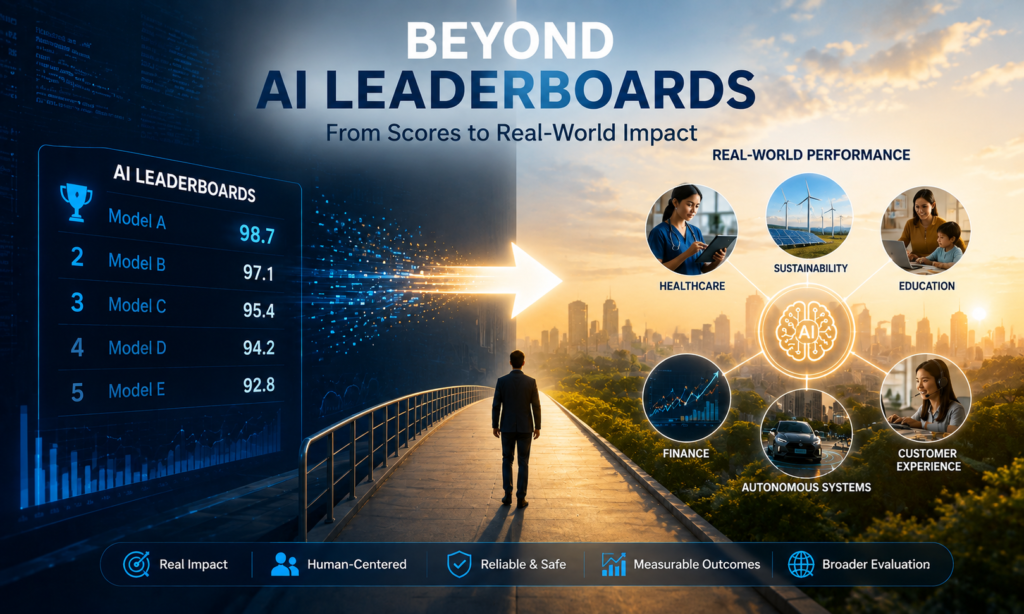
Next generation AI evaluation should not just evaluate models based on their ability to answer specific questions, but must also measure other aspects. Nowadays, systems more and more carry out more complicated tasks that involve planning, using tools, researching, coding, decision making, extended interactions etc.
- New private information can eliminate problems of memorization and contamination of benchmarks.
- Real-world tasks show the usefulness of real world outcomes of models.
- The performance can be assessed with varying levels of difficulty using adaptive testing.
- Consistency can be measured over a long period of time in a complex multi-step workflow.
- Human-centred assessments can consider aspects of reliability, usefulness, transparency and recovery.
Practical performance should be a larger measure
Educators are not often using AI for the sole purpose of being cool.It is very rare for businesses to implement AI just to get a great score on a benchmark. They employ models to perform certain tasks like analysing documents, creating software, handling customer queries, finding information, and processing internal information.
In these applications, other than accuracy, are considerations. It’s also important for organisations to know how much it costs, how fast it is, how consistent it is, how secure it is, how reliable it is and how often there are major errors.
It is possible that an AI model that achieves a slightly lower score on a test, but has a high accuracy on a day-to-day task, could be worth much more than a model which has a record-breaking score.
Adaptability Can Reveal More Than Repeated Question Solving
An actual great AI system ought to be able to take care of circumstances it has never faced prior. Evaluations can then impose new conditions, lack of information, and new constraints and instructions.
An example of such a task would be a complex business task in which the information is increasingly changing the initial situation, which an AI agent is given. The evaluation may be the ability of the system to update the plan to reflect this change, or not making this outmoded assumption.
Reliability should be accompanied with Intelligence measurements.
In the real world the outputs of AI systems should be reliable, particularly when that output is used to make critical decisions. A model that is quite accurate for most of the time, but has a tendency to give extreme errors in a minority of circumstances may still cause a large amount of risk.
Hallucination, confidence calibration, consistency, instruction-following, uncertainty recognition and error recovery should thus be looked at in future benchmarks.
Conclusion
The AI benchmark bubble doesn’t indicate that the advancement of AI is simply a figment of imagination. Today’s models are in fact evolving to be more adept at a wide range of technical and creative problems. A concern is that sometimes scores for the benchmark assessments will give a more limited view than the numbers.
AI systems are becoming more than just chatbots, they are transforming into more powerful and capable tools like coding assistants, research systems and decision-support tools.Evaluation needs to adapt to new and more powerful and capable AI systems, and move beyond chatbots. Static tests can continue to be helpful, but they need to be used in conjunction with some new problems, real world tasks, adaptive assessment and reliability assessment.
FAQs
1. What does the AI benchmark bubble mean?
The AI benchmark bubble refers to the worries that enhancements in the benchmarks can overestimate actual advancements in general intelligence.
2. Are there any use of AI benchmarks?
Benchmarks are important for comparisons, but can’t be all that intelligence.
3. Is optimization of AI models for benchmarks possible?
Development strategies can help to execute better on known evaluation patterns, but don’t necessarily help to achieve wider capabilities.
4. Why is it a problem that Ben’s bench is contaminated?
The models may be able to use the information they learned earlier in the evaluation process if it is contaminated.
5. What should be the measures of the future AI evaluations?
Future assessments should assess adaptability, reliability, reasoning, real-world consistency, and effective task completion.