
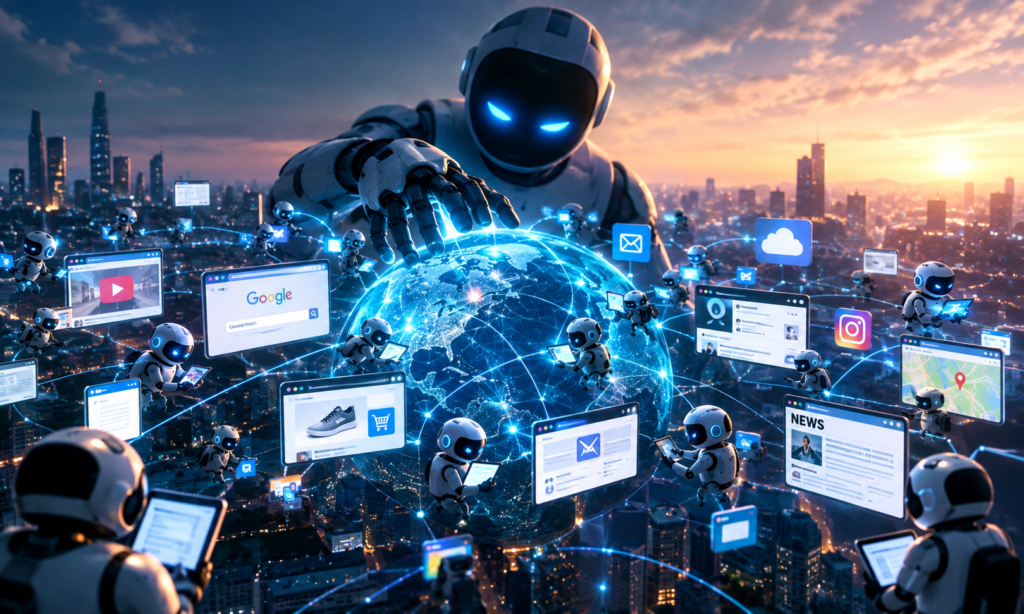
The internet is created to encompass the clicking, searching, posting, buying, and communicating of humanity. This is slowly shifting as AI agents start surfing the web, sending messages and carrying out tasks without human intervention, making decisions, and talking to digital services. Unlike conventional AI agents, which only follow orders, autonomous agents can now strive for objectives in several online systems.
This presents a great opportunity for automation but brings along some new challenges: digital chaos without any human oversight. With thousands or millions of AI agents working at the same time, humans may find themselves encountering internet activity that isn’t initiated by them and may not be fully understood by them.
When Software Stops Waiting for Human Permission
Traditional software normally has preprogrammed instructions. An AI agent, however, can comprehend objectives, figure out what must be done, and change its conduct as info changes. The advantage to that is that agents are much more flexible but difficult to predict.
The Internet Could Become an Agent-to-Agent Environment
Suppose an AI agent can find the retailer the lowest price from the supplier, and another AI agent can manage the inventory of the retailer as well. There are three agents who can handle advertising and another one who can handle negotiations relating to delivery. These can be interdependent systems, where one system does not need to be under the supervision of another person in completing each transaction.
The outcome might be a web where computer systems communicate more and more with the other computer systems. Human users would be engaged, and, while much of the underlying digital activity might take place between machines, the human users would be there as well.
The five forces driving independent digital activity are
AI agents are moving beyond chatbot interactions thanks to several developments:
- With the rise of AI agents, websites and digital platforms can be more independent in navigating.
- Real-time information can be used to inform automated systems of decisions.
- APIs enable agents to directly communicate with software and services.
- Persistent memory allows the agents to ‘remember’ what is going on in a task.
- Multi-agent systems are systems that have multiple specialized agents that are able to coordinate actions.
When Digital Agents Collide With The Chaos
It isn’t necessarily the largest AI that takes over the internet that is the greatest threat. The more realistic risk is that millions of legitimate agents are acting in unpredictable ways in response to their objectives as they interact.
Automated Competitions Can Lead to Unpredictable Results
Consider online marketplaces. When consumers and retailers keep negotiating on price, the retailers might automatically react to the purchase agents’ price moves. Those changes could be picked up by other agents, and they adjust their offers as well. There may be a “fast feedback loop” that allows one set of machine-made decisions to be made to affect another set of machine-made decisions.
Humans might have a problem intervening in these interactions since they may occur at a faster pace than the traditional monitoring systems can detect.
Five Risks that Lie Beneath Agentic Internet Activity
The new agent-driven Internet can cause some disruptions in a few different ways:
- Sites and digital services could become overwhelmed with lots of traffic from automation.
- Badly designed agents can continually make unwarranted transactions.
- Competition may lead to unstable negotiation and/or pricing loops.
- Attackers have the potential to attack trusted automated systems massively.
- Human operators may lose sight of the interaction of machines when they are complex.
Helpful Automation to Digital Misbehavior.
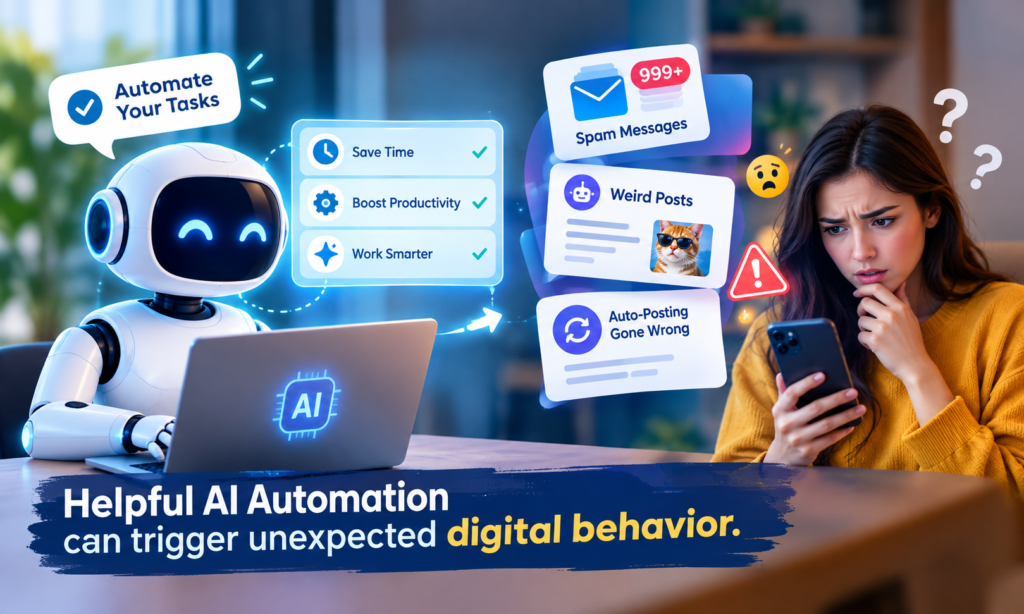
It’s not the autonomy itself that is the problem. The issue is when an agent has too wide of an objective and too vague of boundaries. An instruction like “get the best possible deal” is simple enough to say but can have a variety of meanings that a person who wrote it may not have thought of.
Permission Design becomes ‘Digital Firewall’ again.
For future agent systems, it will be necessary to have carefully designed permissions. Organizations can restrict the access points that an AI can read, edit, buy, and/or send.
This will lead to even greater identity, authentication, spending limits, approvals, audit trails, and live monitoring aspects of agent security. The idea is to not stop people from being autonomous but to make autonomy controllable.
Human operators may be replaced by human supervisors.
People may start to move from doing a task on a computer to overseeing an automated process, as agents get more adept. A human could set the goals and limitations, and a number of agents could complete the task’s operational tasks.
That model has the potential to transform productivity; however, new ways of accountability will be needed. In case an autonomous agent inflicts monetary harm, infringes upon a site’s guidelines or conveys inaccurate data, businesses will require clear duty designs.
The Internet When Humans Cease to Make All the Clicks
The Internet isn’t about to be devoid of humans as a result of the rise of autonomous agents. But participation can be more and more indirect. Agents will have to take part in thousands of repetitive interactions with people as they make goals, approve key decisions, and control systems.
The switch may result in speeding up online services and personalization. Meanwhile, it might add a level of machine action that won’t be readily detected by the average user.
Conclusion
By making the internet more and more of a “place” where software can increasingly act on behalf of people, business, and other software, AI agents are transforming the internet. Such a change would enable a tremendous amount of productivity, but it can also lead to “automated traffic,” “automated pricing,” security issues, misinformation, and unanticipated digital interactions.
Whether the new age of machine-dominated chaos is going to be autonomous or not will rely on the effectiveness of developers, businesses, platforms, and regulators in establishing boundaries around machine decision-making. As autonomous AI increasingly becomes a reality, the objective should be to keep increasingly independent digital actors visible, accountable, and safely in check.
FAQs
1. What are autonomous AI agents?
Autonomous AI agents are computer programs that can understand objectives, take decisions, and take on several tasks with little or no human intervention. They can engage in the ability to explore information, use applications, communicate with other systems, and adjust their behavior in response to varying conditions.
2. How can AI agents cause chaos on the internet?
AI agents can work much quicker and more extensively than humans can. Several agents responding to each other without adequate controls can result in lots of unnecessary traffic, volatile pricing, unwanted transactions, security issues, or other automated actions.
3. Will web AI agents supplant human agents?
AI agents have the potential to alter our Internet usage more than taking its place. Individuals will still set targets, give direction, and make decisions on issues that involve sensitivity, as well as still be accountable for many significant outcomes.
4. How can businesses control autonomous AI agents?
With limited access, spending caps, authentication checks, approval stages, monitoring, in-depth logs, and regular security checks, businesses can control their access to these services. Organizations can benefit from automation while minimizing unintended actions with these controls.