
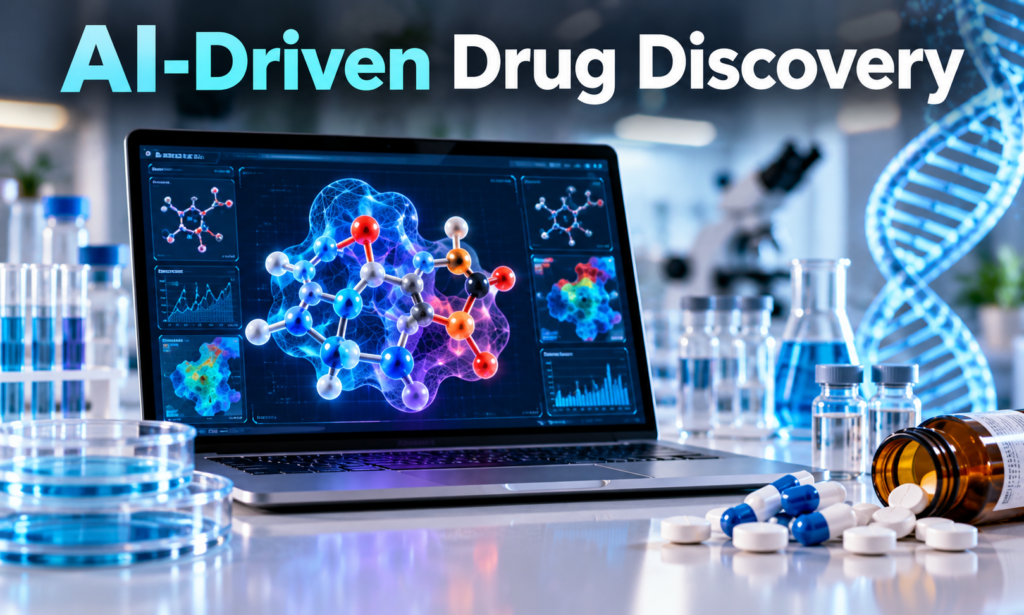
AI is revolutionizing the process of discovery and development of potential drugs. The drug discovery process can take years in the lab, extensive chemical testing and a considerable amount of money. On the other hand, AI-driven molecular design is a new method which can be used to anticipate the properties of molecules, explore chemical structures and identify potential drug candidates in the per-physical experimental stage.
Instead of studying the molecule one by one, researchers can utilize the machine learning models to evaluate huge chemical spaces and suggest chemistry with specific biological features. It’s a hybrid of computational chemistry, biological information and experimental testing that enables early stage drug discovery to be more focused and efficient.
Inside the Molecular Search for Promising Drug Candidates
The first step in drug discovery is to have an understanding of how chemical compounds bind to biological targets such as proteins which participate in disease. The molecular structure, experimental data and biological connections are fed into the AI system, which uses this data to recognize chemical patterns that have the potential for beneficial activity.
Teaching Algorithms the Language of Chemistry
Atoms are held together by chemical bonds to make molecules which have an effect on their behavior. These structures can be modeled using machine learning models as molecular graphs, chemical sequences or 3D structures.
Algorithms, through the study of experimental data, learn relationships between molecular properties (such as solubility, toxicity, biological activity), and molecular features. Such predictions guide scientists to focus their efforts on the compounds that they want to study in the lab but those predictions do not necessarily mean these compounds are accurate.
Five Technologies Driving AI-Based Molecular Design
To discover chemicals, a number of computational techniques are currently used which serve various phases in chemical research.
- Generative molecular models
- Graph neural networks
- Protein structure prediction
- Molecular docking simulations
- Reinforcement learning algorithms
Generative models: generate new chemical structuresGraph neural networks learn atom-atom/bond relationships. The structure prediction of proteins can give useful information regarding possible targets for the development of drugs. The simulation of docking can predict possible molecular interactions and reinforcement learning can be used to optimize compounds to a selected chemical aim.
These technologies are working together to enable more systematic exploration and predicting in the future will be supported by experiments.
Designing Compounds Around Biological Targets
The design of molecules based on the structural features of disease related proteins can be done, instead of searching only for molecules available in the chemical libraries. The process is called Structure Based Drug Design.
Matching Molecular Shapes With Protein Binding Sites
Proteins have structurally defined regions in which some molecules can be bound and might have an impact on biological activity. These binding regions are studied by the use of AI-assisted systems and compounds are generated that could interact with these regions.
When experimentally determined structures are not available, predicted protein structures, even those obtained by using sophisticated computer programs, can aid this. Proteins, however, are highly flexible and their in viva behavior could be very different to the static calculations.
Scientists then test the compounds’ effectiveness in the laboratory to see if they have the desired effect, in the context of their predicted structure.
Digital Molecules to Laboratory Evidence
Having a molecule work well in a computer simulation doesn’t necessarily mean that it can be a useful medicine. Drug candidates need to have appropriate biological activity, characteristics of safety and chemical practicability.
Effective evaluation of absorption, toxicity and chemical stability are necessary for this.To do this, the Absorption, Toxicity and Chemical Stability must be evaluated.
Absorption, distribution, metabolism, excretion and toxicity are collectively known as ADMIT properties which can be predicted by an AI model. The assessments can be used to find certain compounds that might have issues when developed.
A molecule, for instance, could have a high affinity for the disease related protein, but a low solubility and/or a rapid rate of metabolic degradation. These risks can be identified using computational screening, prior to costly testing.
Critical Checkpoints Before a Molecule Advances
Many parameters need to be evaluated before selecting compounds for further development from the AI generated compounds.
- Biological target activity with a verified activity.
- Can be used safely as a preliminary.
- Suitable molecular stability
- Practical chemical synthesis
- Reproducible experimental results
These are checkpoints to avoid the misconception that these help achieve therapeutic success when they actually achieve promising computational results. Throughout development independent validation is still necessary, as is transparency regarding experiments.
How Pharmaceutical Research is Incorporating Generative AI
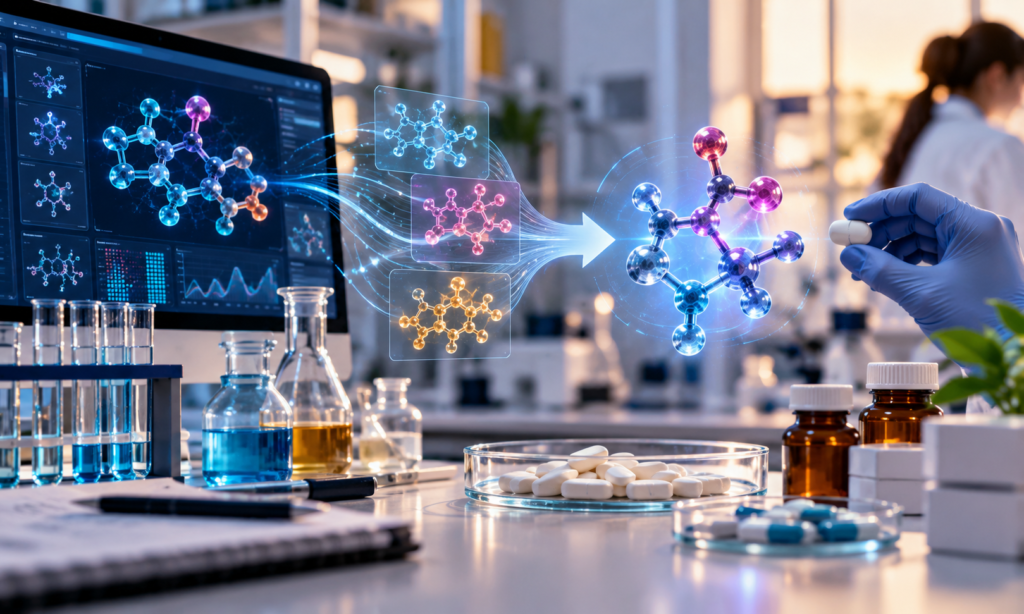
The applications of generative AI in pharmaceuticals and biotechnology are increasingly the subject of investigation, particularly by companies looking for drug leads, optimizing the properties of drug candidates and predicting molecular properties.
In fact, there are lots of instances of AI-powered drug discovery systems created by different companies, including Silicon Medicine.Organizations like Silicon Medicine have already started building AI-powered tools for drug discovery, which is a testament to the increasing interest in artificial intelligence in the field. They also show that finding a compound that might have a potential application and establishing a treatment, are two different things.
While AI can minimize the number of unsuitable compounds entering certain stages in the development process, it is still important that biological understanding, maneuverability, regulatory assessment and clinical data would all play a role in the success of the development process.
The scientific limitations that led to a computational breakthrough.
Experimentally generated data, missing biological data and a lack of examples of rare chemical structures may all be problematic for the AI models. While predictions can be inaccurate if the molecules being generated are significantly different from those in the training data, they tend to be more accurate for more similar molecules.
Yucatan is also an issue with synthesis. While a structure that is extremely attractive and appealing to the computer may be very complex and/or too expensive to produce.
These are being tackled in a number of ways, including enhancements to the data sets, uncertainty quantification, feedback from lab experiments, and the synergy of computational scientists and medicinal chemists. The best strategies take a scientific approach to the use of AI as a decision support tool instead of as an alternative to experimental research.
Conclusion
Leveraging AI, molecular design is now enabling the possibilities of early-stage medicine discovery by bringing the fields of chemical prediction, generative design and biological research together. With computational evidence, scientists can investigate candidate structures in an efficient manner and select experiments based on the computational evidence.
But, it is still necessary to thoroughly validate, test for safety and investigate clinically to find useful medicines. Perhaps the most significant impact of the AI could be to better pose chemical questions and, in turn, to more effectively probe the answers with greater accuracy.
Frequently Asked Questions (FAQs)
1. How does AI discover potential new medicines?
The AI tools can be used to predict the chemical and biological properties of molecules, as well as identify the molecules with promising properties and generate their structures for experiments.
2. Can AI design completely new molecules?
Yes. The novelty, usefulness, and incontestability of the proposed previously unexplored molecular structures need to be checked and verified, but this can be done by generative models.
3. Does AI eliminate laboratory testing?
No. Biological activity, safety and therapeutic activity needs to be confirmed by laboratory experiments and clinical trials.
4. What are the molecular designing technologies provided by AI?
Some commonly employed technologies are graph neural networks, generative models, protein structure prediction, molecular docking and reinforcement learning.
5. Can AI speed up the process of drug discovery?
Selected research tasks, such as virtual screening and compound prioritization, can be faster with the assistance of AI, but that doesn’t mean they will be quicker to get to medicine.