
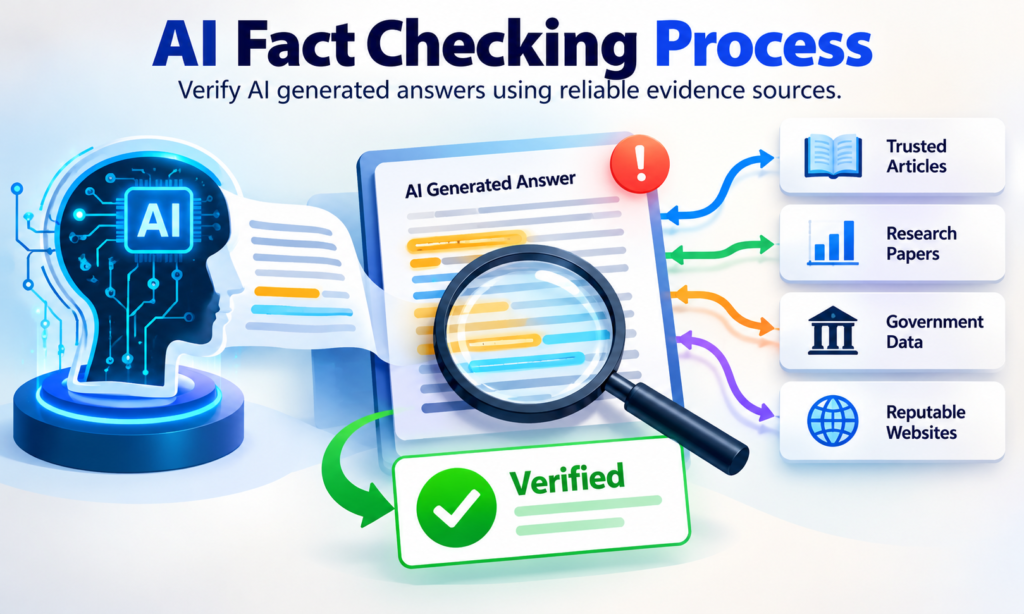
Generating convincing explanations in a timely manner with the help of AI tools does not automatically mean that these are correct. Often answers generated include correct information and reference information that are either fabricated or outdated or incorrect conclusions. Successful ai fact checking involves verifying individual claims, and cross-referencing them with reliable evidence. Readers, researchers and publishers will find the following guide to be an explanation of a practical review method.
Check Sources Before Identifying Claim
The first step in the AI fact checking process is to differentiate between opinions, assumptions and predictions from testable statements. One paragraph can have more than one claim that needs to have varying forms of evidence. When looked at one by one, they don’t make any statements that seem to be true.
Make sense of explanations into questions.
In the case of Ai answer verification, create key statements into questions that other sources can respond to. If AI mentions a scientific study, state who wrote it, when it was published, how it was conducted and the results of the study. In the course of ai claim verification – before looking up the claim – use the original words. The first step in accurate ai fact checking is to know what is in need of confirmation.
Make claims with real consequences a priority
Pay extra attention to medical guidance, legal requirements, finances, safety instructions, and information to be published. Evaluating the accuracy of facts produced by AI can be done by taking into account the potential consequences and available evidence. Responsible ai fact checking focuses efforts on an unsupported claim that might impact on a critical decision.
Trace Statements Back to Original Evidence
When citing, it is important to open up the content as opposed to relying on trustworthy website names. Identify the evidence to back up each of the claims and see if the understanding of the evidence corresponds to the conclusions it leads to. Even a real citation may be inappropriate, incomplete, and/or misinterpreted.
Examine Primary Documents Carefully
When using ai fact verification, choose to use original studies, official records, regulatory publications, and technical documentation, if available. In the process of answering questions within the context of artificial intelligence, check the authors, date, methodology and limitations. Strong ai fact checking takes a closer look at the likelihood that evidence supports a statement rather than assuming that all evidence that is attributed to an authoritative source does support the statement.
Compare Independent Sources
Multiple articles that repeat the same news are not considered as confirmation. Look for information in reverse and find out other evidence. This enhances the accuracy of the facts in the AI’s output and sheds light on unwarranted consensus. If there is a difference of opinion from credible sources, then the difference should be recorded by ai fact checking, not certainty.
Use a Standardized Review Checklist
An easy-to-follow fact checking procedure enables readers to discover errors that should be avoided when consuming content produced by AI. When consequential and/or publishable claims appear in an answer, use these checks.
- Check names, dates, places and numbers with original records.
- Open citations and find passages directly supporting individual statements.
- Differentiate between observations, opinions, and predictions.
- Assess if new information alters an existing understanding.
- Mark unconfirmed statements as being unverified instead of false.
This process helps to enhance the verification of the claims in the air, yet keeps absent evidence and contradictory evidence. It also helps to make an audit easier to understand for those who may be reading through the work in the future.
Check Numbers, Quotations, and Context
One reason for mistakes in answers is that they may be disguised in otherwise effective explanations. In fact checking, re-create calculations from the original data, double check measurement units and looking at periods of comparison. Percentages can be misleading if they are based on different denominators, or if they don’t include all the context.
Recalculate Results Independently
Check totals, averages and percentage changes are checked independently for factual accuracy. Make comparisons and comparisons of quotes to the text; read and understand text before making conclusions. It’s important to differentiate a sentence that’s been copied out of context and is therefore misleading and an accurate copy of the original. Arithmetic and interpretation is tested with careful ai fact checking.
Examine Dates and Geographic Scope
There may be new regulations, pricing, and/or product capabilities. Ask about the year of information application and the jurisdiction that it applied to. In case of ai misinformation detection, a statement from the past that appears to be current might lead to misinformation even if it was accurate at the time of its publication. Thorough ai fact checking records dates and places, and only presents information that is relevant.
Build an Editorial Verification Workflow
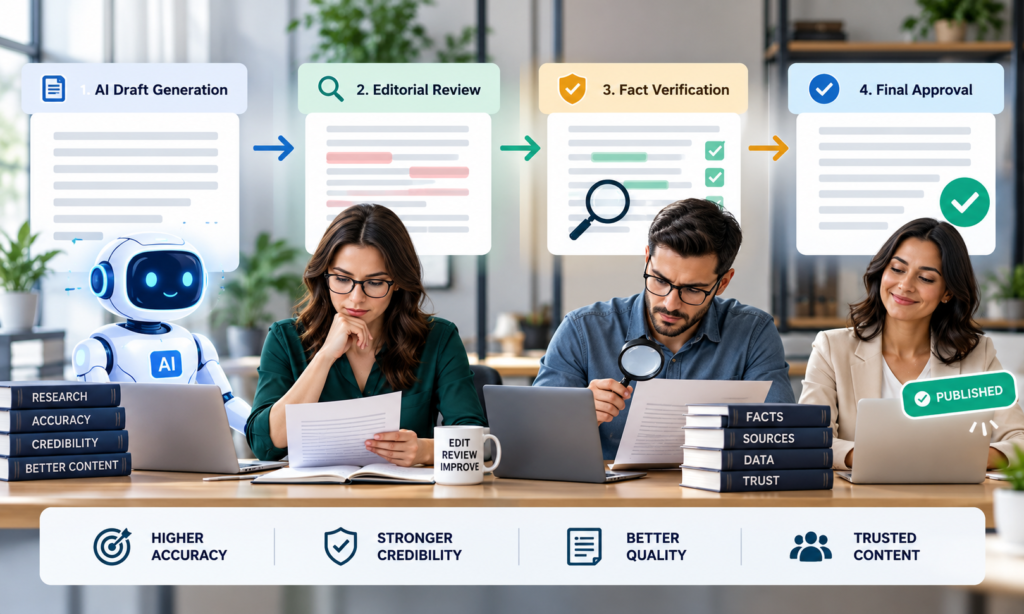
When fact checking is a documented process, it’s beneficial for organizations. Evidence can be attached to a text, points made in a text can be challenged when they lack evidence, and technical statements can be evaluated by specialists. Defines who is responsible for what, minimizes confusion and makes it easier to correct. This will enable the reviewers to see the reasons for an accepted, rejected or unresolved claim.
Prepare a Clear Review Process
A common checklist ensures consistency of the verification among contributors. The regular review and checking of evidence with teams helps to maintain the accuracy of ai facts during the revocation or updating of published guidance or when teams revisit claims.
- Don’t make the claim any other way than its actual wording.
- Save each source and its specific supporting passage.
- Record observations that have been confirmed, challenged or not yet confirmed.
- Refer follow-up questions to suitably qualified experts.
- Review time sensitive content just prior to publication.
Maintain Transparent Verification Records
This ai fact checking structure facilitates ai claim verification and boosts the capability of ai misinformation detection by means of traceable decisions. It enables an ai fact verified to repeat the process without having to recreate the entire fact verification process for every fact verified.
Clearing up ai fact checking records makes it simpler to revisit and also examine afresh. Recurring patterns of fact checking and misinformation detection by a regular reviews and structured by ai claim verification allows editors to differentiate evidence from inference.
With documented ai fact verification, there is responsible correction, and carefully considered ai misinformation detection helps to minimize unsupported conclusions. The ongoing process of ai fact checking helps to hold people accountable, but it doesn’t offer absolute truth and accuracy.
Conclusion
Evidence, context, and an appropriate level of skepticism are all needed to use AI to trust. A good ai fact check is one that involves an inspection of the source and independent calculations, as well as uncertainty that is transparent. Regularly verifying answers to the questions asked in the AI can help readers not get confused by confident language and trust it as a fact.
Frequently Asked Questions
1.Can AI Authenticate its own Answers?
While AI can propose checks, it is essential to have independent AI checking as reviews generated by AI can make the same errors as the ones made in the past.
2.Are Linked Citations Always Reliable?
No. ai fact verification involves verifying the source that you cited is a source supporting the exact statement that you are making.
3.How to recognize a fabricated claim?
Search for missing research, unreferenced quotes and conflicting dates. Such checks enhance the reliability of ai misinformation detection.
4.What claims should be given the highest priority?
Make safety, money, health and public communication a top priority. Use ai claim verification, based on the level of consequences of error.
5.What’s making Verification Reliable?
Record, admit ignorance and make corrections. Multiple ai fact checks lead to informed editorial decisions.