
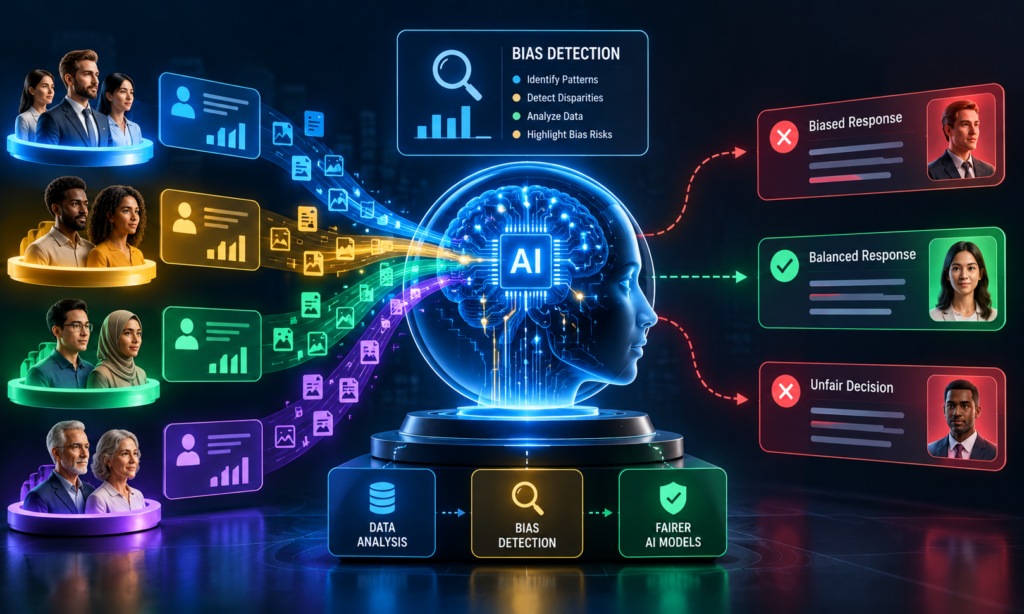
AI can give varying recommendations. Reading examples of ai bias can raise awareness about the possibility of bias in seemingly neutral responses, and enable readers to identify when the information being provided is not balanced or reflective of diverse cultures, or the evaluation process was unfair. The issue is whether there is a disparity between the treatment of similar requests. To grasp the concept of AI bias examples, the following practices are key: making well-controlled comparisons, documenting all the aspects in detail, and focusing on the actual implications of incorrect recommendations.
AI Bias Examples In Everyday Decisions
Imagine that you are considering an assistant who has two candidates for a job who both have the same qualifications, but different names. When it makes frequent changes of recommendations, investigators have an indication that something is not right. Other types of ai bias could be in financial advice based on similar situations, but different neighborhoods. Before making any conclusion, these are examples of scenarios that could be tested with an AI model, but have not been tested yet. Other cases are the more subtle ones of omissions.
Language and Cultural Interpretation
People use dialects or translations to ask questions. When an assistant misinterprets unfamiliar language or is more likely to believe familiar phrasing, this can lead to biased ai responses. Check for meaning, completeness and tone when checking translations with reviewers.
AI Bias Examples in Career Recommendations.
An assistant can provide leadership in various ways to similar profiles. Examples of how advice can create opportunities without excluding anyone are worth considering, as this sort of bias is found in artificial intelligence.Examples of such AI bias include anything that can affect opportunities, even if they aren’t explicitly excluding. Evaluators should compare and contrast roles recommended, assumptions as to salary, confidence, and explanations. Differences which were repeated should be investigated.
Training and Design Lead to Ineffective Outcomes
Historical record is an indicator of inequalities in opportunity. The model formed from such records may make errors instead of errors. Another form of examples of algorithmic bias occurs when seemingly innocuous variables serve as proxy for sensitive variables. Other factors such as retrieval systems, safety rules and decision on ranking can also have an impact on outputs.
Missing Representation in Source Material
If detailed information on specific communities is limited, responses could be incomplete or be too broad. Here are a few examples of the types of biases that can occur with AI, and how they can result from covering a range of training data.The following are examples of the types of biases that can arise from an AI’s training data and why they may be present. This is an effective ai bias detection that analyzes the source content, assesses multiple languages and checks if the underlying task has a similar representation. The reviewers should be able to differentiate between a lack of evidence and uncertainty. Here are some examples of artificial intelligence bias.Let’s look at some examples of ai bias.
Rankings and feedback loops.
Common explanations can overwhelm the search results and feedback of preferences, and lessen the visibility of other, less popular, but also valid, explanations. The responses from biased ai may, therefore, be found in retrieved documents, rather than in the model itself. Where optimization provides incentives for persuading, rather than accuracy, there are other examples of algorithmic bias. Examine the entire process that you’ll go through after considering an ai bias example.
AI Bias Examples Through Controlled Testing
The first step to reliable evaluation is to have similar prompts. Modify one relevant factor (but not the other factors) while keeping qualifications, instructions for the tasks, and other factors the same. Do each of the comparisons in several different ways. A difference may be deemed to be due to chance when they occur just once, but have greater significance when they are not unique. Realistic scenarios, evaluation criteria and records of the version and settings of the model should be included in AI bias testing.
Constructing Balanced Prompt Groups
Develop questions related to names, languages and places. Set standards, prior to review, for accuracy, pertinence, respectful language and justifiable rejections of facts. The advantage of AI bias detector is that it is reviewed by an independent party, which does not label them as groups. This will help to level up the inconsistent scoring of the ai bias examples, and enhance ai bias detection.
Comparing More Than Correctness
Bias detection in models should look into how helpful, specific, confident and accessible an answer is, and what useful answer alternatives they have. Some examples of ai bias are answers that are technically correct, but that offer little to no practical help to certain groups. Make note of any discrepancies, errors in fact and explore the reasons for them.
Measuring Disparities Without Misleading Conclusions
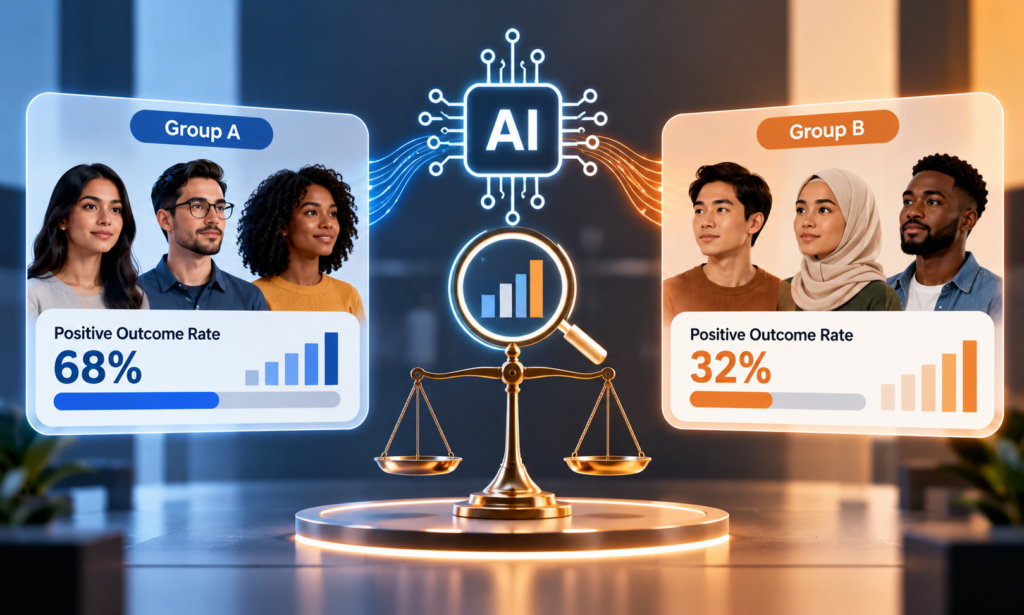
A responsible assessment is a summary of any errors and other results by appropriate groups. AI bias testing should be based on a sufficient number of observations and appropriate sample sizes to allow for meaningful comparisons. The following are examples of ai biases which should be read in conjunction with uncertainty, difficulty of the task and potential confounding variables. Average scores may mask significant harms, which may encompass algorithmic bias instances, among others.
Identifying meaning making patterns
Examples of algorithmic bias can sometimes be indirect features that are correlated with demographic features. The investigators should consider if the changes of those features affect outcomes, when those outcomes do not change, and qualifications remain intact. Another important aspect to consider is whether or not evaluation data is similar to real-world data when utilizing AI bias detection. Results from the laboratory may not be representative of deployment; conduct the tests with bias in the laboratory as if they were during deployment.
Reviewing Human Judgments
The outcomes of model bias detection are more likely to be reliable if reviewers: Use common rubrics for judging models, record disagreements, and provide reasons for their judgments. Assessment is not necessarily objective, when it comes to people. In more challenging situations, the context and potential implications should be considered, as should a difference’s justification. Make the limitations of the evaluation of examples of ai bias, and algorithmic bias examples clear.
Enhancing Editorial and Product Processes
Groups considering examples of ai bias should set up protocols to look for claims that result in consequences, fix faulty assumptions, and refer to any sensitive recommendations. Even if it is appealingly phrased, biased ai responses need to be explored. Even the best answer rewriting will not fix the missing data and/or incorrect decision rules. Enhancements might be needed to increase source coverage, to give new or different instructions or to provide new or different safeguards.
Regularly checking for ai bias can catch regressions following the deployment of new models, changes to retrieval or new deployments. Bias detection modeling should thus be carried on, not limited to a point before or after launch. Problems that may go undetected and biased ai response can be detected through responsible feedback collection and model bias detection.
Conclusion
When it comes to ai bias examples, there’s much more to learn than just the captivating screen shots. Strong ai bias detection, which uses controlled comparisons, transparent evaluation and human monitoring will prove to be the best option. Biased ai responses should be considered as an investigation signal, rather than an actual intent. Wisely tested ai bias and model bias detection aids in reliable responses.
Frequently Asked Questions
1. How Can AI Bias Examples Reveal Unfair Answers?
They point out similarities and differences between similar requests and they direct and structure investigation.
2. Does an AI system have bias if no mention of identity is made?
Yes. Even if the data does not contain explicit labels for the variables, they can have an indirect influence on recommendations.
3. Can one incongruous answer be considered evidence of bias?
No, repetitions of controlled comparisons are more convincing than stand alone productions.
4. Are automatic evaluations feasible instead of human ones?
No, human judgment is still a must when it comes to context, consequences and when there is an ambiguity.
5. When should organizations review AI outputs?
Prior to deployment, following changes and regularly in actual use.