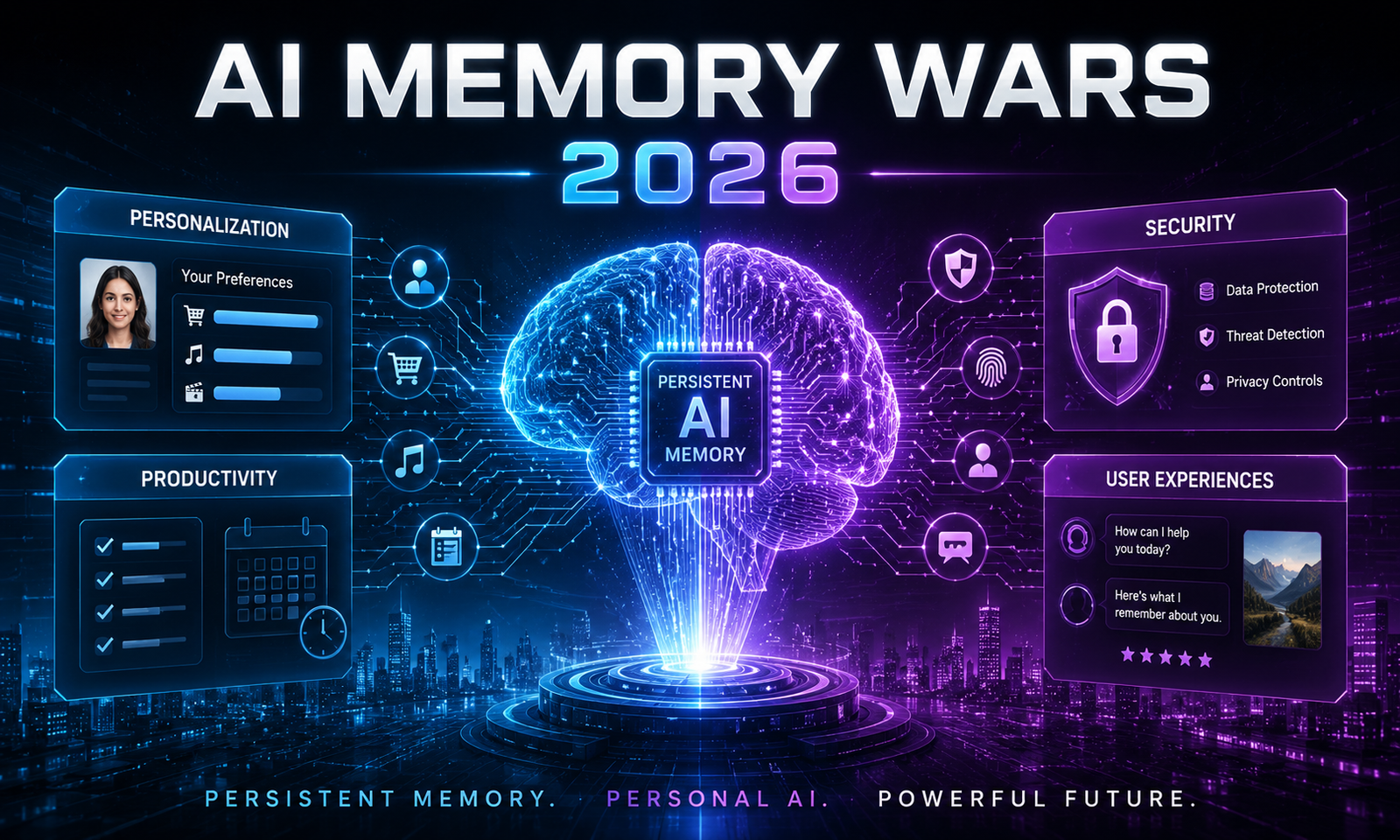
The AI race has left behind the quest for creating just bigger language models or refining reasoning skills to enter a new phase. One of the most significant differences between AI platforms in 2026 will be their ability to retain context and important details from previous interactions, user preferences, and active projects. One of the key differences between the various AI platforms in 2026 will be their ability to remember and recall information from previous interactions, user preferences, and important context. This change is transforming AI assistants into more personalized, productive, and valuable tools as they become more than ever.
Memory is increasingly becoming a strategic asset as businesses increasingly use AI in their day to day activities. Organizations that are able to provide secure, transparent and user controlled memory characteristics are getting the edge in their games and creating an experience similar to working with a trusted colleague, rather than a conventional chatbot.
What Is Persistent AI Memory?
Persistent AI memory enables an AI assistant to remember information that it has chosen to remember from one conversation to the next. The AI is able to remember the preferences and previous interactions that have been saved while users are in a chat, which means that they don’t have to repeat instructions or details for each new chat.
Persistent memory stores data for a long time and is used to create long-term personalization – unlike the transient memory chat history, which is not designed to have a long lifespan.
Why AI Memory is the next battleground
Memory is the next differentiator between AI platforms, and with all the models becoming so much alike in terms of functionality, this becomes a key attribute to consider. As a result of their efficiency and the added satisfaction to users, memory technologies are increasingly being embraced by organizations in order to gain user loyalty in the long run.
Key reasons companies are prioritizing AI memory:
- Responds in an individualized way without repeating context.
- Productivity improvements – remembers active projects.
- Improves user experience, thus promoting customer retention.
- Helps to enable smarter enterprise knowledge management.
- Establishes a sustainable competitive edge for AI Platforms.
The technology behind Persistent Memory.
Persistent memory does not store all of the conversations, but instead uses multiple technologies to create persistence. Information is intelligently retrieved from the AI system to only provide relevant information in the answer – avoiding unnecessary processing and preserving context.
Vector Databases & Semantic Search
The modern AI systems use vector databases to store information, rather than the literal words that can be found in the documents.The modern AI systems are based on storing information in a vector database, which organizes knowledge based on meaning, rather than on the literal words that can be found in the documents. This enables AI to remember things even if the user types in queries in a different way, leading to more natural and accurate dialogues.
Retrieval-Augmented Generation (RAG)
Retrieval-Augmented Generation (RAG) is a technique that allows AI to look into its trusted memory before producing answers to questions. In the case of the assistant, the training of the model is complemented with the use of reasoning and knowledge stored, which results in greater factual accuracy and fewer repetitions of prompts.
Permission Based Memory Controls
Nowadays, the top AI services offer users the ability to review, edit, delete or temporarily disable memory. These permission-based controls will help to ensure transparency, and will allow individuals and organisations to be confident that their information is under their control.
A Privacy and security victory is under way.
Memory for improving personalisation brings increased responsibility. Consumers and businesses require AI platforms to take the security of stored information seriously, and have clear policies on security procedures. Intelligence is not the only essential thing that is as valuable in the AI market as trust.
The following are key issues of privacy:
- User-controlled memory management.
- All-round data protection features.
- Consent to store information without having to provide justification.
- Sensitive talk box to use for temporary chat.
- Adherence to changing data protection laws and rules around the world.
The business effects of the industries.
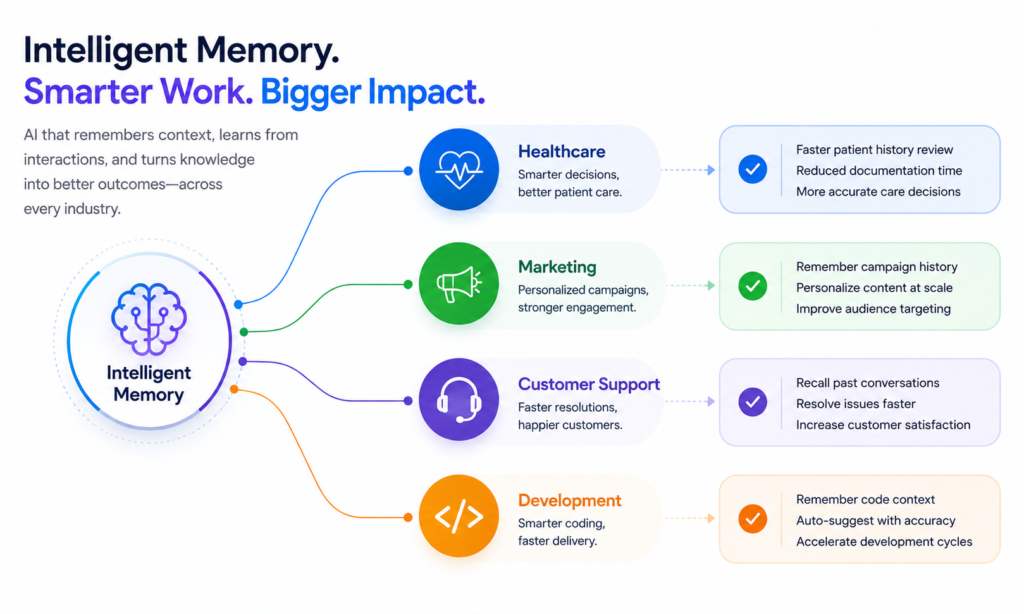
Organizations are already transforming the way they leverage AI in their processes in various industries with persistent AI memory. AI assistants are moving beyond being just chatbots to being productivity partners that can enable a variety of workflows.
Customer Support
AI can recall past interactions, purchase history, and common problems faced by customers, aiding support teams to resolve issues faster and deliver a better customer experience.
This is a marketing and content creation course.
Brands can leverage AI to revive their memory of campaign goals, voice, and audience preferences, as well as publication rules to make their marketing teams more efficient. This means a more uniformity between blogs, posts in the ads, emails and social media.
Software Development
When developers need to code with a higher efficiency, it would be better if coding assistants can remember the architecture of the project, coding standard, preferred coding framework, and documentation.
Healthcare and Enterprise Operations.
AI can assist professionals when it comes to remembering approved workflows, organizational procedures and authorized contextual information, when set up with proper privacy safeguards, without impacting compliance.
Challenges Companies Must Overcome
While persistent memory offers significant benefits, there are still a number of technical and ethical issues that need to be addressed in order for persistent memory to be more widely adopted throughout the organization.
Memory Accuracy
AI needs to be able to differentiate between useful information in the long-term and information which is just out of date. Erroneous memories can lead to reoccurring errors, and ultimately erode user confidence.
Data Security
When information is stored, it’s an easy-goal for cybercriminals. To safeguard sensitive memory data, use of strong encryption, secure authentication and constant monitoring is very important.
Conclusion
In 2026, AI Memory is shaping the competitive field of artificial intelligence by delivering unmatched longevity of AI memory.In 2026, AI Memory is redefining the landscape of Artificial Intelligence, providing an unparalleled approach to the challenge of AI memory. Robust reasoning and speedy types continue to be significant, however recalling significant context is quickly turning into the aspect that genuinely improves user experience. Higher productivity for businesses, customised support for users, and improved development of smarter applications – these are just a few benefits of this. Companies that make the best of intelligent memory and robust security, privacy, and transparency will be at the forefront of the next wave of AI innovation. The AI platforms of the future that will remember responsibly, and not just quickly, are most likely to gain the trust of and be adopted by people in the years to come.
Frequently Asked Questions (FAQs).
1. Persistent AI memory is a new type of memory introduced to the AI industry.
Persistent AI memory refers to the ability for an AI system to retain information from previous interactions and conversations, allowing it to interact more personalized and efficiently.
2. What is the significance of AI memory in 2026?
Persistent memory offers a competitive edge in the world of AI models that are increasingly performing at par with each other: through personalization, productivity and user experience.
3. Security and privacy of persistent AI memory.
The majority of the major AI platforms offer user capabilities like conversation management, editing, deleting and temporary chats. The security is based on the platform’s policies and implementation of security.
4. What are the top sectors that can greatly benefit from the use of AI memory?
The industries benefiting from the increased benefits are in customer support, software development, marketing, healthcare, education and enterprise knowledge management.
5. What are the problems with having a long-term memory in a persistent AI?
Some of the major issues are privacy protection, consent, memory accuracy, secure data storage, regulatory compliance, and preventing old or mistaken memories from impacting responses.