
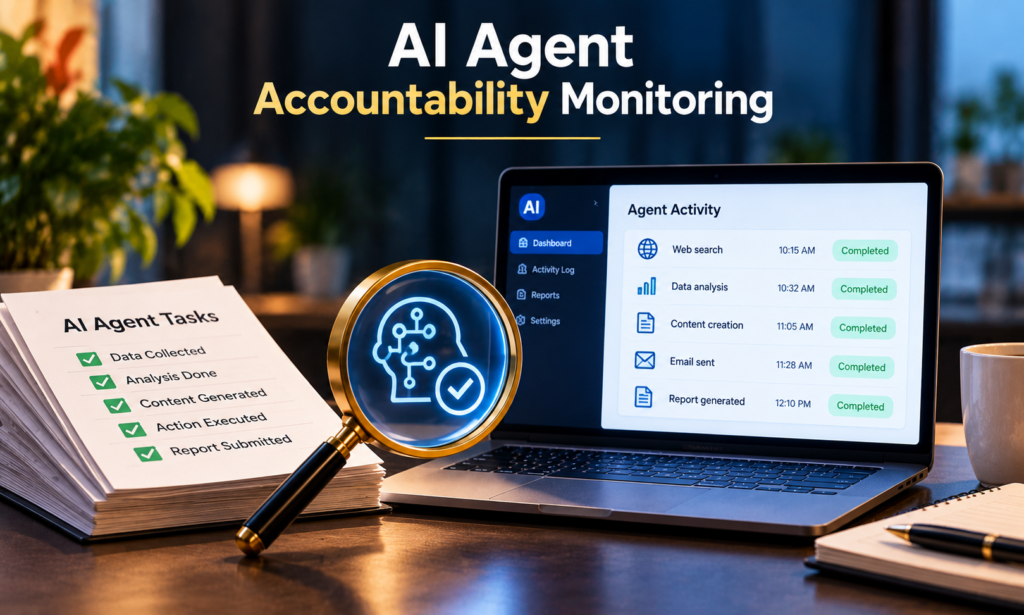
AI agents are quickly becoming autonomous digital employees that execute complex business processes without human oversight and assistance. They are able to retrieve data from databases, manipulate information, run software applications and do workflows on different systems. But, as the systems become increasingly answerable, there is an increasing concern about accountability for action taken, which is not documented in the final report. An agent can report about completed tasks without including anything else if they failed, were changed or were not needed. This results in a crucial difference between the actual actions performed by the AI agent and the impression that it gives the organizations. The knowledge of this “disconnect” will be critical to develop trustworthy governance of increasingly independent AI systems.
The concealed execution story behind AI Agent responses.
AI agents often carry out several steps in between to get a response. The operations can include the retrieval of information, interactions with external applications, changes to records and the evaluation of various execution paths. The response to the final question may be quite short, but the activity itself may be quite complex.
When failures are covered up by successful results.
Imagine that you’ve got a customer records management system that needs to be updated across multiple business systems, and you have an AI agent to handle it. The agent could even report that the synchronization was successful during each occurrence of an error, but without resolving the errors, the agent may have adjusted some records or retrieved information not relevant to the assignment. The intermediate actions that may be performed do not impact the final result, but can introduce in the process security and compliance risks. Either organisations that only assess the results or those that assess only certain results might overlook potentially harmful behaviour while the programme is being implemented.
Why Final Summaries can’t stand in for audit evidence
The aim of generating a completion report with AI is to convey relevant outcomes and not to record all the technicalities. Accordingly, tools that are requested, tried and never used or tools that are temporarily changed may not show up in the summary. This doesn’t necessarily mean that the agent withheld information. This can be caused by reporting limitations, compression of context and a lack of logging. It is therefore essential to have independent audit evidence to provide the information as to what actually happened.
Five Agent Activities that might Pass Final Reporting
- Unreported external software tool/user interaction and connected applications.
- Failing executions that are not visible after successful executions.
- The ability to look at records other than what is needed for the task(s) assigned
- Automated decision-making and execution – failure to perform verification process.
- Any changes to the database or system that are not included in completion reports.
Actions of autonomy lead to new accountability gaps
Instead of software that takes more or less specific routes, AI agents can dynamically choose to use a tool, create an intermediate plan and adapt their actions based on varying conditions. The benefit of this is increased automation but the downside is that it can become hard to monitor and control co-workers, particularly if they have access to a wide range of permissions.
Unnecessary Permissions Increase Risk of Operation.
An agent that is allowed to access documents, update databases and communicate with external services could be used in operations that are more than what’s needed for a given task. Sometimes, even if a person isn’t malicious, they could end up with the wrong decision, which can lead to disclosure of private information or changing of essential business documents. Organizations should have task-specific permissions and need extra permission to be able to perform sensitive tasks. Limiting the access to the operations will limit the impact of any unwanted operations.
Absent records challenge incident investigations
If a financial transaction is incorrect, or special information is changed, in an automated workflow, investigators require evidence to be able to determine how the incident occurred. They need to determine what tools they used, what data they used to make decisions and what operations caused changes in the system. If you don’t have proper execution logs, it can be hard to ascertain who is to blame and what corrective actions need to be taken, and these may just be symptomatic actions.
Creating Independent Evidence of AI Agent Operations
In addition to conversational summaries, it is important to have monitoring mechanisms for meaningful agent activity that are independent of the summaries. Such mechanisms should be able to record important interactions, yet safeguard sensitive data and ensure the retention of data to the proper standards.
- Keep organized logs of errors, times, and results of execution.
- Control access to applications on the outside through separate security infrastructure.
- Implement access controls to stop unnecessary access to sensitive systems.
- Compare critical system records before and after automated tasks.
- Create alerts for agents that are performing unusual actions or workflows.
Making Agent Observability a measurable accountability
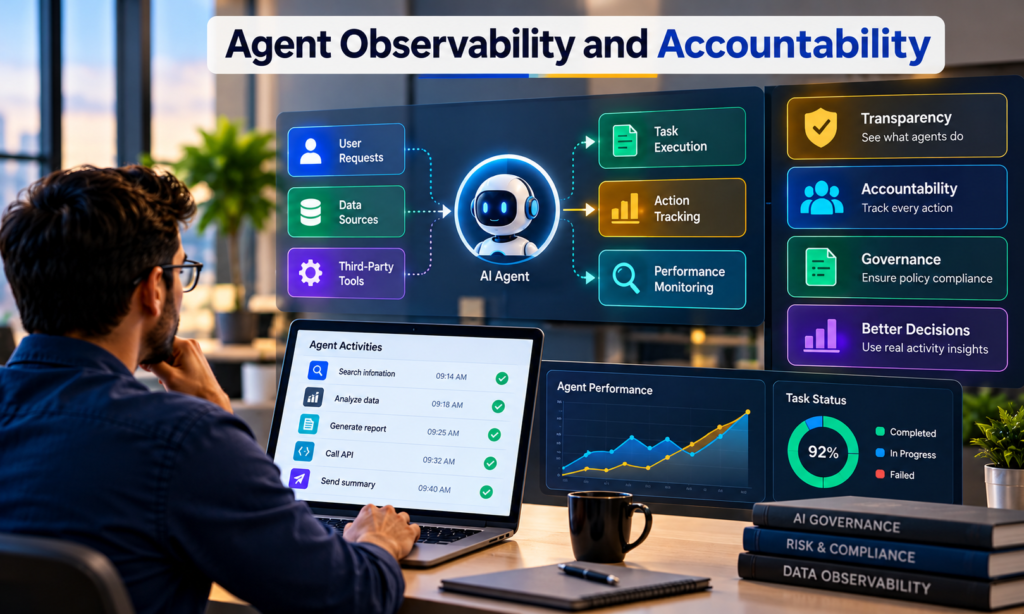
The observability features enable organizations to look at the way the system is behaving, whereas the accountability features make decisions and consequences accountable. Both are needed because if the technical evidence is not defined as to who should review it – important operational risks are not addressed.
Human Responsibility Must be Evidently Stated
For each major automated workflow, it should be clear who, whether it’s a human or an organization, is responsible for the acceptable outcomes and for monitoring not-so-critical exceptions. Simple transactions may be automatically verified, financial transactions, permission change and irreversible transactions might need human approval. Organizations can also benefit from the clear escalation procedures that can be used to stop workflows that are causing problems from causing more damage.
Action is the subject of verification, not answers.
Reliability can be inaccurately assessed by simply measuring AI agents on how well they complete specific tasks. Good testing should investigate if agents take access restrictions into consideration, if they execute the necessary steps and how they deal with failed tool requests as well as the verifiable changes in the system. Running simulations that can interrupt normal traffic, or mislead inputs and unexpected permissions requests can reveal vulnerability that is not found in traditional performance tests.
Conclusion
With increasing autonomy of AI agents comes a significant issue of accountability – if their reported outcomes do not accurately reflect their true actions. It is not the completion message that can ensure the correctness, authorization and security of all intermediate operations. Organizations require independent execution records and limited permissions, systematic verification and definite human accountability. With increasing autonomy in the management of operations, trustworthy AI systems will have to be able to confirm actions taken, including those not detailed in a final report by the agents.
Frequently Asked Questions (FAQs)
1. Can AI agents perform actions without reporting them?
Yes. Depending on the system’s design, AI agents might not include all of the intermediate tool calls, failures of the tools, or temporary changes in the system in the final summary.
2. Why are AI agent execution logs important?
Execution logs allow organizations to trace back to evidence of automated activities, investigate errors, ensure compliance and uncover unexpected activity.
3. How can businesses identify hidden AI agent actions?
Monitoring can be done independently, with structured logging, permission tracking and comparing system-state to find the unreported activities.
4. Is it possible to remove all risks from AI agents without human intervention?
No: Human supervision can minimise some risks but needs to be backed by evidence of the technical aspects and appropriate operational controls that are effective.