
Now that AI has come to a new era beyond the mere concept of intelligence. The speed of AI agents is becoming a key element of intelligence as they start to plan tasks, call tools, write code, retrieve information, and follow multi-step workflows to answer questions.
Commonly, the traditional approach to AI involves discussing the number of parameters in the model, benchmark performance, and, more recently, the improved capabilities of the models. But agentic systems have an additional requirement: an AI agent can be required to call dozens of models while performing a task. That inference can add up over that workflow each additional second of inference. NVIDIA calls these agentic trajectories “sequences of actions, observations, and decisions” that have a high latency.
AI is transforming the definition of agentic workload performance.
AI agents are not just like any other chatbots. A chatbot can produce one answer to one question at most, while an agent will have to make a lot of deliberations on his part, looking for information, using external tools, evaluating the answer, and determining what to do next.
Each decision creates another inference cycle.
For example, a product researcher might try to find information from a number of sources, compare the specifications, check the price, summarize the information, and then produce a product recommendation. There may be additional calls to the model for each step. If these calls occur in succession, small delays in calls can become big delays.
Tool call latency is shown to be a significant component of the end-to-end latency in a tool-based agentic system, with a figure of 15% found in a Microsoft study. Its research, SUTRADHARA, also showed that the orchestration and inference can be done together to decrease orchestration latency compared to orchestrating and inferring separately.
Speed becomes part of agent intelligence.
A high-speed response can make a difference in the real world, even if the actions performed are more limited than the slowest, but more capable, model.
The performance of agents should instead be assessed over the entire workflow process and not model responses. Some metrics of interest are time to first token, token generation rate, end-to-end task latency, throughput, memory efficiency, and the time taken for tool execution.
Inference Engines are turning into special-purpose infrastructure.
Today’s inference engines provide optimizations for the actual use of trained models in production. The efficient serving, token generation, scheduling, and caching are some of the main features of the various technologies, including TensorRT-LLM, vLLM, and SGLang, that are emerging in this area. The NVIDIA NIM platform is designed to optimize throughput and latency of agentic workloads with its optimized inference engines, says NVIDIA.
It indicates a larger shift: more and more, the performance of AI models is a systems engineering problem that’s not only about models and accelerators but also about memory, networking, orchestration, and serving software as well.
Faster Tokens Can Improve Agent Economics
Sure, there’s more to speed than user experience. Shortening the time it takes for infrastructure to make an inference could mean it can do more useful work at the same time and may even help to utilize resources better.
NVIDIA’s latest benchmarks have focused on the cost and performance per watt with low-latency agentic workloads. On the other hand, OpenAI’s August 2026 announcement of its Jalapeño inference chip revealed that it had better latency and greater AI work per watt in a variety of models tested.
Larger is still better, but more efficient is better still.
More powerful and capable models, and higher performance on challenging tasks, can be obtained in larger models. But deploying massive models effectively relies on infrastructure that is able to support the memory and compute requirements of these models.
The new target is not just to get bigger AI but to achieve more and more usefulness per second and per watt. This is particularly critical, where agents need to run alongside at an enterprise scale.
The design of new AI infrastructure is being focused around speed.
The era of training accelerators is over, as the hardware race is continuing to progress. More and more companies are developing infrastructures that are specifically geared towards inference, context management, networking, and agent execution.
- With reduced latency inference, there is less waiting time in multi-step agent workflows.
- Specialized accelerators boost the number of tokens generated and overall power efficiency.
- Agents can more easily and quickly “reuse” large contexts without being recalculated again.
- Optimized networking minimizes delays in the model, tool, storage, and orchestration.
- The software engines efficiently schedule, cache, batch, and execute models.
NVIDIA is making strides towards agentic inference.
NVIDIA also says it’s building its new infrastructure to support agentic workloads. This Vera Rubin platform is created as a fusion of GPUs, CPUs, networking, storage, and inference accelerators, and the company claims its Groq 3 LPX system will be useful for quickly generating tokens in agentic applications.
Context Memory Is Getting to Become a Performance Layer.
Long-context agents have the ability to retrieve a lot of information over and over again. That information will be slower and more costly to make inferences on if systems are constantly reloading the information.
New infrastructure is now going towards context reuse and memory management. For instance, NVIDIA’s BlueField-4 solutions come with the promise of AI-native storage to deliver a faster long- and short-term memory for agentic workloads.
The Winning Stack Will Coordinate Multiple Components
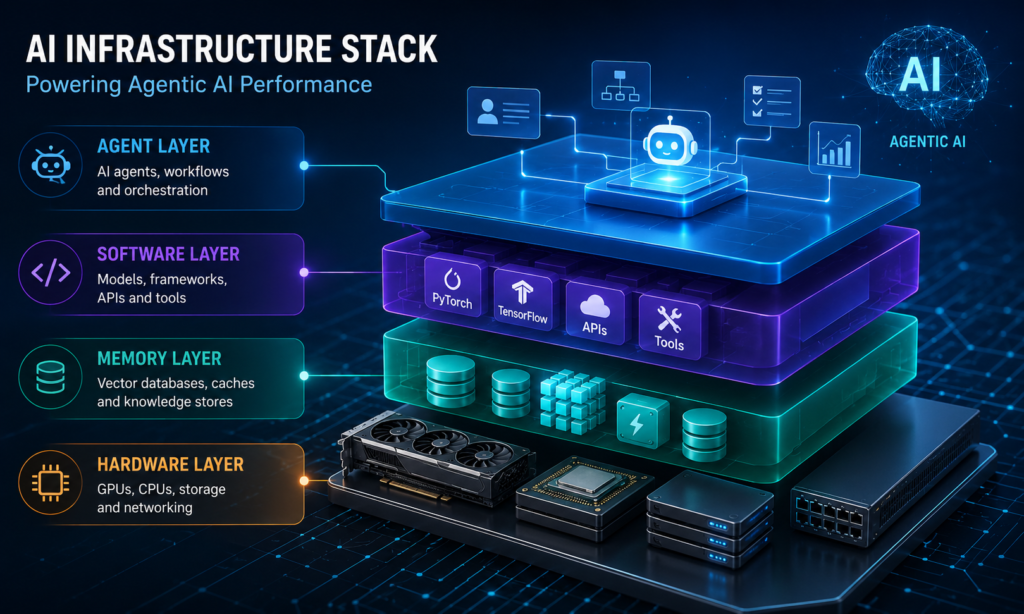
However, it takes more than a powerful GPU to have a fast agent. Orchestration and tool execution can be done by CPUs, generation of tokens by accelerators, maintenance of context in memory systems, motion of information on the networks, and scheduling of workloads done by inference engines.
That’s why today’s AI infrastructure tends to resemble a network of computing units instead of an assortment of standalone systems. A similar view of inference as a complete package optimization of hardware, networking, memory, and software is taken by NVIDIA.
Conclusion
AI is going from a model-centric to an inference-centric world. Agents alter the game of bigger models—larger models are still useful, especially for complex reasoning, but intelligence must be delivered over and over through a workflow.
The more agents make decisions and more tools they use, the more delays will occur. So, the ability to make quick inferences, to work efficiently with memory, to orchestrate them optimally, and to use specialized hardware is crucial to the development of AI.
FAQs
1. Why is inference speed important for AI agents?
There can be many reasoning steps or tool usage steps needed for an AI agent to complete a task, which increases the latency over the full task. Agents can respond and take action faster, leading to quicker decisions and actions.
2. Is the bigger size of AI models losing its significance?
Of course, the larger models can give better reasoning and skills, but this depends more and more on infrastructure’s efficiency and quickness to serve these large models.
3. What is an AI inference engine?
An AI inference engine is software and infrastructure designed to efficiently execute trained AI models, including simplifying the scheduling, caching, memory management, batching, and token generation processes.
4. Why are custom inference chips being built by companies?
Custom chips may be created as per the inference needs, which can enhance the latency, throughput, energy efficiency, and operating cost over the general hardware.