
META PLATFORMS, INC. (NASDAQ: META), a worldwide social technology and innovation leader in the field of artificial intelligence, has today unveiled a game-changer roadmap in development and deployment of four generations of custom AI chips that will drive the next generation of AI-based services, content recommendation engines, and data center infrastructure at the company.
These chips are part of what the company collectively refers to as the Meta Training and Inference Accelerators (MTIA) and are an additional step by Meta to invest in the development of its own proprietary hardware specifically designed to meet the needs of the accelerating AI workloads. The project is one of the largest internal chip development projects a large technology firm has ever embarked on, one that will position Meta to optimize performance, manage costs, and scale AI performance across apps (Facebook, Instagram, Threads, Reels, WhatsApp, etc.).
A New Era of In-House Designed AI Hardware.
The chip generations are currently under development at Meta, which states that they will be the MTIA 300, MTIA 400, MTIA 450, and MTIA 500 that it will use to speed up AI inference and training workloads within its extensive worldwide network. The project is a multiyear undertaking that supports the overall approach of Meta to cease dependence on third-party hardware supplied by its rivals like NVIDIA and AMD and own the entire AI stack.
Why These Chips Matter
These MTIA chips are not processors that are generic. These are specifically designed to support AI workloads and recommendation systems, the heart of the personalized experience that users experience every day in the apps at Meta. The recommendation systems are in charge of prioritizing posts, videos, advertisements, and suggestions based on the way they guess which ones each user will find interesting. Development of custom silicon precisely that fits these complex algorithms can achieve major advances in speed and efficiency as well as cost-effectiveness.
The AI systems at Meta compute billions of data points within seconds, and these systems demand great computational capabilities. The conventional third-party chips are generic, and Meta is convinced that dedicated custom chips can provide better performance aspects that are more relevant to its specific areas of operation.
The Four MTIA Generations of Chips.
All four new MTIA chips have their purpose in the AI strategy at Meta. Collectively, they create a multi-layer platform that is able to manage various tasks such as generative AI, up-to-date ranking, and recommendation:
MTIA 300 – Already in Operation
The MTIA 300 chip is already implemented in the infrastructure of Meta and is actively utilized in the ranking and recommendation systems of Meta. This involves the personalized feeds on Facebook and Instagram that will dictate what the users will view the most and why.
Meta engineers strived to make MTIA 300 compatible with its already existing software and machine learning models and make the process of inference and personalization on a global scale as fast as possible.
Next-Generation Inference Hardware MTIA 400.
The MTIA 400, the next in line after the MTIA 300, is already in high testing stages and will be implemented in a data center soon. Aiming to maintain a balance between high performance and broad applicability, MTIA 400 will facilitate the more complicated AI tasks and speed up the scaling capabilities of Meta to serve AI systems.
MTIA 450 and 500 – Advanced Inference Innovations.
MTIA 450 and MTIA 500 are the future of the Meta custom silicon business, which is scheduled to be deployed until 2027 and after. Those chips will have significantly better memory bandwidth, performance per watt, and dedicated AI inference workload accelerators, those that enable AI models to provide real-time responses to user interactions without retraining.
The meta-engineers point out that a generation-to-generation enhancement has features such as higher compute throughput and memory efficiency, which are used to decrease latency, enhance accuracy, and offer greater scalability to real-time AI services.
Cadence and scaling in six months.
The other aspect of the chip strategy that Meta has implemented is a fast development cycle—it tries to roll out a new generation after every six months. This cyclic process also means that AI architecture, memory systems, and inference optimization innovations are constantly integrated into new chip designs and deployed in time.
The Implications of This to Meta and the Industry.
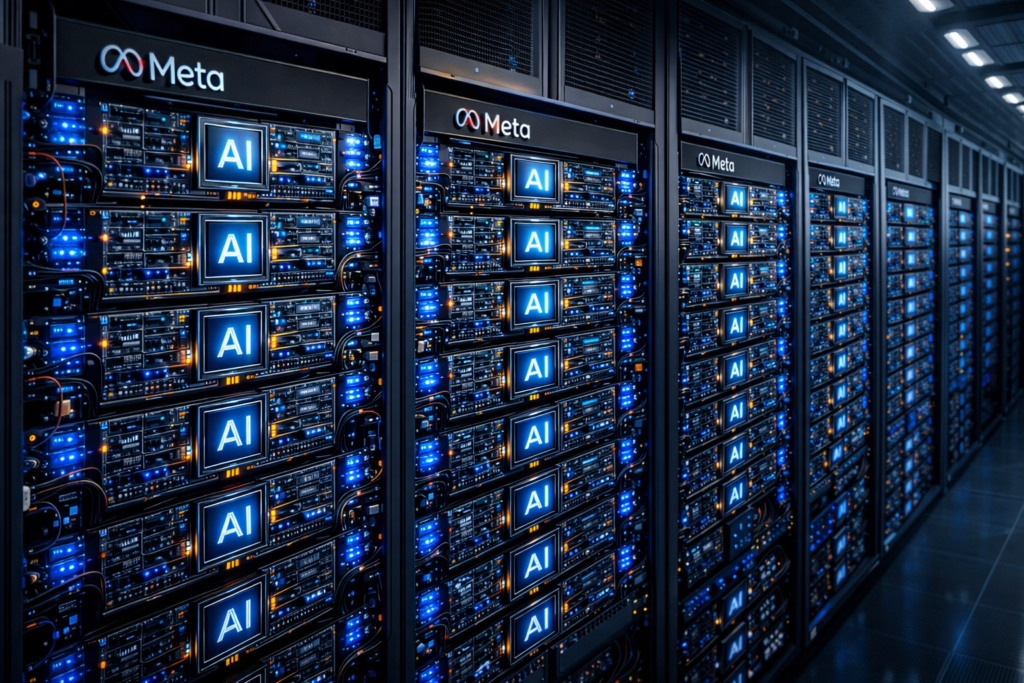
The announcement of Meta is a major change in the international arena of AI hardware.
Less Dependence on Third-Party Vendors.
Although Meta will still be relying on GPUs and AI chips provided by third-party vendors such as NVIDIA and AMD to support some functions, the introduction of the MTIA chips is meant to support the workloads at a higher efficiency and at a relatively lower cost in the long term. Following acquisition of its own silicon will enable Meta to lessen its reliance on competitors in the market and take more control of its AI infrastructure levels.
Competitive Positioning
Traditionally, the AI chip market has been controlled by the established manufacturers of GPUs, but the massive custom silicon roadmap of Meta indicates that the large-scale strategic organizations of big tech are finding bespoke hardware worthwhile. Purpose-built chips might be able to serve a particular workflow such as recommendation ranking or generative AI more efficiently than general-purpose hardware.
The move by Meta to develop its own chip-based AI also highlights the more general industry trend where major technological players are making more and more investments in vertical integration, the packaging of software, hardware, and services in compatible stacks that are optimized in terms of both performance and cost.
Sponsoring Global AI Infrastructure of Supporting Meta.
The AI hardware investments are part of a larger infrastructure plan that includes growing data centers and maximizing power efficiency that is being made by Meta. Not only do AI training and inference systems need compute power, but cooling, networking, and storage infrastructure are also necessary to run at scale.
Designing chips and enhancing the infrastructure can enable Meta to enhance the overall efficiency of the system by minimizing energy requirements and hardware area but enabling the expansion of AI applications in the future.
Wider Effect on Users and Developers.
The users and developers of Meta are likely to gain in a number of ways due to the deployment of the custom chips:
Quicker and Wiser AI Reactions—With faster hardware, AI capabilities, such as content suggestions to generative ones, are capable of delivering quicker and more precise reactions.
More Fine-Tuned Experiences – More complex machine learning models are backed by improved hardware that serves more people with content specific to their preferences.
Improved Tooling for Developers: Developers who construct on the platforms provided by Meta will have greater headroom in terms of performance and predictable response behavior in the ecosystem of Meta.
The emphasis on custom silicon at Meta can also promote the broader use of AI-focused chip architectures, which could affect the manner in which the software frameworks such as PyTorch and TensorFlow manage to schedule hardware.
Conclusion.
Meta Platforms, Inc. is reported to have four new custom chips for its AI and recommendation systems, which are MTIA 300, 400, 450, and 500. They are dedicated AI inference and ranking workload chips used to power personalized content and user suggestions on Facebook, Instagram, Threads, WhatsApp, and Reels. The MTIA 300 is already in use in the infrastructure of Meta, and the rest of the chips are expected to be rolled out by 2027. The aim of the chips developed at Meta is to make them faster in responding to AI, more efficient, and less reliant on third-party vendors like NVIDIA and AMD.
This undertaking is one of the larger developments of the AI architecture and international data centers of Meta, where bespoke silicon and other performance and energy-efficient hardware are employed to get the most out of the system. There will be smarter suggestions, more rapid interactions with AI, and more personalized experiences for users and predictable AI execution and improved hardware capabilities for developers. The move itself is also a new trend in the industry, with larger tech companies looking towards vertical integration to streamline their AI software and hardware stack.
Frequently Asked Questions (FAQs).
1. What are Meta’s new chips?
The new chips of Meta are four generations of customized AI accelerators called Meta Training and Inference Accelerators (MTIA), which are designed to execute AI workloads and content recommendation systems on the platforms of Meta.
2. What is the reason why Meta is developing its own chips?
Meta will enhance performance, eliminate reliance on outside suppliers, and customize silicon to the needs of AI and recommendation workloads that are the core of its products.
3. When are the new chips to be put into action?
The initial chip is MTIA 300, which is already in operation. There are other chips that will be rolled out in the next two years until 2027, such as the MTIA 400, 450, and 500.
4. What are the advantages of custom chips?
Custodial chips are able to provide faster execution of particular tasks, improved energy effectiveness, and increased interconnection with the AI software ecosystem of Meta compared to general-purpose processors.
5. Will Meta cease to use NVIDIA or AMD chips?
None. NVIDIA and AMD hardware will remain used by Meta, but the company will be moving towards increasingly using its own chips to do important inference and ranking tasks.