
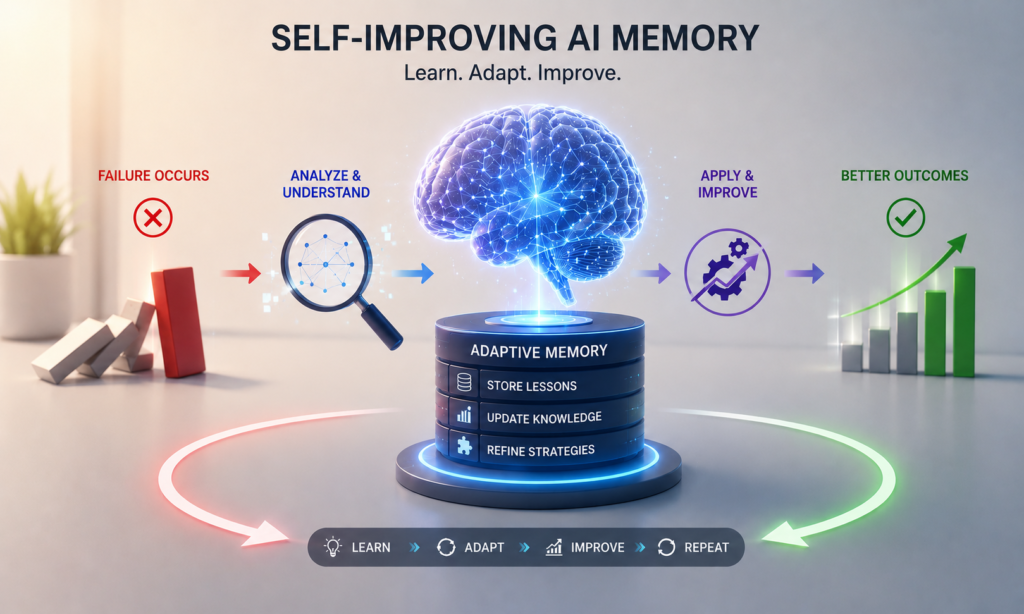
AI is going beyond the systems that can churn out answers based on previously learned patterns. The new generation of AI is to learn from past mistakes and to become better in the next decision. These systems can document how the task failed, assess the results, and learn from this experience for future interactions rather than viewing failure as the result of a task.
This is related to self-improving memory systems. With the added capability of having a persistent and structured memory for experiences, agents can remember useful experiences, feedback, unsuccessful strategies, and successful outcomes. This could help make AI more adaptable and consistent and more capable of doing more complex tasks without the need for continuous retraining over time.
Static knowledge to machine experience
The traditional models of AI mostly rely on information they learn while training or information given in the current context. When a response fails, it’s not a lesson that is lost. Self-improving memory changes that by enabling AI to remember and apply it in similar scenarios.
- Unsuccessful actions and their results can be saved by the systems.
- Feedback loops: Human or environmental feedback can be used to see what needs improvement.
- Experience retrieval: During new task(s), relevant past experience(s) may be retrieved.
- Refining strategies: AI can tweak strategies according to repeated outcomes.
- Long-term adaptation: lessons that can be of importance over more than one interaction.
The mistakes become reusable and useful knowledge.
The true potential of AI memory extends beyond mere storage to enable smart information handling. AI memory is not just about storing information; it’s about smart information handling. It’s an idea of converting past experiences into knowledge that has an impact on future decisions.
For instance, an AI research agent could continuously select weak sources when researching a specific topic. In the event that the agent’s memory is able to store these unsuccessful decisions and select better alternatives, the agent may use the knowledge gained in its future research.
This establishes a feedback loop for continuous action, observation, evaluation, memory, and improvement by AI. If the system can successfully retain the lesson from an earlier attempt, the system doesn’t have to repeat that mistake in the system.
Different Memory Layers Support Different Tasks
Advanced AI systems may possess more than one type of memory, instead of having one large memory. Short-term memory can store information required for the task at hand, and long-term memory can store information that was important in the past.
Episodic memory may hold onto particular experiences, and procedural memory may hold onto strategies/methods for performing repetitive tasks. These functions can be separated to facilitate the easier retrieval of information and for AI to identify what information is useful.
Reflection provides an additional level of learning.
In the case of reflection, an AI system reviews its performance of a task. Rather than just logging “failed,” the system can do some of the work and try to figure out what the reason for the failure was.
It may highlight one or more of the following: an incorrect assumption, missing information, incorrect tools, or an inefficient strategy. The analysis of that can then be converted to a reusable lesson. But reflection has to be judged, as sometimes an artificial intelligence can come up with a false explanation of the error.
Autonomous Agents Can Become More Consistent
Imagine an AI agent that would be able to create periodic business reports. Initial attempts may involve picking out information that is unrelated, failing to pick up on changes of information and/or not using the appropriate format.
If these failures are analyzed and recorded, the agent will be more able to identify them in the future. It does not need to start over but can be a good source of the previous lesson and choose another more suitable strategy.
This may lead to more consistent autonomous AI, as not only will they be operating, but they’ll also be learning from what they do.
A Real-World Example of Robotics.
The teaching and learning process is a process of experiencing through hands-on activities, which in the field of robotics is known as hands-on learning. The motion of a robot trying to grab an unfamiliar object can get immediate information on whether it succeeds or slips, collides, or achieves the desired outcome.
A memory system is able to store some information about the environment that the action was successful or unsuccessful in. These experiences can then be used to help guide future attempts.
The danger of being misled by the wrong lesson.
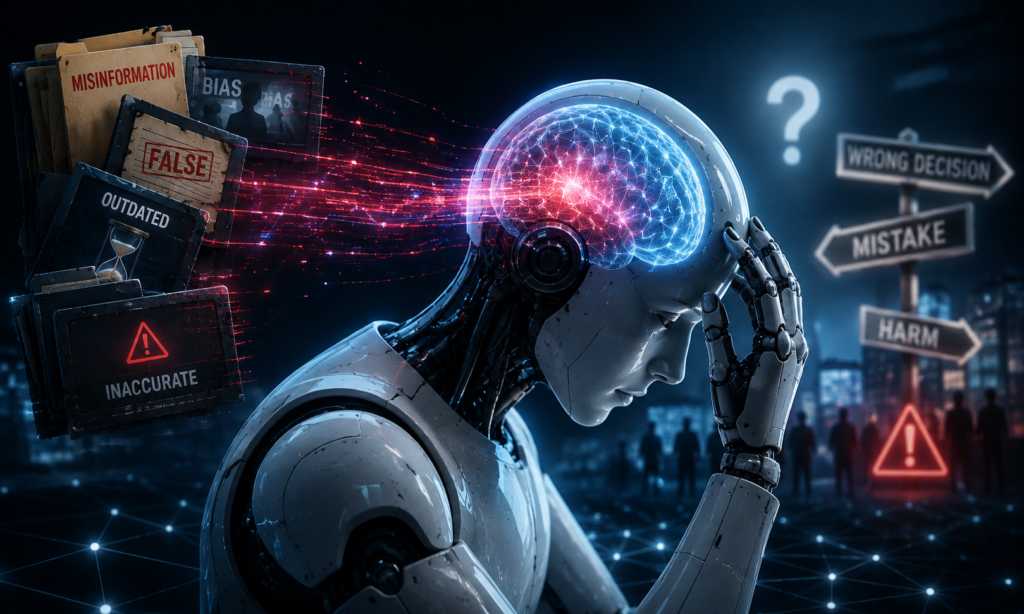
Another challenge to self-improvement is the potential for learning the incorrect lesson from a failure.
A system may deduct a point for the wrong strategy if it didn’t actually cause the poor result but was the result of something else. If this wrong assumption becomes a “recall” and the AI continues to do so in the next situation, it could be that this strategy turns out to be counterproductive.
The memory also can be corrupted by information that is not reliable on memory or by malicious instructions. As the implications of persistent memory will impact future decisions, safeguarding it becomes a crucial component of AI security.
The Way Forward for Learning AI
It may be possible to gradually alter the way that intelligent systems are built and used, as self-improving memory emerges. Rather than needing to be trained and deployed with periodic re-training, AI agents could be trained on the fly in their experience.
The most highly capable systems will probably be the ones that integrate the use of foundation models with external tools, structured memory, evaluation systems, feedback loops, and safety controls. This could enable AI to learn new and beneficial skills while preventing it from getting bogged down in unreliable data.
Conclusion
Failure learning is a significant step along the path that intelligent systems take in becoming more sophisticated. Self-improving memory enables AI agents to remember the experiences, learn from failed decisions, and incorporate valuable insights into their future actions.
But there are new risks as well with persistent memory. If an agent is misinformed, misinterpreted, or receiving incorrect feedback, then it can become a habit in his/her decision-making practice.
FAQs
1. What is a self-improving AI memory system?
An AI memory system that is self-improving, storing and recalling experiences, feedback, outcomes, and strategies to influence future tasks.
2. How to train AI to learn from failure?
When the action is unsuccessful, AI can review the action, assess the results, determine the potential cause(s), and record a valuable lesson. If a similar situation arises, then the system can remember the previous one and tweak its way accordingly.
3. Does AI memory automatically make an AI smarter?
No. Memory is not enough to have a greater intelligence. Errors or faulty memories can be detrimental to performance; thus, a filter and evaluation and verification of memory are crucial.
4. Will AI be able to evolve without the need to retrain the primary model?
Yes, some architectures of AI can enhance the behavior of a model without tuning the parameters of the model based on external memory, feedback, reflection, tools, or updated strategies.