
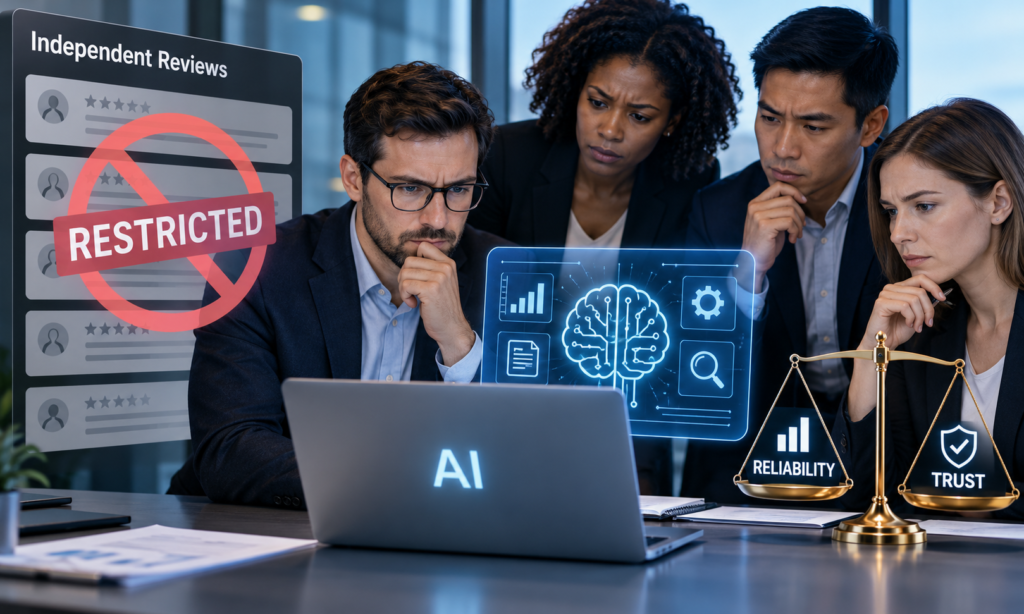
Artificial intelligence is present in the hiring process, financial decisions, customer interaction, and business operations. As we see an increase in the use of automated systems by companies, independent AI audits have become a must for the verification of reliability, fairness, and accountability. But also we see that which models are used, what the internal data sets are, and how decisions are made are often off limits which in turn makes for tough evaluations.
Businesses face an important question: How do they put stock in AI audit reports when auditors don’t look at everything? That which is true of the answer is that it rests in open testing methods, credible evidence, what is put in writing about limitations, and independent verification. Out of this comes what organizations use to tell which assessments are reliable and which are not.
Access Restrictions Produce an Evidence Vacuum in AI Auditing.
AI developers often put out that access which in turn protects their intellectual property, confidential info and system security which is for them to be allowed but also at the same time they are also preventing auditors which should be looking at certain tech practices out.
Proprietary Systems preclude independent review.
External auditors can have access to some outputs but not the training datasets or model architecture also we see that at times they do not have info on which reported performance is of the full system’s performance.
A model which does well in controlled settings may perform differently in unexpected situations. Businesses should also look at what was tested and which technical issues played a role in that which we base our conclusions on.
Selective samples may produce false confidence.
Some evaluations are of preapproved scenarios which the AI puts forth. They may show what is acceptable performance in some cases which in turn may ignore large input sets, demographic issues, or functional failure.
Reliable audit reports are a result of independent investigation which uncovers weak points as they are which in turn supports the identification of problem areas. Should this element of independence be missing from an audit it may produce what appears to be useful data but in fact does not fully prove out the reliability of the system.
Five which point to a more credible conduct of AI audits.
Organizations which review limited access audit reports should note these signs of technical quality.
- Clearly defined audit scope
- Independent auditor involvement
- Documented testing methodologies
- Reproducible evaluation evidence
- Transparent reporting of limitations
These presenters report to decision makers on what is supported by in depth research. By themselves no one of them is a guarantee for reliability, but together they create a better base for audited quality.
Trust is built from Multiple Audits’ Reports.
A formal assessment is but one element of AI governance. Also what is required is support from documentation, operational monitoring, and investigation of unexpected results.
Testing results present the support for our conclusions.
Credible reports present results of what was evaluated, which performance metrics were used, what sampling methods were applied and which failure patterns were identified. Where it is not possible to share specific info due to confidentiality issues auditors may present aggregate results or protected evidence.
Businesses must separate what is supported by direct tests from what is reported by developers. This distinction in what we present makes it easier to see which of our conclusions are still in question.
Continuous Assessment Reveals Operational Discrepancies.
AI performance changes with model updates, user behavior, or real world data shift. Audit success before going live does not guarantee steady results post release.
Organizations are to watch for error rates, harmful output, fairness issues, and unexpected behavior in the course of operation. Large changes which we see should go to investigation, corrective action, and if needed, more evaluation.
Confidentiality and yet still Effective Verification.
Protecting sensitive technology doesn’t always preclude independent review. We have put in place access structures which support in depth audit while at the same time we reduce commercial and security risks.
In Controlled Settings we do in depth technical testing.
Secure evaluation environments which allow qualified auditors to look at system performance in a non-invasive way which does not also give them access to proprietary information. Access controls, confidentiality agreements, logging, and restricted data handling are tools which we use to minimize exposure.
However, in that which we put forward, auditors must still be able to perform meaningful tests, conduct failure investigations, and report material findings. Security measures put in place should protect sensitive info without determining in advance what the results should be.
Five questions businesses should put to themselves before accepting findings.
Before turning to AI audits, procurement teams and governance leaders should review the evidence which supports its findings.
- Who selected the test cases?
- Which systems remained inaccessible?
- Were failures independently investigated?
- Can findings be independently reproduced?
- When will reassessment become necessary?
These issues put to light what in fact was assessed of operational risks vs what was reported by the providers. Also we see which issues were left unaddressed and at that point which if any additional protective measures must be put in place before full scale roll out.
Accountability should go beyond the audit certificate.

Audit certificates do not replace the primary responsibility of organizations. Companies are still responsible for which AI tools they implement into their processes especially as that which is automated may affect individual persons.
Risk Responsibility Determines What is Considered Sufficient Evidence.
A low risk content classification platform and a credit decision support from AI also require a different level of assurance. We see that for large scale implementations we may have to put in stronger testing, human oversight, incident reporting, and independent review.
Frameworks like NIST AI Risk Management Framework and ISO/IEC 42001 which support structured governance do exist. At the same time though, following a framework doesn’t guarantee that a particular model is safe or free of bias.
End result.
Restricted AI reviews do provide value in some cases but their results must be based on what auditors did see. Independent testing which reports on what is limited, secure access arrangements, and continuous monitoring raise confidence without requiring full transparency.
Businesses should present to risk based decisions what audits find out instead of treating audit results as the final say. Trust is made more solid when companies grasp which elements an audit covers and which do not.
Commonly Asked Questions (FAQS).
1.Do companies have faith in AI audits which don’t include full system access?
Trust is in part that which we put in when there is independent testing, transparently presented limitations, credible evidence and the issue at hand is fully addressed by the available examination which in turn supports the intended use.
2.AI companies which conduct which they do not allow public audit of.
Companies may control access to do so for proprietary technology, confidential data sets, customer privacy, and system security.
3.What is the approach independent auditors take to review restricted AI models?
Auditors may use controlled test environments, black box assessments, protected data sets, and published performance results.
4.Is the AI auditors’ report perfect?
No. Audits look at certain systems in which we set the stage and we can not report that they will perform flawlessly in all situations.
5.Businesses should what is the frequency of review for audited AI systems?
Reassessment is to follow after large scale model modifications, which also includes changes in risk and in performance that are apparent, or when there are other large material changes in the area of application.
1