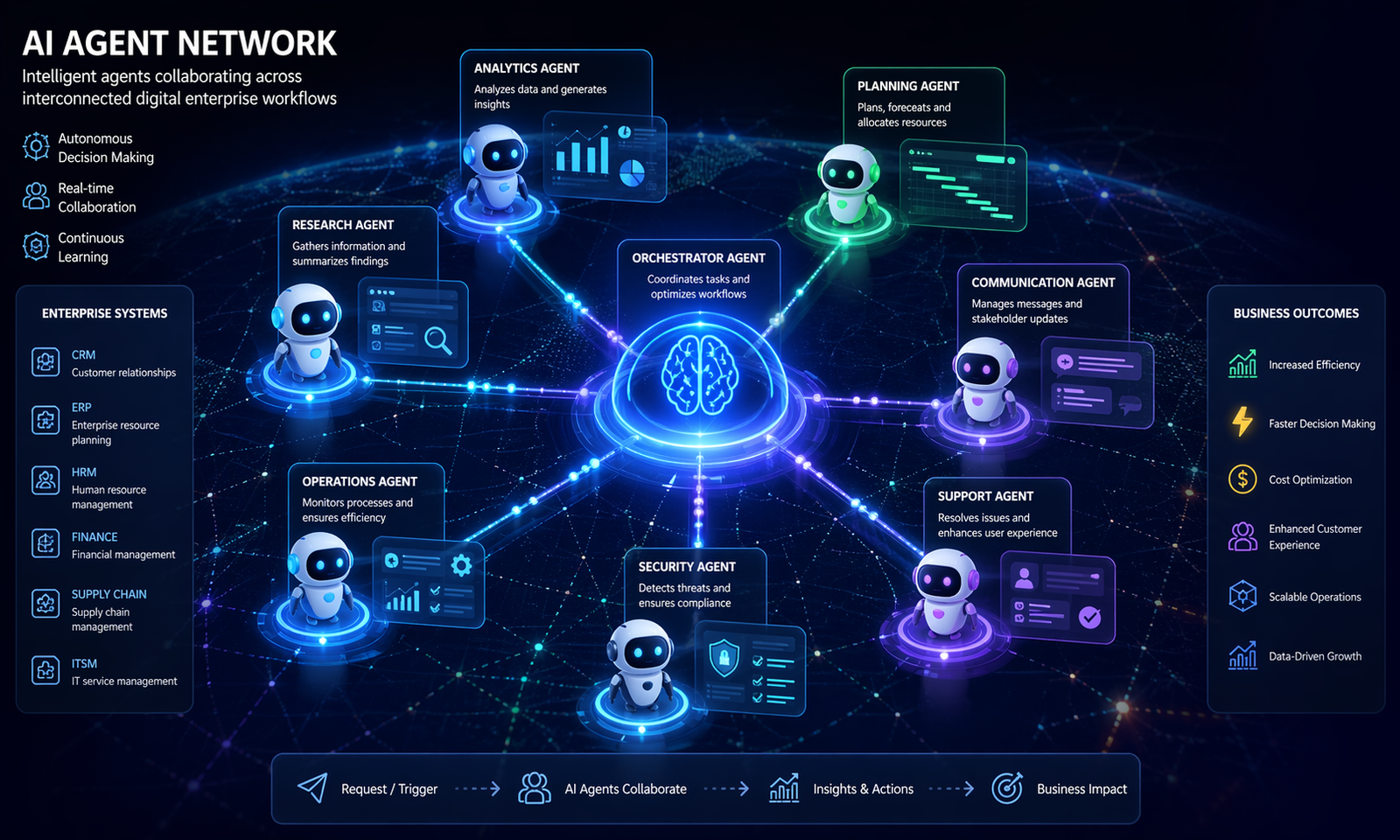
The transformation of digital systems towards agentic AI is transforming the way digital systems operate to enhance them beyond being instruction-based to being intelligent beings that can act on their own. Such systems are able to plan, make decisions and perform without having to be under human guidance. By combining a number of these agents, they result in multi-agent systems (MAS), which allow the establishment of autonomous AI organizations that replicate human enterprises- but are faster, smarter, and without a cessation.
These artificial intelligence based ecosystems are finding their way into the industries where speed, accuracy and adaptability are of paramount importance. Agentic AI is transforming the contemporary organizational forms, in terms of decision-making and implementation.
Basic features of Agentic AI.
- Goal-Oriented Execution:
The agentic AI systems are developed to pursue specific goals, and are capable of changing their strategies according to the changing inputs and results.
- Independent Decision-Making:
These agents perform an assessment of the situation, interpretation of data, and make effective decisions without the need to break them down into steps that need to be implemented by the human factor.
- Adaptive Learning:
The agentic systems are also able to optimize their performance with time by responding to feedback and interacting with the environment and become more efficient and accurate.
- Real-Time Context Awareness:
Agents can be aware of their operating environment and change their behaviour in real time to fit in the environment.
- Tool Integration Capability:
They are able to integrate easily with other systems like APIs, databases and even software tools to increase their functionality.
Basic building blocks of Multi-agent systems.
- Autonomous Agents:
Agents are independent, having a certain role and, based on special capabilities, helping to achieve the system goal.
- Shared Digital Environment:
Agents operate in a shared ecosystem where information, activities and interactions are in real time.
- Communication Protocols:
The means of communication facilitate efficient communication between agents and organize actions as well.
- Coordination Strategies:
There are sets of rules and algorithms that dictate the collaboration, negotiation or competition of the agents towards a common goal.
- Decision-Making Frameworks:
These models are useful in assisting agents to prioritize, conflict resolution, and maximizing the overall performance of the system.
How Autonomous Organizations are made possible by Agentic AI.
Decentralized Intelligence
In agentic AI organizations, multiple agents are involved in the decision-making process, instead of it being dominated by a central system. This structure does away with the bottlenecks and enables quicker reaction to dynamic situations. The system is very flexible and scalable as each agent works independently, although they are all working towards a single goal.
Role-Based Agent Architecture
There are special agents who are designated to play specific roles like planners, executors, analysts and optimizers. Such separation of duties makes sure that every job is done by the best suited organization. It is also a reflection of the traditional business departments except that it is highly fast and accurate.
Ongoing and expandable Process.
The AI systems that are agentic are 24/7, meaning that they will not get tired, and there will be workflows all the time. New agents can be easily added and this enables organizations to scale without affecting performance or efficiency.
Applications of Agentic AI in the real world.
Smart Customer Service software.
The agentic AI complements customer service by having a number of agents, which respond to queries and personalize customer interactions and escalate complex cases. This results in quicker response, and better customer satisfaction on the digital platforms.
Self-managed Supply Chain Management.
In the logistics and supply chain processes, agents handle inventory, forecast demand and streamline delivery routes on-demand. It minimizes the cost of operation, and enhances the efficiency of the whole chain of supply.
Trading Financial Automation and Trading.
Financial markets have many multi-agent systems that are utilized to analyze trends, execute trades as well as manage risks. They have a great advantage in a dynamic environment because of their capability to process large amount of information in real time.
The positive effects of Agentic AI in Organizations.
The concept of agentic AI results in a new dimension of operational intelligence that has a great impact on the performance of business. Organizations can deliver quicker execution and decision-making results by facilitating systems to operate autonomously and work together with each other.
Such systems help to achieve workload reduction as repetitive and complex tasks can be automated, and the teams can work on strategic initiatives. Also, multi-agent systems are scalable, which means that businesses will be able to meet the growing demands without significant changes in infrastructure. All in all, agentic AI spurs productivity, innovation and long-term growth.
Multiple-agent AI Organizations challenges.
Though agentic AI is highly beneficial, it is also accompanied by challenges which need to be tackled by organizations. With the growth in the number of agents, it can become complicated to coordinate multiple agents. Failure to optimally utilize communication overhead can affect performance.
Ethical concerns are also applicable, where autonomous systems should be in line with the human values and must work within specified limits. The problem of security risks and governance has to be solved in order to provide the safe and reliable operation. These issues have to be overcome to create strong and confident AI organizations.
Further development of Agentic AI and Autonomous Enterprises.
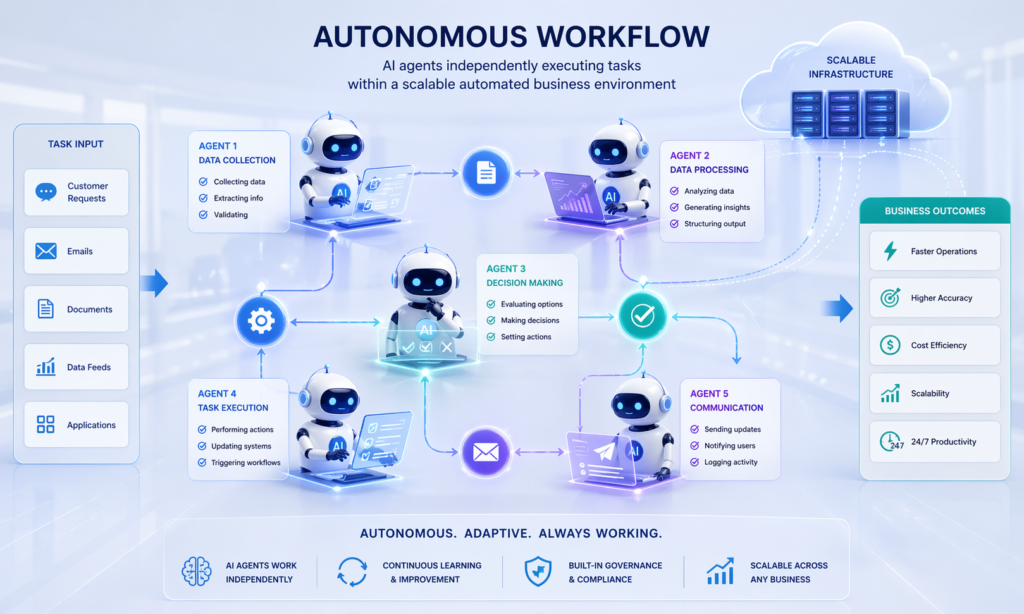
The next evolution of agentic AI is the complete autonomous digital ecosystems that organizations would act with minimum human participation. These systems will be interconnected with developing technologies, including IoT, robotics, and high-level analytics and will give rise to highly adaptive environments.
With ongoing innovation, the AI agents will not only be able to perform tasks but also be included in the strategic decision-making process. Such a shift will transform the way businesses are conducted and autonomous AI organizations will become a major contributor to the digital transformation.
Conclusion
Multi-agent systems and agentic AI are revolutionizing the very nature of organizations as they add autonomy, intelligence, and scalability to all processes. Such systems make it possible to make decisions much faster, operate continuously and effectively cooperate within complex environments. With more companies embracing this technology, autonomous AI organizations will be the basis of innovation and growth in the future.
Frequently asked questions (FAQs).
1. How is the difference between traditional AI and agentic AI related?
Conventional AI reacts to the inputs, whereas agentic AI takes initiative and acts on its own, as well as seeks objectives.
2. What are the uses of multi-agent systems?
They allow complex problems to be solved by working together, being scalable, and having distributed intelligence.
3. Will agentic AI put human workers out of business?
It has the capability of automating repetitive and decision based processes, but human beings are still needed when it comes to strategy and oversight.
4. Are there multi-agent systems which are secure?
Provided they are designed with due protocols, encryption and monitoring systems they can be safe.
5. Which industries are the most benefiting from agentic AI?
The impact is the greatest on finance, healthcare, logistics, eCommerce, and customer service.