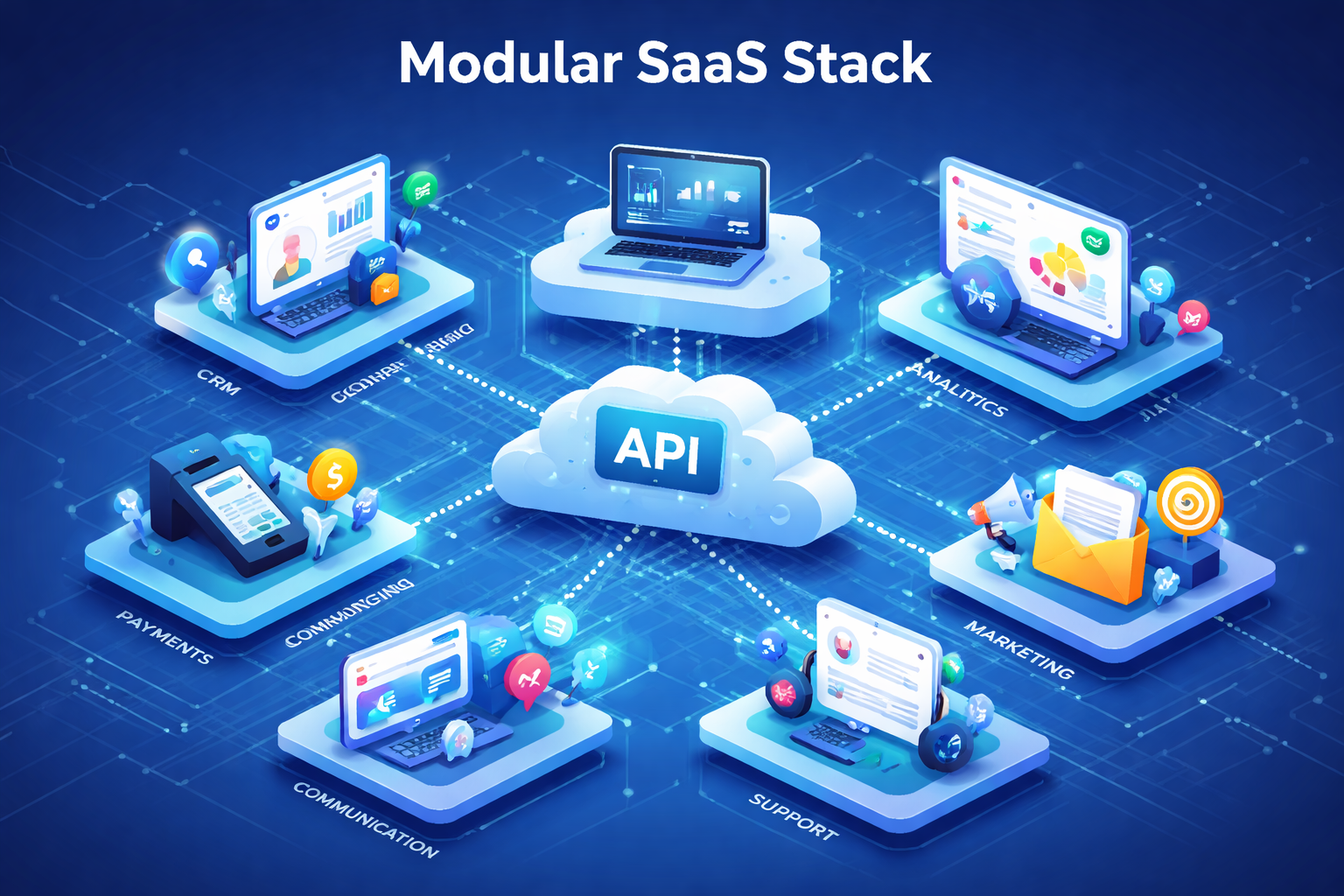
In 2026, the SaaS market will have stopped being based on fixed monolithic platforms, and instead, it will be made up of flexible, composable ecosystems that are driven by APIs. A large solution with a single control over all functions is no longer desired by businesses. They would instead be more comfortable with a modular design with everything being fine-tuned to a given task and integrated. This is not merely a trend but it speaks of a greater need of agility, speed and creativity in the digital world that is highly competitive.
Composable SaaS? What is it?
Composable SaaS is a new software model in which companies create customized tech stack with independent tools that are linked through APIs. Companies do not turn to a single vendor to handle all their operations but choose the most appropriate solution regarding each of their functions such as marketing, payments, analytics, or CRM, and integrate them into a single system.
Basic Backbone of Composable SaaS.
The composable SaaS is developed based on the modular architecture, that is, all the components are independent of each other, but they collaborate with each other via APIs. This enables the businesses to substitute or upgrade single parts without affecting the whole system. It establishes a dynamic environment in which innovation is continuous as opposed to each update by vendors.
API-First Ecosystem
An API-first approach is at the core of composable SaaS. APIs are intermediaries which enable various software applications to communicate with each other in real-time. This facilitates smooth data flow, automation and scalability that makes the system very efficient and dynamic to the changing business requirements.
Customization at Scale
Among the greatest benefits is that it is possible to tailor software stacks to specific needs. Businesses no longer have to adapt their workflow to a tool, the tools can fit their workflow. This will result in enhanced productivity and results.
The reason why All-in-One SaaS Tools are becoming irrelevant.
- Little flexibility limits customization of the business.
- Slow innovation due to monolithic architecture
- Spending money on the features that are hardly used.
- Dependency on one vendor ecosystem.
- Challenging interconnections with new tools and APIs.
The API Economy is on the Rise.
- APIs facilitate the flow of information on various platforms.
- Reduced time to develop and deploy products.
- Decision-making is enhanced by sharing real-time data.
- Promotes innovation by integrating with third parties.
- Enables scalable and decentralized software ecosystems.
Advantages of Composable SaaS.
More Flexibility and Control.
Composable SaaS will enable organizations to select tools that best fit their requirements. Such control will guarantee that the unneeded features or restrictions do not limit the businesses. It enables teams to create workflows that are in line with their objectives leading to increased efficiency and performance.
Accelerated Innovation
In the case of composable systems, companies are able to implement new technologies fast without having to wait for a centralized platform to be updated. This allows quick experimentation, quick iteration and being able to remain ahead of competitors in competitive markets.
Cost Efficiency
Businesses do not pay to have a bundle of services, but only invest in tools which they utilize. This greatly saves money and guarantees improved distribution of resources, particularly to start ups and companies in the stage of growth.
Difficulties of Composable SaaS.
Integration Complexity
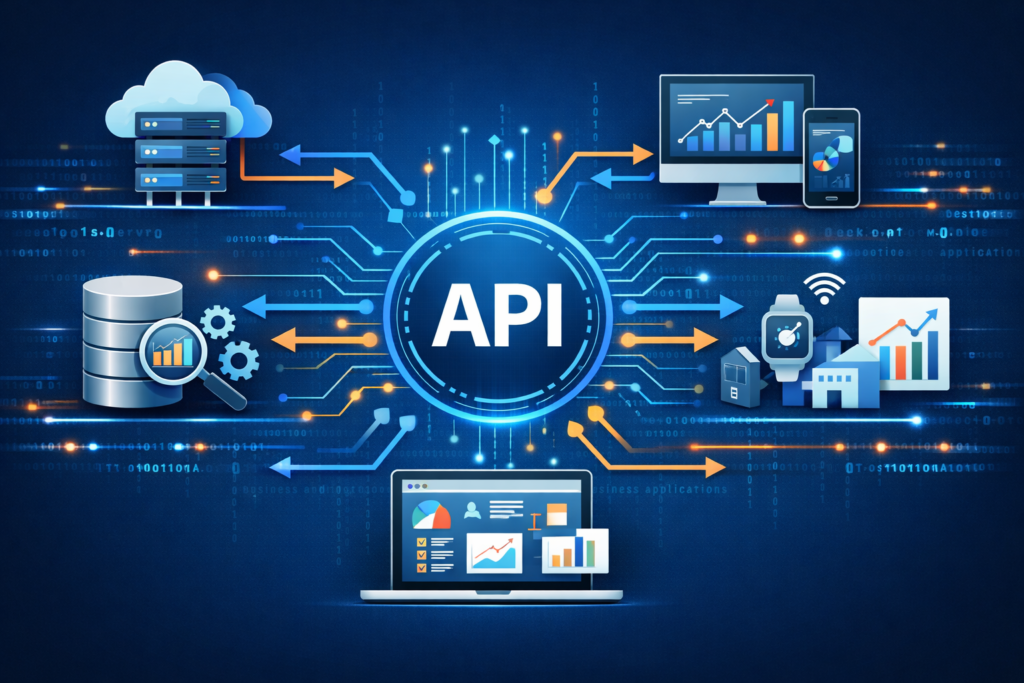
Although composability is a flexible feature, it may be difficult to integrate several tools in a technical manner. To maintain a smooth flow of activities in their businesses, businesses require the right API management strategies and competent developers.
Security Risks
Increased integrations translate to increased entry points to possible threats. Companies need to adopt tough security measures such as encryption and authentication systems to secure sensitive data in systems.
Vendor Management
Dealing with a number of vendors may add to operational overhead. The companies need to take care of relationships, updates and dependencies to ensure the stability of the system.
The way businesses are utilizing this Model.
Startups Driving Innovation
Early adopters of composable SaaS are startups since it enables them to grow fast and try out various tools without the need to enter into long-term agreements. This is flexibility that provides them with a competitive advantage in swiftly evolving markets.
Enterprises Transitioning Gradually
The massive businesses are abandoning the old systems to adopt a hybrid system. They are disaggregating monolithic platforms into smaller units, and moving to a fully composable architecture.
Trends in Composable SaaS going forward.
No-Code and Low-Code Rise.
No-code and low-code tools are making integration of APIs to become simpler. This enables users who do not have technical skills to create and operate workflows, which makes composable SaaS more accessible within companies.
AI-Powered Automation
Artificial intelligence is significantly contributing to streamlining workflow in various tools. The composable ecosystems can be analyzed, automated in repetitive tasks, and improved in decision-making by AI.
Conclusion
By 2026, composable SaaS and the API economy will transform the use of software by businesses. The fall of all in one devices is an indication of an increasing demand for flexibility, efficiency and innovation. Although issues such as integration and security are still an issue, the advantages outweigh the disadvantages. Such a modular approach will enable organizations that implement it to be more flexible, larger, and capable of succeeding in a more dynamic digital world.
FAQs
1. How is the simple definition of composable SaaS?
Composable SaaS refers to creating your own software system by assembling various tools together with APIs rather than using a single platform.
2. What is the reason why businesses are abandoning all in one tools?
They are inflexible, slow innovation and usually have features that are not needed that add expenses.
3. Does composable SaaS cost a lot to implement?
First, it can be costly to invest initially in integration, but it will save money in the long term by removing unused features.
4. How does the API work in this model?
APIs are used to integrate various tools enabling them to communicate and cooperate with one another.
5. Is it possible to embrace composable SaaS by non-technical users?
Indeed, now, even the non-technical user can create and maintain integrations due to the emergence of no-code tools.