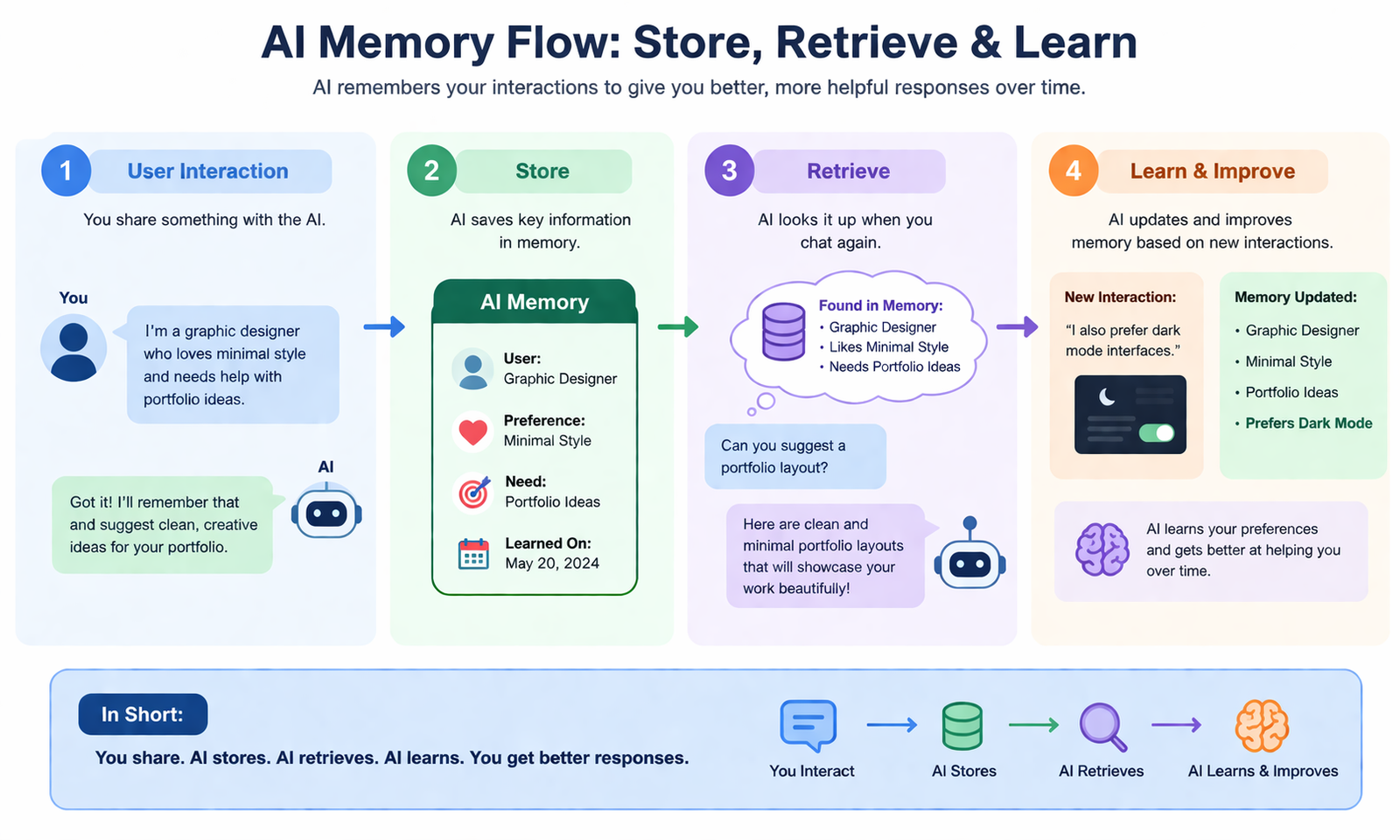
Artificial Intelligence has progressed very fast, yet there has always been a significant drawback, which is a memory deficit. Old-fashioned AI models are unresponsive and cannot remember previous interactions or work on individual requests. This allows their efficiency but is not really intelligent. This paradigm is shifting with the introduction of AI memory systems where machines are now able to remember, learn, and change over time.
AI Memory Systems What Are They?
AI memory systems refer to structures which enable artificial intelligence to store, retrieve and utilise information in interactions. These systems create context and enhance AI by not considering each query as novel, which is more personalized and effective.
They integrate both internal model and external storage layers like databases and the vector memory systems. This enables AI to remember user preference, past dialogues and behavioral patterns, to give a more human experience of interaction.
Types of AI Memory
Short-Term Memory
AI short-term memory has the role of preserving the context in one interaction or session. It assists the system to keep track of what is being discussed at a particular moment, making the responses relevant and coherent. To illustrate, during a conversation, AI will recall previous sections of the conversation and reply to it. Nevertheless, such memory is momentary and will be wiped off as soon as the session is over, which is limited in scope but critical to the quality of real-time interactions.
Long-Term (Persistent) Memory
Persistent memory makes AI much more powerful and intelligent as it enables it to store information not only within the one session. Such a memory allows systems to store user preferences, historical behavior, and history of interaction. Consequently, AI will be capable of providing very personalized experiences, enhancing recommendations, and changing its responses according to the learned patterns. One of the milestones on the way to making AI systems more human is persistent memory, which makes their thought process and interaction more human.
External Memory Systems
External memory systems enhance AI capabilities by integrating them with databases, APIs, and cloud storage. These systems enable AI to retrieve large amounts of organized and unorganized information in real time. In such a way, AI can get past its internal constraints and offer more precise, recent, and scalable solutions. External memory is particularly applicable to enterprise applications where it is highly important to work with large sets of data effectively.
The major advantages of AI Memory Systems.
- Allows high-level personalization, depending on the user behaviour.
- Enhances accuracy of responses using the past.
- Promotes life-long learning and change.
- Lesson repetition and redundancy.
- Improves the user experience and interaction.
The power of Persistent Memory to improve AI Intelligence.
Improved Personalization
Long-lasting memory enables AI to get to know individual users better. Using the preferences, past interactions, and behavioral patterns, AI can provide responses that are more relevant and interesting. This results in a more natural and satisfying user experience similar to that of communicating with a human that recalls prior dialogues.
Better Decision-Making
In instances where AI has access to historical data, it will be able to make more informed decisions. It is able to compare previous results, determine patterns and enhance its forecasts as time passes. This can be utilized mainly in such areas as finance, healthcare and marketing, where decisions that are based on data are the key to success.
Continuous Learning
Persistent memory AI systems are dynamic. They are constantly developing through the learning process. This implies that the system will be smarter with time, becoming a better performer and able to adapt to new situations, without the need to be retrained regularly.
Difficulties of AI Memory Systems.
- The issues of data privacy and data security become even greater.
- A large-scale memory storage is tricky to handle.
- Poor-quality stored data may lead to risk of bias.
- Costs of high infrastructure and computing.
- Problem in sorting out pertinent vs. irrelevant information.
Real-World Applications
Customer Support
Memory-based AI chatbots can remember prior communications, minimizing the information that users need to provide. This results in the shortening of resolution times and satisfaction by the customer.
Healthcare
In the medical industry, AI memory systems will be able to follow the medical history of the patient and give more precise diagnoses and treatment plans. This enhances efficiency and quality of care.
E-commerce
The e-commerce is based on AI memory, which analyzes the browsing and purchase behavior. This enables them to suggest products that are in line with user preference, which boosts conversion rates and customer loyalty.
Conclusion
One of the significant steps towards making artificial intelligence really smart is AI memory systems. Through persistent memory, AI is able to learn through previous interactions, make improvements to fit the needs of users and offer very personalized experiences. Privacy and scalability are still a problem, but the advantages are game changers. As the technology keeps on advancing, it will be very important in developing the future of intelligent systems and the interaction between man and AI.
FAQs
1. What is persistent memory in AI?
Persistent memory ensures that AI systems can store and recall information over multiple sessions and therefore can learn in the long term and learners can be personalized.
2. What is the benefit of AI memory in terms of user experience?
It boosts personalisation, retains context and gives more precise and pertinent answers based on previous interactions.
3. Is AI memory safe when used?
It becomes safe when adequate security rules, such as encryption and data protection rules are adhered to.
4. What are the industries that AI memory systems help most?
Some of the best industries that AI memory can be used are healthcare, e-commerce, education, and customer support.
5. Is AI memory biasing?
Yes, in case there are biases in the stored data they can be reinforced by AI. There should be proper monitoring and ethical practices.