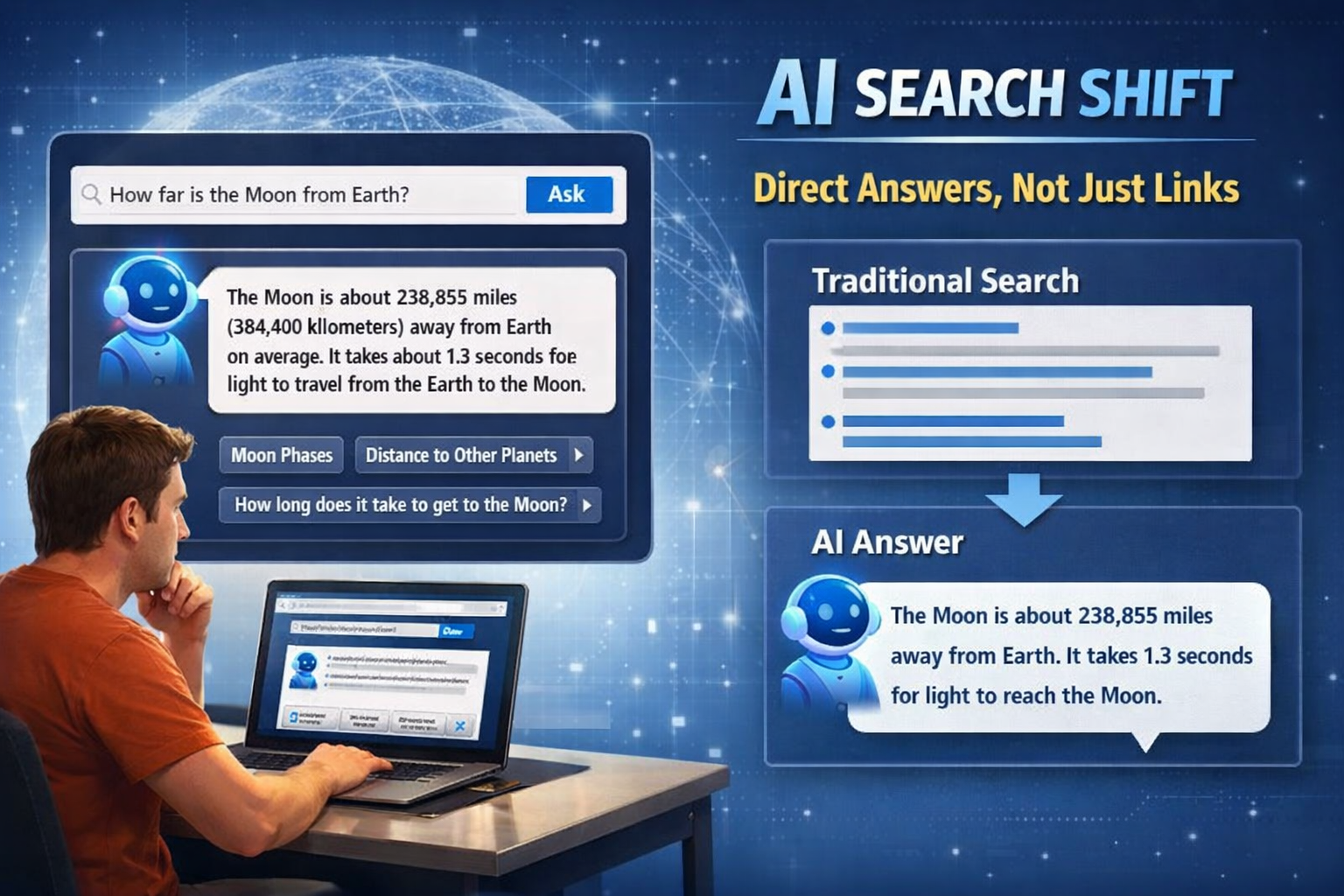
The internet is more than ever transforming and some of the largest changes we are experiencing today are the changes in the traditional search engine into the AI-powered answer engine. Over the years, users had been relying on search engines to locate information by navigating through numerous links, evaluating sources and deriving useful information. Nonetheless, the advent of artificial intelligence has radically transformed this experience, providing direct, conversational and highly accurate answers within a few seconds.
Not only the speed is involved in this change, but also it is redefining the interaction of people with information on the internet. The internet is becoming more intuitive, personalized, and efficient by eliminating friction in the search process and redefining user expectations with AI.
The Search Engines to Answer Engine Evolution.
Tradition Search Experience.
Previously, the search engines operated by indexing billions of web pages and ranking it according to relevance, keywords and authority. The users were forced to sift through a number of results, clicking on various pages and had to find the answers that they needed manually. This was not only an effective process but also time consuming, laborious and critical.
Keywords optimization and backlink strategies were also a major concern of content makers to attain high ranking. Although this strategy contributed to the visibility, in many cases, it resulted in content being produced based on algorithms rather than real needs of users.
The Dawn of AI Answer Engines.
Answer engines have become a competition to question answering with the development of AI technologies such as natural language processing and machine learning. These systems can interpret user intent, context and even tone of conversation to give accurate answers in real time.
AI does not provide a variety of choices but rather shrinks down to the optimal answer and delivers it in a format that is easy to comprehend and structured in a well-organized format. This change has greatly enhanced user experience and minimized the aspect of a lot of browsing.
The Transformation of the Internet by AI.
AI is not only making search better; it is transforming the digital ecosystem. This is a technological shift that is impacting every aspect of the content and the way people consume it, as well as how it is created.
AI allows access to information much faster as it summarizes complex issues giving brief answers. This enables users to find solutions in their decisions without necessarily wasting a lot of time doing research. It also shifts the consumption of content since individuals are currently more inclined to utilize straightforward, well structured, and direct answers as opposed to protracted articles unless they need to do so.
The other significant transformation is that SEO became an improved strategy commonly known as Generative Engine Optimization. Content must now maintain an appropriate level of intent, context and clarity as opposed to just depending on keywords. AI systems focus on meaningful, well-structured and trustworthy content.
Also, there is an increase in zero- click searches, which implies that users frequently find an answer without going to a site. This puts the old models of traffic to test and it is encouraging business to think more of authority and presence as opposed to clicks.
- The quicker access to correct information.
- Replacement of the keywords with user intent.
- Additional significance of structured content.
- Increase in zero-click search.
- Individual response according to context.
Effect on Businesses and Content Creators.
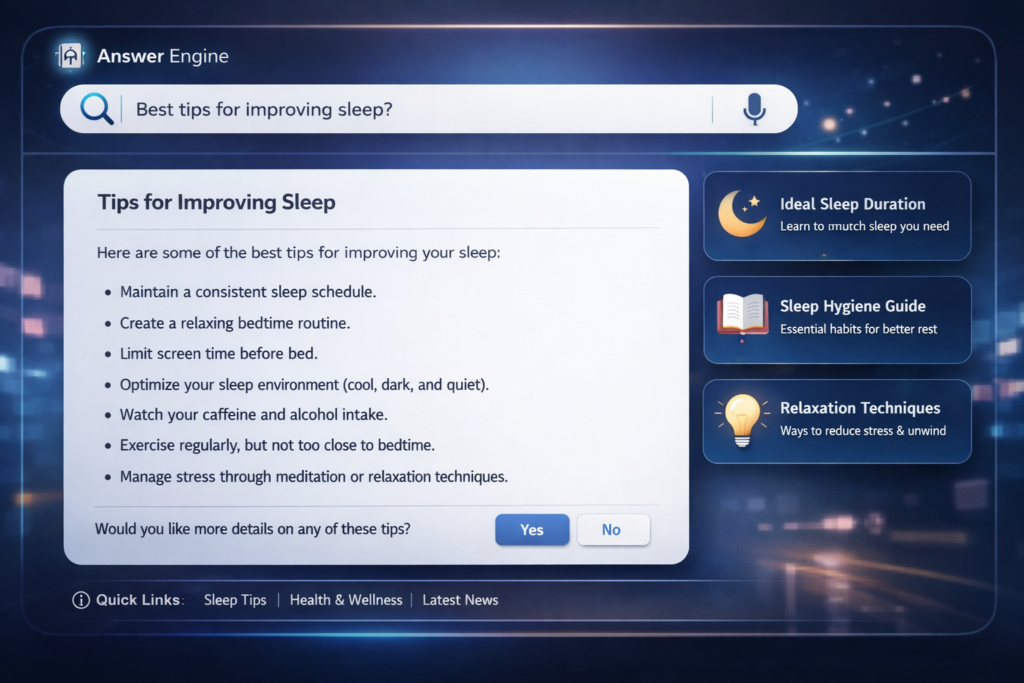
The move towards the use of answer engines is compelling companies and content creators to re-evaluate their policies. It is no longer possible to create high volumes of content. Rather, there has been a shift in emphasis to providing quality, informative and authoritative content that directly responds to user queries.
To gain the trust and credibility, brands now have to prove their reliability and expert support because AI systems prefer expert-supported information that is credible. This gives such factors as experience, expertise, authority and trust even greater significance.
Meanwhile, new opportunities are also formed by this transformation. Smaller brands that have quite relevant and well-organized content have a chance to compete with larger players and become visible with the help of AI-driven platforms.
- Concentrate on quality rather than quantity.
- Significance of authority and indicators of trust.
- Demand for AI-friendly content structure.
- Niche and emerging brands Opportunities.
- Emphasis on direct and clear answers
Future Internet.
Conversational interfaces and intelligent systems that know users more than ever before will be the future of the internet. Chat-based interactions are replacing the use of search bars gradually and users interact in a natural and personalized way, getting an immediate and personalized response.
With the further development of AI, its users will increasingly use summarized insights to make fast decisions. This will lessen the steps that are used in locating information and make it efficient in different industries.
The creation of content will also change greatly with the creators dedicating their time to create information that can be easily interpreted and presented by AI. Organized formatting, semantic clarity and contextual richness will be key components of content success.
Conclusion.
The transformation of search engines to answer engines is a significant turning point in the history of the internet. The AI is bringing information close to users, personalized, and efficient, transforming the interaction of users with digital platforms.
This is an opportunity and challenge to businesses and creators. To cope with this new landscape, clarity, trust, and user intent have to be considered. Individuals that adopt them will be in a good place to succeed in the future of an AI-driven internet.
Frequently Asked questions (F&Q).
1. What is the answer engine?
An answer engine is an artificial intelligence (AI) application that does not show a list of links to the user but directly answers his query.
2. What is the effect of AI on search behavior?
Search with AI is becoming quicker and more natural as the technology comprehends the intent of users and provides the answers in real time.
3. How can SEO be differentiated with GEO?
SEO is aimed at search results ranking, whereas GEO is aimed at content optimization to be chosen and rendered by AI systems.
4. Will websites be out of favor because of AI?
It is true that zero-click searches might lead to a decrease in traffic of some websites, yet good content might still ensure visibility.
5. What can content creators do to adjust to this change?
They need to concentrate on quality, structured, and purposeful content that pertinently responds to the queries of users.