
In the past, computing infrastructure has relied on human engineering.Traditionally, the computing infrastructure has been engineered by humans. AI models are trained and operated on Chips, Servers, Networks, Cooling Systems and Data Centers.
That’s all about to change. AI is helping engineers make infrastructure designs and optimizing it, which will be used by future AI systems. It makes a virtuous circle where the more advanced AI is available, the more powerful the computing system and the more powerful the AI, the more advanced it gets.
AI Is Entering the Hardware Engineering Workflow
There are many decisions to make when designing modern hardware that concerns the performance, memory, power, heat, manufacturing and cost. AI can test numerous combinations, and guide engineers to more potentially viable designs quicker.
- AI can simulate various processor configurations.
- Algorithms can help to optimise the structure of the circuits.
- A machine learning based memory architecture can be created.
- AI can analyze various pieces of server configurations.
- Optimization can be done for AI workloads using hardware.
Processor Layout Is Emerging as an Optimization Problem
In the advanced processors, there are billions of transistors, and components that are tightly connected. They influence the communication effectiveness, the amount of heat they generate, energy usage and performance.
Optimization based on AI can consider the various layouts and suggest various options that meet multiple engineering requirements. These designs can then be checked by engineers to ensure that the design meets manufacturing and reliability standards.
Specialized Accelerators Being Formed on AI.
GPUs and special purpose accelerators that are optimized to handle intensive math operations are vital to modern AI.
Through the use of an AI engine, engineering can be assisted, and workload behavior can be analyzed to make decisions when it comes to optimizing the hardware configuration for improved performance, memory access or energy use. This could result in more and more niche processors optimised for specific AI applications.
Memory Architecture Is Becoming Part of the AI Design Equation
Only the speed of the processor is not indicative of AI performance. The advanced models continually transfer vast quantities of information from processor to memory and vice versa.
AI can help with this, by examining these data transfers, and determining configurations that minimize unnecessary transfers. To minimize bottlenecks, memory can be moved to be closer to the processing resources, and memory bandwidth increased.
Data Movement Can Be as Important as Computation
Information can’t be transferred over a computing system without taking up time and energy. The inefficiencies in data transfers can ultimately reduce the benefits of using faster processors, especially as AI models grow in size.These inefficiencies in data transfer can ultimately curb the benefits of faster processors, particularly with growing AI model sizes.
This optimization can be done with AI and evaluate which components need access to the data, when it is being transferred, and where it is stored. The knowledge gained from these can be used to create architectures that use a combination of processing and memory in a more efficient manner.
Data Centers Are Becoming Adaptive Computing Environments
AI infrastructure isn’t just processor based. The large AI systems are reliant on interconnected servers, networking, electrical, storage and cooling infrastructure.
AI can leverage this operational data to inform these facilities on how they respond dynamically.
- The workloads can be deployed to appropriate compute entities
- Power distribution can be in accordance to processing demand
- Equipment Cooled: Cooling can be adjusted based on equipment temperatures.
- It can be determined earlier that there are hardware problems.
- The usage pattern can be used to estimate the capacity requirements.
Cooling Can Follow Real-Time Computing Demand
Many processors running within a tightly packed server rack produce a large amount of heat with the high performance accelerators.
Machine learning can take in all of these temperatures, processor usage, airflow and cooling equipment, and correlate them all. Cooling resources could then be shifted towards those areas where there is higher cooling demand.
Power Management can be More Precise.
AI data centers need a lot of electrical power, but it doesn’t all need to be used by each and every server.
Workload management systems can be used to intelligently manage resources by analyzing workload patterns and power consumption. This can aid operators to determine the power usage and areas to enhance efficiency.
Network Architecture is Entering the AI Optimization Loop.
Often large AI models are trained on many processors, which operate in parallel. Networking is a key element of the infrastructure of these processors as they have to be constantly communicating information.
Machine learning tools can analyse the communication, congestion and the distribution of load between computing resources and can provide more efficient connections.
Processor Clusters require faster communication
If the information that they need to work on has to be transferred to and from other processors, they must wait for this information, and powerful accelerators cannot work efficiently when they have to wait.
An optimized workload distribution and optimized communication path is possible by using AI-assisted optimization to optimize the distribution of workloads to clusters and optimize the organization of communications paths. This will speed up computing resources and minimize bottlenecks if there is greater coordination between the different groups.
Digital Twins Are Creating Virtual Infrastructure Laboratories
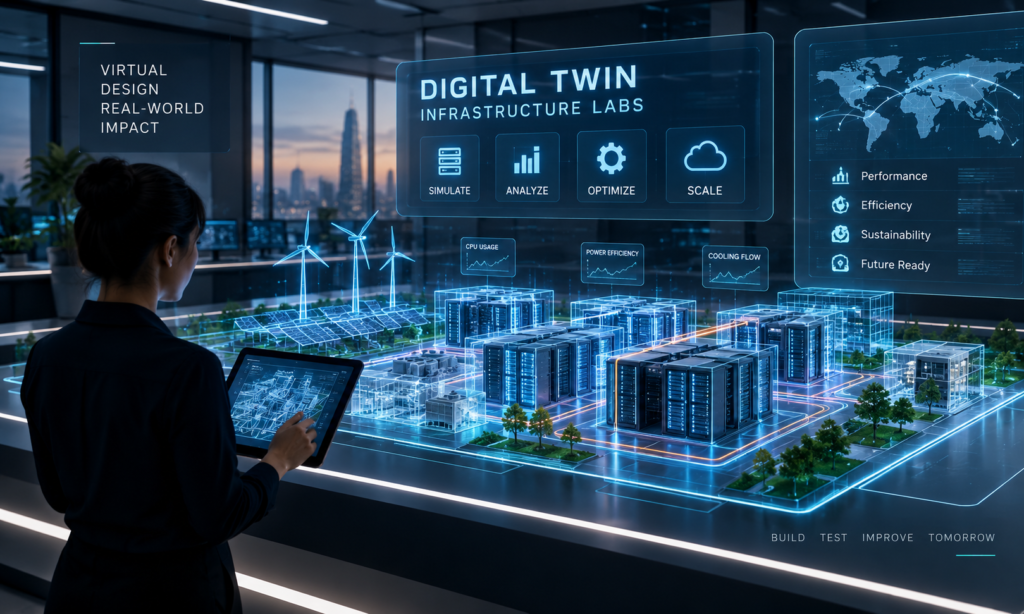
Digital twins are virtual replicas of the physical computing environment. Engineers can simulate a server, networking, cooling equipment and power supply in the models, without changing the real facilities.
These simulations can be used to assess other configurations, without the need to immediately modify costly physical systems, using AI.
Simulations can save the time and cost of trial and error.
Switching production Data Centers can be a rather costly and risky process. Engineers can use digital simulations for a more safe working environment.
AI can analyze and compare the various arrangements of the servers, cooling methods, network configurations, and workload distribution. They can then be further engineered for consideration for physical implementation, if any are deemed as promising.
AI and Infrastructure are creating a continuous cycle of learning.
There is a lot of information that AI systems can provide about the utilization of the processor, memory usage, network traffic, power consumption, and thermal effects.
This information can be used to direct the necessary improvements for Infrastructure. The more demanding AI models can then be aided by better hardware, and the processes of these models can yield new information for another wave of infrastructure design and construction.
Conclusion
AI is now starting to affect the physical computing substructure that supports AI. The potential areas of optimization for processor layouts, memory systems, accelerator clusters, networking, cooling and power management are increasing, and AI can help with these optimizations.
This forms a circle of benefits as AI is used to enhance computing facilities and computing facilities are used to enhance AI. As these technologies advance and are going hand in hand, there will be more and more connections between infrastructure engineering and the development of AI.
FAQs
1. Can AI develop computer chips without human engineers?
While AI can help with optimizing and laying out chips, it doesn’t remove the need for engineers to deal with constraints, validating those solutions, ensuring they are reliable, and determining production rules.
2. How can AI improve data center infrastructure?
AI can analyze workloads, temperature, energy usage, network activity and hardware performance and optimize the management of the infrastructure.
3. What is the significance of memory for the AI infrastructure?
There are large volumes of data transferred back and forth between AI models, all the time. Improved memory systems are faster and less costly, enhance the efficiency of the computer, and eliminate bottlenecks.
4. What is the significance of digital twins for AI infrastructure?
Digital twins enable engineers to test infrastructure configurations, and assess the impact of changes, before making them in real world infrastructure.