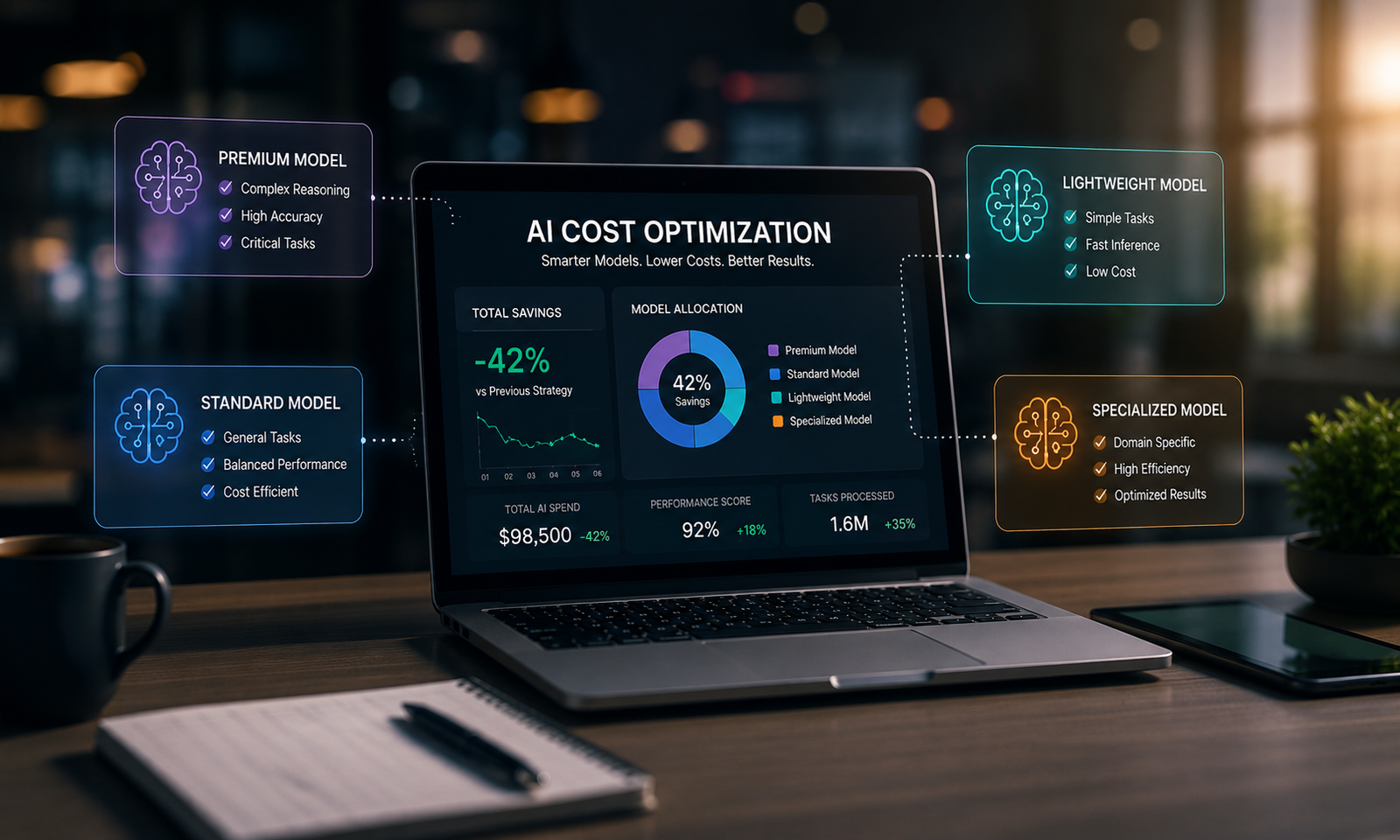
Artificial Intelligence isn’t a new and experimental technology for businesses anymore; it has become a vital component of everyday business. Today, businesses rely on AI for its efficiency in various other fields such as customer service, software development, financial analysis and content creation. But with the rise in the use of AI, so have also increased the operating costs. Many organisations have recognized that using a single premium AI model for all tasks is impractical and expensive, and so have moved to adopting another model for specific tasks.In 2026, many companies have found it impractical and cost prohibitive to use a single premium AI model for all purposes, and as a result have opted for a different AI model for specific tasks.
To solve this problem, enterprises are turning to a multi-model approach to AI, which involves using several AI models with their respective advantages, performance characteristics and costs. Companies direct tasks to the most appropriate AI system, avoiding the need to send the same requests to the same AI system, which will be costly. This method does not only save money, but also provides better quality of response, enhances security and boosts operational efficiencies.
Selecting the appropriate AI model for each business task.
The ability of using various AI models for various workloads can ensure organizations are as efficient as possible and control their AI spending.
- Customers’ requests are managed by lightweight models.
- Advanced reasoning models – business strategy decisions.
- Coding assistants are tools that assist software development teams in their coding tasks.
- The images and visual documents are analysed by Vision AI models.
- Private AI: Private information is handled by private models.
Greater speed and lower cost.
While writing emails, summarizing reports, or even translation can be tasks that require premium AI models, they aren’t necessarily ones that are complex. Thanks to their lightweight designs, businesses use lightweight models for day-to-day use, resulting in reduced token usage, and operational costs, along with an exceptional response time.
Specialized models for better performance
All AI models come with their own sets of advantages. Some are good at writing codes, some are good at reasoning, some are good at creating contents and some are good at analysing images. When choosing a model for a task, it is important to match it with the appropriate task, to increase accuracy and productivity.
Stronger Data Security
There is a growing shift towards using private or on-premise AI models for sensitive business information or towards public AI services that are used for less sensitive tasks.Private or on-premise AI models are being used for more sensitive business data, whereas public AI services are being used for less sensitive tasks. This helps to ensure that the enterprise’s data is safe and that the industry regulations are followed.
Improved Business Continuity
Multi-model AI provides flexibility to organizations to change service providers, as and when required. When one AI becomes unavailable or incurs higher costs, the other AI can seamlessly take over the tasks.In the event that one AI is down or has an increase in pricing, the business can easily switch over to the other AI, without interruption.
More flexibility in the future for growth.
As technology advances, businesses can seamlessly adopt new AI models and models without having to overhaul their systems. This flexibility will facilitate innovativeness as well as long-term AI investments to be controlled.
The Impact of AI Cost Optimization on Enterprise Strategy
Optimizing AI usage is shifting from a line item in the budget to a key business strategy.Cost optimization of AI is no longer a budget discussion, it’s an integral part of the business.
- AI routing automatically chooses the best performing model, based on cost.
- Go through usage of the tokens and minimize spending.
- The premium models are only used on complicated reasoning jobs.
- By utilizing open-source AI, businesses can reduce their operational costs.Open-source AI can help to reduce the cost of operation.
- AI Governance enhances financial governance and adherence.
Intelligent AI Routing
Today’s AI orchestration solutions consider every request and choose the optimum model for it. They are aware of the considerations of complexity, responsiveness, security needs and token costs to ensure efficiency of every workload.
Reducing Infrastructure Expenses
Running enterprise AI does not need to be a difficult task as it demands robust computing power. A large number of companies are now integrating cloud (AI) with smaller local models that lower their usage of the GPUs and still deliver high performance.
AI is open-source and is becoming mainstream.
The open-source AI models are becoming more popular since they not only cut licensing costs, but also allow for greater customization and control over business data. Several businesses today take advantage of hybrid AI setups involving custom and open-source AI technologies.
AI Governance enhances Financial Visibility.
AI spending, performance, compliance and model usage is tracked by organizations via centrally managed platforms. The information guides leaders to make the best use of their investments, and to increase their efficiency.
The multi-model AI provides long-term competitive advantage.
While organizations with a single provider may struggle with their reliance on one technology for all their needs, a business that has multiple AI models can adapt more rapidly to new technologies, minimize their dependency on their vendor and more effectively scale their adoption of AI.
Advantages of Multi-Model AI for Today’s Businesses
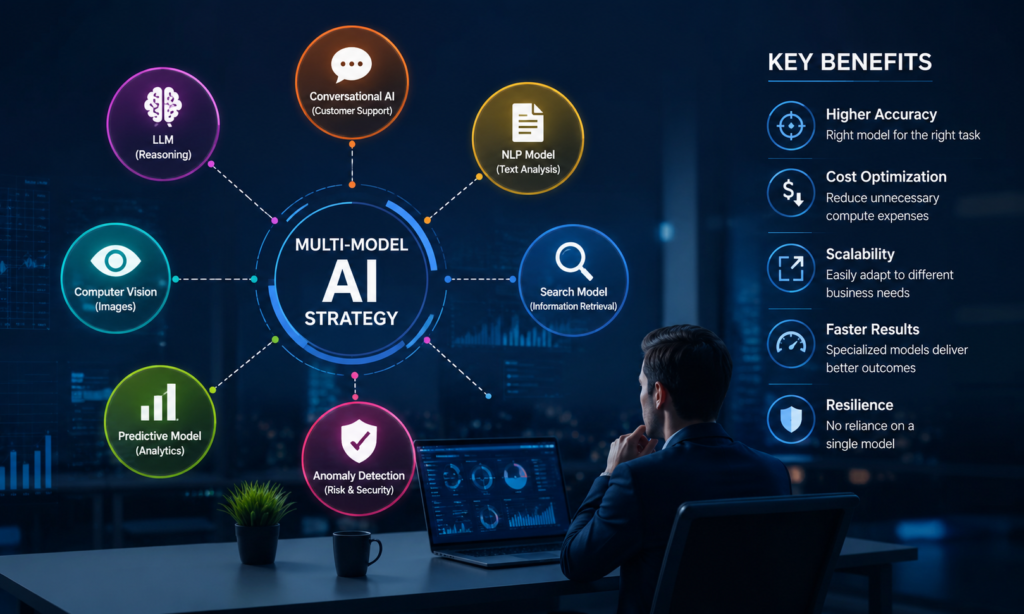
With ongoing investments in AI, multi-model AI is proving to be a viable approach in finding a balance between performance and cost. Rather than using a single AI system, companies can assign certain tasks to the right AI system, which will enhance the efficiency in different departments. This way, you prevent unnecessary expenses on AI, while also producing quality results. It also allows for quicker workflows, enhanced data security and scalability with the increasing adoption of AI. Multiple AI models allow businesses to be more innovative, while staying within the budget of their technology.
Why Multi-Model AI Will Shape the Future of Enterprise Innovation
The shift of Enterprise AI is towards a more flexible future, rather than relying on a single provider. Businesses have a wide variety of options to optimise their operations with new AI models with specialized capabilities being launched on a regular basis. AI models will rapidly evolve in response to market shifts and new technologies if they are a hybrid of cloud AI, private AI and open-source. Not only does this help to reduce costs over the years but it also helps to boost the resilience of business, boost innovation and establish a sustainable ecosystem for AI development and future growth.
Conclusion
As businesses increasingly leverage AI in their operations, it has emerged as a key priority for 2026.With the widespread adoption of AI in 2026, enterprises are making it a priority to optimize their costs. Using several AI models rather than relying on a single platform can help businesses reduce expenses, enhance its performance, bolster its security, and enable more flexibility in its operations. With the advancement of AI technology, multi model AI is likely to be the default model that will be used by organizations that want sustainable and scalable AI.
Frequently Asked Questions (FAQs)
Q1. What is multi-model AI?
Businesses are beginning to utilize a multi-model AI approach which involves deploying multiple AI models for various jobs to boost the overall performance and minimize expenses.
Q2. Why is there a shift to multi-model AI by enterprises for 2026?
Multi-model AI is becoming a growing preference for enterprises as it helps them cut down costs, boost efficiency, enhance their security measures, and not be dependent on any AI solution provider.
Q3. In what way is multi-model AI a way of lowering the cost of AI?
It helps to offload low-level tasks to cost-effective AI models, and only uses high-end models for more sophisticated tasks, thereby cutting down on AI expenses.
Q4. What are the top industries that can gain from the use of multi-model AI?
The sectors that gain the most are: Healthcare, banking, retail, manufacturing, legal services and software development.
Q5. Could multi-model AI be the enterprise AI of the future?
Yes. Multi-model AI systems are more scalable, flexible and cost-effective, and are the preferred approach to AI systems for modern businesses.