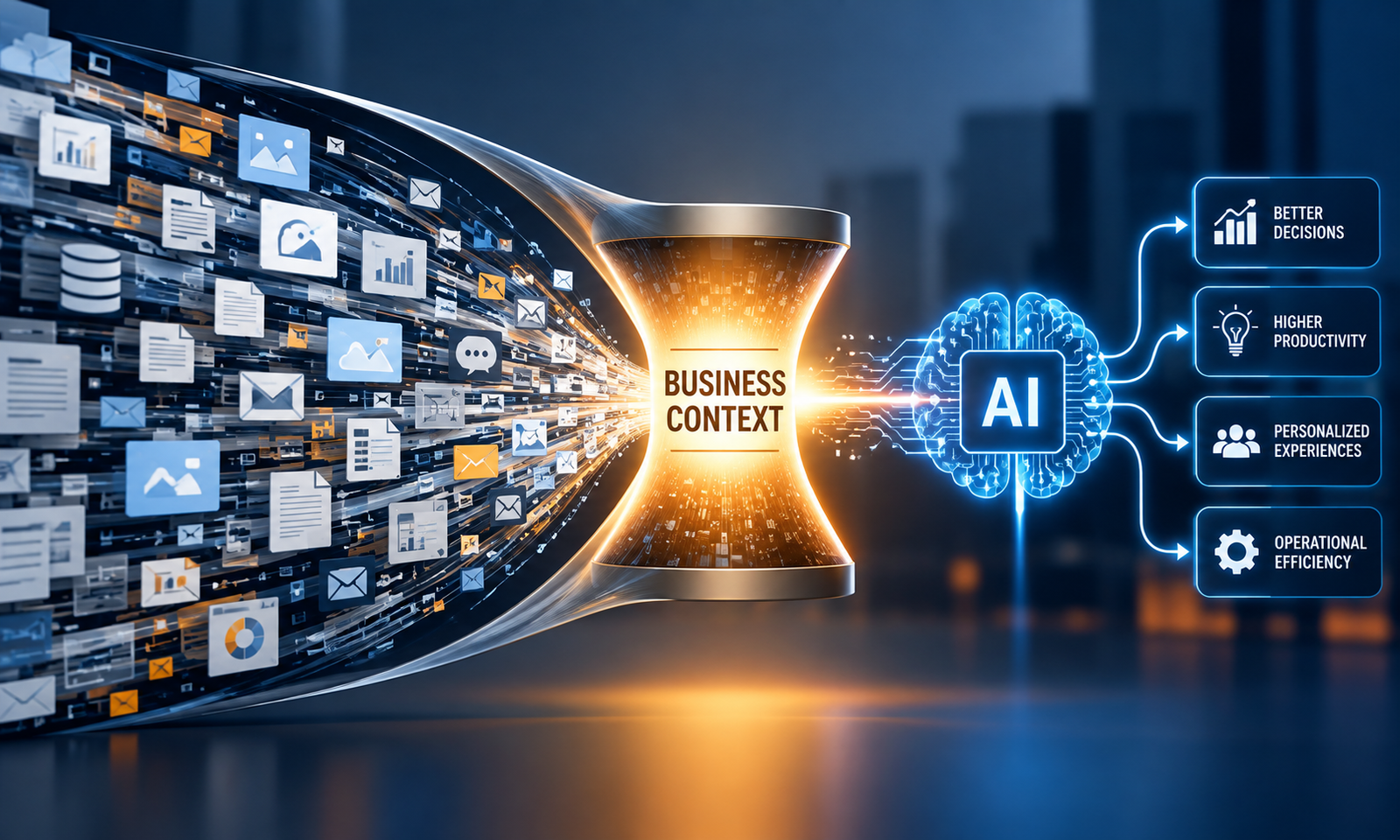
Building more powerful models of AI for years has been the focus of AI development. The big models, the reasoning they provide, the context window they offer, multi modality, and the performance on benchmarks were the new metrics for AI advances. The same was true of businesses – they tended to think that the more sophisticated the model, the more successful it would be.
This may not be a safe assumption in the future. AI models of today can even create content, analyze documents, write code, create document summaries, and handle complex workflow. However, the systems are often found to be less effective at providing insight where it is required to have understanding of a particular circumstance within the business side. But it’s not always model intelligence that’s becoming the problem. Now, it’s more about access to business context – in the truest sense of the word.More and more, it’s about access to the business context – in the truest sense of the word.
Model Intelligence Is Meeting the Business Context Gap
The aim of foundation models is to comprehend the general patterns in language, data and general knowledge. They are able to describe the typical way of functioning of the customer service, financial, sales, logistics, or software development. However, they are not necessarily familiar with the way that an organization works, for a given organization.
A model may have the knowledge of the refund policies, but lack the knowledge of the latest policies of a company. It could be able to make a sales recommendation without being aware of what the customer’s had said in the past or what contract they currently have, the area that they are in, pricing, or what products are available. The answer might seem smart’ but be logically incorrect.
General Knowledge will not substitute Internal Knowledge
When it comes to the use of AI in the everyday world of business, this distinction is crucial. Private, constantly evolving, and scattered information is vital to organizations. There are a lot of things to consider and this is directly related to the answers of the customers, the terms used internally, the details of the product, policies, approval process and past decisions.
Business Context has Several Critical Layers
It’s more challenging to add business context than to upload a couple of documents. There are various types of enterprise information, such as across CRM platforms, ERP systems, internal databases, cloud storage, support software, project tools, emails, analytics platforms, and knowledge bases. Requires various sets of this information for different tasks.
The most important context may include:
- Customer history and recent interactions
- Details of the products and prices are available.
- Improve procedures, policies and processes
- Employee roles and access permissions
- Real-time transaction and action information.
Context Quality is as important as Volume.
Longer context windows means that the models are able to process more information, but this does not mean that they are reliable. A larger context window just provides the AI system with more dubious information to work with if the documentation it gets is out of date, there are duplicate documents, irrelevant files, and conflicting policies.
It is thus important for businesses to consider the context in terms of what actually matters, how recent or old it is, who it’s from, and how accurate it is. Sometimes a half dozen documents with the right content can be more useful than hundreds of documents with related content.
Retrieval is becoming a key aspect of enterprise AI.
With AI integrated with businesses’ knowledge, accessing the right information becomes another technical challenge. For large organisations, your million records and documents could be in various systems. AI will not be able to analyze all that for any employee’s question.
Retrieval-augmented generation (RAG) is one solution that can help tackle this issue. The retrieval system is used to search approved information sources, locate information that is relevant and return it to the model, which then generates a response. This enables AI to integrate with overall business understanding and the latest information.
Information must arrive at the right time.
When you think of a customer-support assistant, the request for a warranty comes to mind. May require customer purchase history, product model, current warranty policy, customer-support history and exceptions to the policy. A sales associate who is working with the same customer might require pricing, inventory, contract details, and discussions with customers recently.
Permissions Are Becoming Part of Context Engineering
Examples of enterprise context might include internal strategy, financial information, employee data, contracts, customer data (confidential), and other proprietary knowledge. Access to business data can create significant permissions and access issues with introducing an AI system.
The system should be able to recognize which information is pertinent and which information is not permitted for the requesting employee or application. When AI is another means of accessing information, the boundaries of the existing organizations should be preserved.
AI Agents Make Access Control More Important
This is even more important when it comes to AI agents. Different from normal chat bots, agents can make changes to the records, create quotations, finish requests, take care of workflows, or interact with other software systems.
An agent must be aware of what they can do, when they need to seek approval, where they have authoritative information and when there is a need for a person to get involved. Business context is thus a combination of rules, permissions, as well as raw data.
Context Engineering Is Growing beyond Prompt Engineering
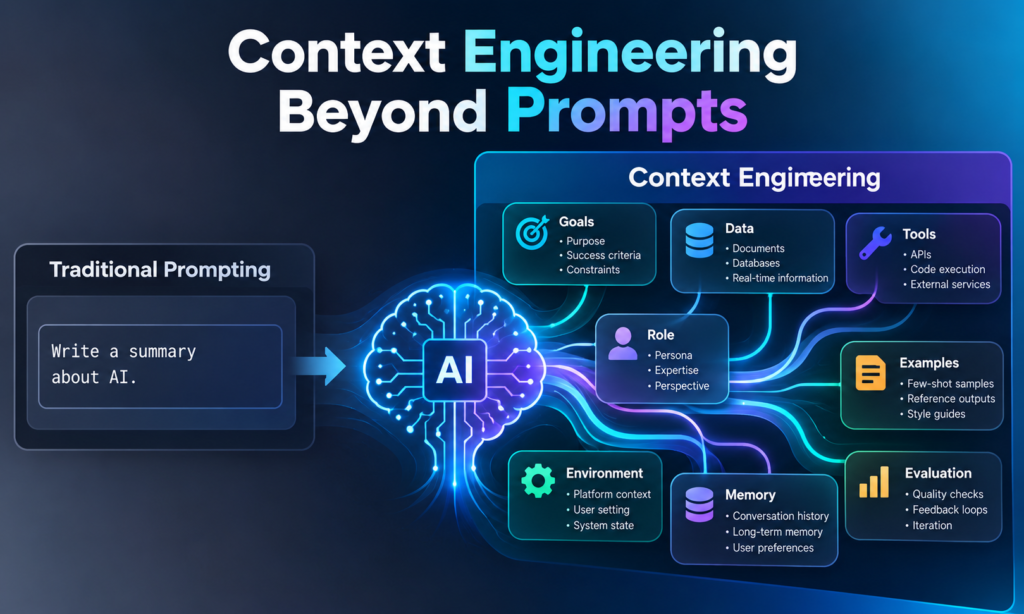
Prompt engineering is about creating effective prompts for AI models. Context engineering which takes into account the broader information context of those instructions. It includes identifying the information to be retrieved, the source of the information, ranking the information and giving the user permission to access the information.
Enterprise search, vector databases, APIs, metadata, knowledge graphs, retrieval pipelines, access controls, and data governance are among the context architectures that can be found in the modern world. These components serve to “encode” the knowledge captured from the information from the various organizations into a knowledge that can be used by AI at the right time.
Conclusion
The AI challenge has become more than simply the capability of the model, it’s becoming a business context. While the current capabilities of advanced models already allow for impressive reasoning, generation and analytical capabilities, they are not of particularly high operational value if the model is not familiar with the organization around the task.
Retrieval, data quality, permissions, information architecture and engineering of context will then be more and more vital to enterprise AI development. Those businesses that can consistently feed AI with correct, up-to-date, relevant and authorised information can be more likely to develop AI systems that are more useful and perform better in how they represent the way their businesses work.
FAQs
1. What does business context mean in AI?
Business context contains information about the business including that pertaining to customers, products, policies, workflows, permissions, operational information and more.
2. How can advanced AI models be insufficient for businesses?
Models may possess good general reasoning skills but they may not possess up-to-date company-specific knowledge, needed for making good operational decisions.
3. How does RAG improve business AI?
RAG fetches information from the sources approved by the model and gives it to the model before generating an answer.
4. What is context engineering?
To collect, sort, analyze, protect and provide task-specific information to AI models is known as context engineering.