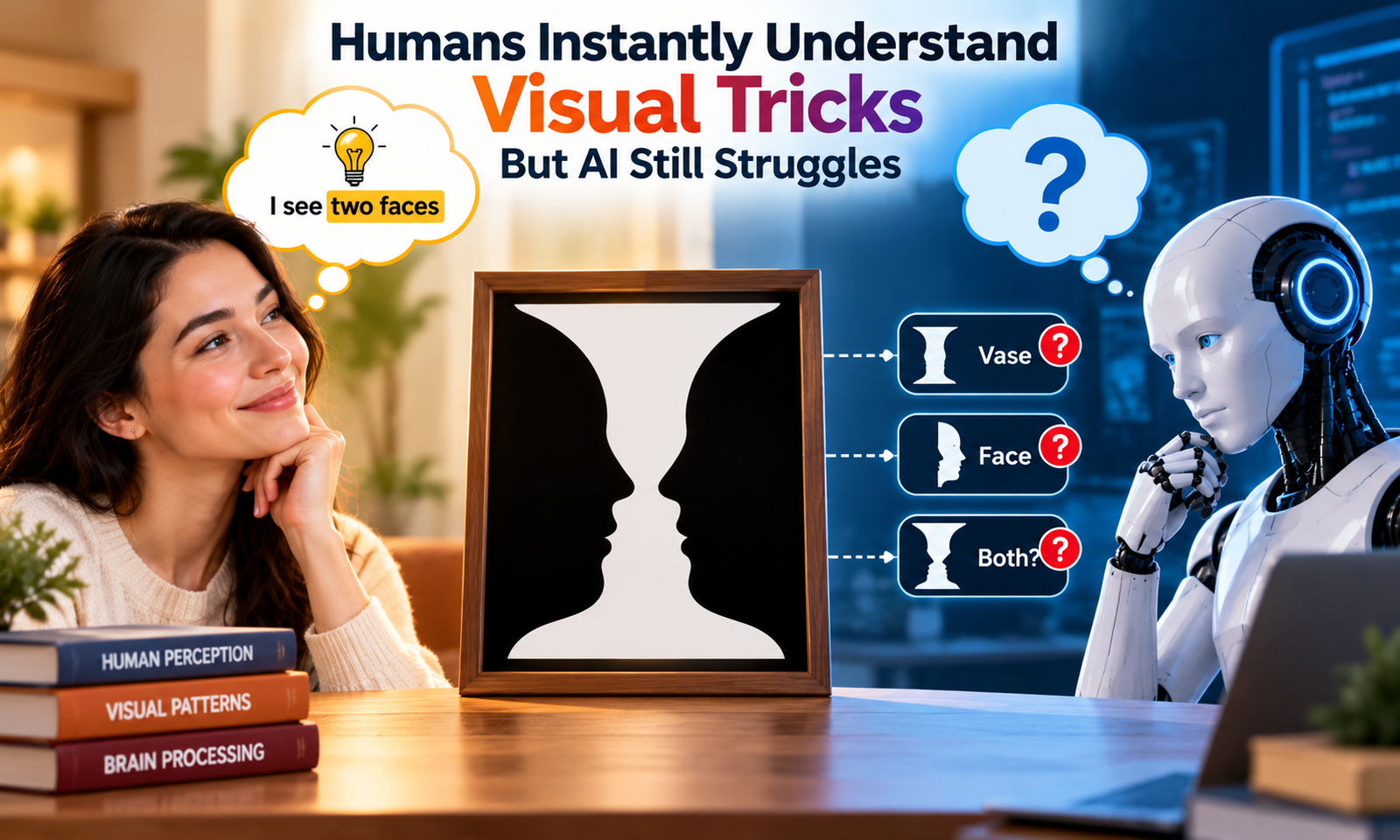
Artificial intelligence technology can identify objects, faces and text and more complex scenes with accuracy. But automatics make it easy for humans to understand visual situations, and still aren’t understood by machines. AI may have trouble distinguishing between the same shape or object if it is viewed from an unusual angle, obscured, or in a different context, such as a different background or lighting.Changes to the angle, partial obstruction, reflections, shadows or different context (background/lighting) can alter how the AI recognizes the same shape or object.
Learning vision is an ongoing process of observation, motion and physical experience for humans. AI principally gets patterns from the training data. This distinction can also account for why computer vision can achieve great accuracy on the one hand, but fail on the other when presented with familiar objects in an unfamiliar manner.
Human Vision Learns Which Changes Matter
Variation is a process that is always dealt with by humans. Objects in distance are smaller, in the shadows darker, partially concealed in other people and are differently shaped from different angles. These changes are typically known as changes in form and are not considered to change the object.
There are some automatic skills that aid this process:
- Recognizing objects from unfamiliar viewing angles
- Completing objects when important sections are hidden
- Differentiating shadows from actual physical objects
- Recognize reflections without assuming any duplicate objects.
- Assisting with visual uncertainty due to context clues.
Perspective Changes’ appearance, not identity.
The cup, when viewed from above, may be almost circular in shape, and when viewed from the side, may show its body and handle. Humans know that it’s the perspective that has changed, not the object.
AI is given a variety of visual elements from each view. If there are very few people in the training who have alternative perspectives, then it may not be a meaningful measure of recognition. Researchers are thus interested in developing models that reflect the identity of the object in spite of modifications in camera position, rotation and distance.
Occlusion Transforms Vision in Prediction
Overlapping objects are present in the environment that is experienced by humans during their everyday activities. Cars obscure other cars, furniture obscures household objects and people are obstructed by walls. Humans typically extrapolate that the unseen parts of an object extend beyond the obstruction.Humans assume that the rest of the object goes over, under, behind, etc. the obstructing object.
AI needs to be able to identify objects based on some limited information. If only an unusual fragment is visible, there could be a number of possible interpretations. Improved spatial reasoning (perception) may facilitate the integration of visible fragments and possible shapes and context.
Machine Vision can be misled by Visual Shortcuts
Not all of the patterns that can be seen are the shape of an object. Signals such as lighting, reflections, textures and backgrounds can yield powerful signals which become recognition shortcuts. These shortcuts will work with images that are familiar, but won’t work if the image changes.
Common sources of visual confusion are:
- Shadows that cast edges that look like physical edges.
- Reflections and making convincing copies of nearby objects
- Textures becoming stronger clues than underlying shapes
- Association of backgrounds to special object categories
- Lighting changes that affect the familiar colors and surface details.
Shadows Make no sense of reality.
Shadows can separate one continuous surface into different sections which seem to be separate surfaces. These changes are normally interpreted by humans by using direction of the light source, object position and past experience.
AI might sometimes consider deep shadows as a significant part of an object’s characteristics. Well, during training, the lighting conditions can be different to make them more robust, but it is still difficult to combine them with an outdoor environment, or with a combination of artificial lights.
Reflections Can Make One Object Look Like Two
Reflective surfaces like windows, water, shiny floors and metal objects reflect without adding anything to the scene. The human senses of depth, surface properties and the context of the environment are used to understand this effect.
AI will have to decide whether the analogous visual patterns are of different objects or reflections. It is more difficult if there are reflective elements that are distorted, faint or obscured.
Context Gives Humans Additional Visual Evidence
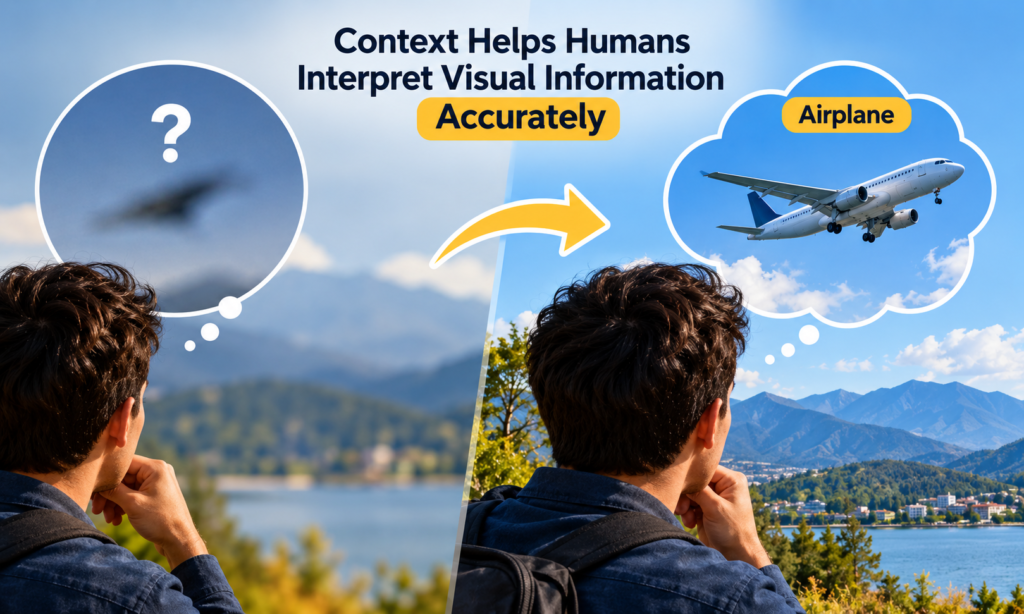
It is extremely uncommon to be able to recognize objects by just shape. Surroundings give hints to the probable size, location, purpose and type of an object. Different meanings can be elicited from the same visual shape depending on its context.
Contextual information is also becoming more and more imperative to AI. But, context can become a short cut when a model is consistently used with a particular background. Then, the moving of this object to an unknown environment could decrease recognition reliability.
Texture Can Distract AI From Shape
Patterns on the surface offer helpful hints, but can be deceptive. There are no specific textures which are seen with a certain category more than once, so that the models may be more dependent than expected on these textures.
Overall geometry is often preserved when the colour, material and/or texture of an object is altered, so that the object can be recognised by the human visual system. Training with wider variations may have the effect of promoting the importance of structural information that is preserved under surface variations.
Motion Reveals Information Static Images Hide
A picture depicts one moment of time, and video depicts objects rotating, moving, disappearing and reappearing. The transitions of evidence are related to continuity and relationships in space.
Humans would assume the ball coming out of the box is the same ball if it was still in the box when it came out.If a ball was in the box and came out again, a human would expect that to be the same ball. Video training can enable AI to recognize the changes in visuals over time, rather than considering each shot as a completely different visual.
Increase Visual Intelligence Stability Building
Just adding in more similar photographs to datasets isn’t enough to improve computer vision. AI requires exposure to a variety of viewpoints, lighting, textures, background and physical set-up.
There is a possibility to link different views from the cameras to the same scene in three dimensional representations. A video will give a temporal continuity and a simulation can systematically create rare visual situations. These methods could be useful in helping models to differentiate between the stable properties of objects and the changing appearance.
Conclusion
While AI vision has developed significantly, human vision can’t be limited to processing the visual pixels. All of these elements (context, geometry, motion, physical expectations, object continuity, and accumulated experience) are all involved in interpreting scenes.
To address this disconnect, new opportunities for more enriched learning experiences and the representation of space, time and physical relationships are needed. To go beyond that familiar ability to correlate familiar images and into a new realm of understanding objects with the same consistency when conditions vary, video, 3D learning, simulation and multimodal systems or robotics could prove useful.
FAQs
1.How can something be so simple that it can fool AI?
Humans use visual information, context, spatial knowledge, experience, and expectations about how an object will behave in combination to learn the statistical regularities from training examples, whereas the AI system relies on the visual information for learning.
2.Why are unusual viewing angles difficult for AI?
The visible features can be significantly altered due to different perspectives. To link different appearances to the same object, AI must be trained with a variety of examples and have enhanced structural representations.
3.Why are partially hidden objects difficult?
Occlusion blurs information that is beneficial for vision. AI has to deduce who is who from the available image parts, the context of the image and its known form.
4.Can the video enhance the visual understanding of AI?
Yes. Video offers motion, continuity, varying perspectives and interactions which facilitate linking of models in terms of their visual likeness over time.
5.How can machine vision become more reliable?
Multiple training, video, 3D visualization, simulations, robotics and more robust assessment techniques can aid in providing AI with more accurate visual and spatial reasoning.