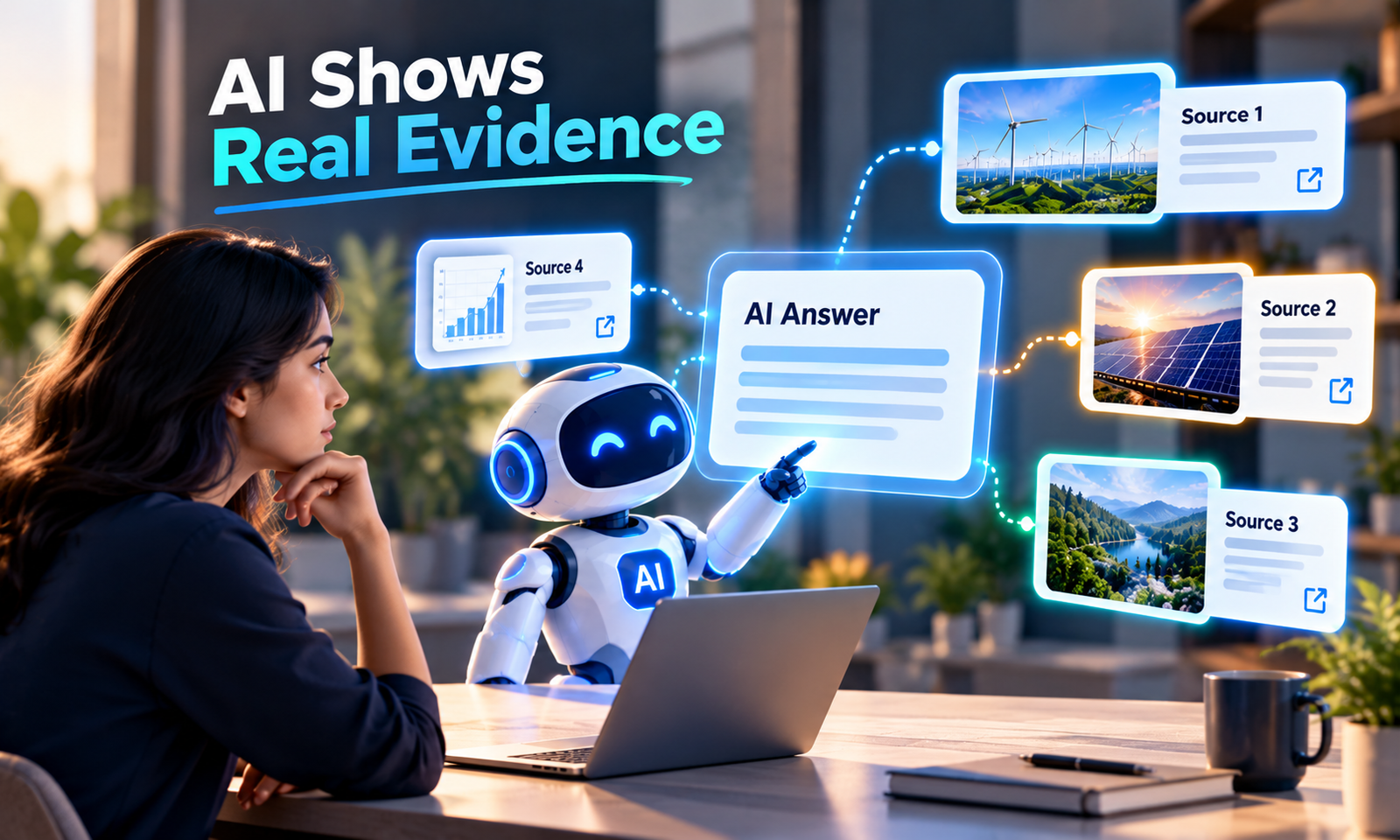
Yes, AI can provide in-depth responses in just a few seconds, but ensure that the language is confident, and remember that it’s not reliable information. Users often are given a nicely crafted answer without being aware of the documents, a quotation, a record or a dataset that informed the answer. Even citing can refer to a whole page instead of it being the actual evidence for a particular statement.
This could be different if it was done in a more transparent fashion. AI systems even have the potential to link key claims straight to the underlying material, identify factual statements in sources and those generated by the AI, detect disagreements between sources, and draw out statements lacking in evidence. Users would be able to look at the underlying of an answer before accepting it, rather than just believing the answer, if it seemed convincing.
Evidence May Become a Part of the Answer.
The focus of most of the AI interfaces is the final output with secondary to material. Future systems might be designed to allow evidence to be placed next to significant claims to enable verification to be a part of everyday experience.
- Claims might make reference to the supporting passages.
- Dates may indicate possibly stale evidence.
- Primary sources could be clearly distinguished.
- Competing information might be on display.
- Unsupported claims may include uncertainty indicators.
Claim-Level Evidence might enhance citations
Traditional citations reference a source but not necessarily which section(s) are being cited. Even if a link is provided to a lengthy research paper or company report, there may still be a lot of work to be done by the user checking the contents of the report.
Evidence from the claim could link each claim to specific paragraphs, tables, statistics or records. For instance, if the AI gave a company’s quarterly revenue, users would be able to quickly glance at the part of the financial filing that includes that amount of revenue. This will make it easier to see the factual basis of the generated answer.
Evidence Could Appear Before the Conclusion
AI might even provide relevant additional details prior to providing a final result. The research system could include relevant documents, key quotes, publication dates and where there are differences and consensus within the sources.
This would be particularly helpful if the information is not complete or when there is some change in information. Users would be able to see the evidence presented, and decide if the AI’s conclusions are in line with the evidence.
Facts and AI Interpretation Need Separation
There’s more to AI than just providing information. It is comparing/contrasting, identifying relationships, summarising and drawing conclusions. These interpretations may be valid, even if not stated by any source(s).
Made inferences should be labeled.
New interfaces might be able to differentiate between the facts that are directly supported and those that are conclusions drawn from the model. For a factual statement a connection may be to a single source but for an analytical conclusion it may be to several pieces of evidence that are developed to form the conclusion.
For instance, you could have a report on falling sales, falling prices and less demand. AI might be able to deduce that a downturn in the market is taking place. It would be misleading to call it an inference, since users would mistakenly think that it is information that has been directly documented when it is really analysis.
Source Disagreement should be displayed
Often there are conflicting sources to draw on. Research studies can provide different conclusions, forecasts make use of different presumptions and initial reports on major events may have conflicting figures.
Rather than have to put all those differences into one “right” answer, AI could present both sides of the argument with the supporting evidence. Their disagreement would allow the users to have a more realistic perception of uncertainty if it was saved.
Evidence quality may be assessed with claims.
It is only when users are able to assess the relevance and quality of sources as to use them, that it is useful to display sources. AI may be able to give contextual indications for the weight to be given to specific evidence.
- The publication dates may reveal dated information.
- Importance given to original records might be increased.
- Confidence could be bolstered with independent agreement.
- Evidence relevance could be assessed per claim.
- Without support, this might reduce certainty displayed.
Strongest Source is dependent on context

The evidence that is best will be different for each question. For a company you might want to use an official financial filing as evidence for a company’s revenue while for a scientific finding you may want to use peer-reviewed research. Government records might be more appropriate for information for regulatory purposes.
AI might then be able to prioritize relevance, authority, originality, context as well as popularity and more than just that. This would make ensuring evidence selection to ensure it is appropriate for the type of claim being assessed a little easier.
Unsupported Claims Could Be Checked Automatically
There could be an additional verification layer to follow after AI has generated the initial response. The system would be able to detect the factually critical claims and compare every claim to the evidence available.
Supportive statements that have strong support may not be changed. Some of the claims may be partially supported and some may be unsupported which may be removed or flagged. This process would NOT remove ALL hallucinations, but would help to decrease the likelihood of weak information presenting itself with undue confidence.
Conclusion
The ability of trustworthy AI to simply make evidence apparent as opposed to more confident responses might be more important. AI responses might be more readily evaluated due to claim-level support, source disagreements (often visible), clear separation of fact and inference, source ranking (taking into account context), and ensuring that there are no statements unsupported by the sources.
Users still would have to use their judgment, especially in case of making critical decisions. But they would have a direct link from one of the generated claims to the information that is used to support the claim. AI might then go beyond a request for trust, and offer evidence to gain it.
FAQs
1. What is AI evidence transparency?
It is the presentation of information to users that backs claims generated by AI that is important.
2. What is the difference between claim level evidence and citations?
It makes a linkage between a single sentence and a given supporting information.
3. Will AI hallucinations be prevented by evidence visibility?
Not entirely, but only to a larger extent may claims be made easier to spot.
4. Can AI display conflicting evidence?
Yes. It can demonstrate to some degree disagreement, rather than false assurance.
5. Should verification of humans remain?
Yes. Visible evidence is a quick way to prove, but cannot be a substitute for human judgment.