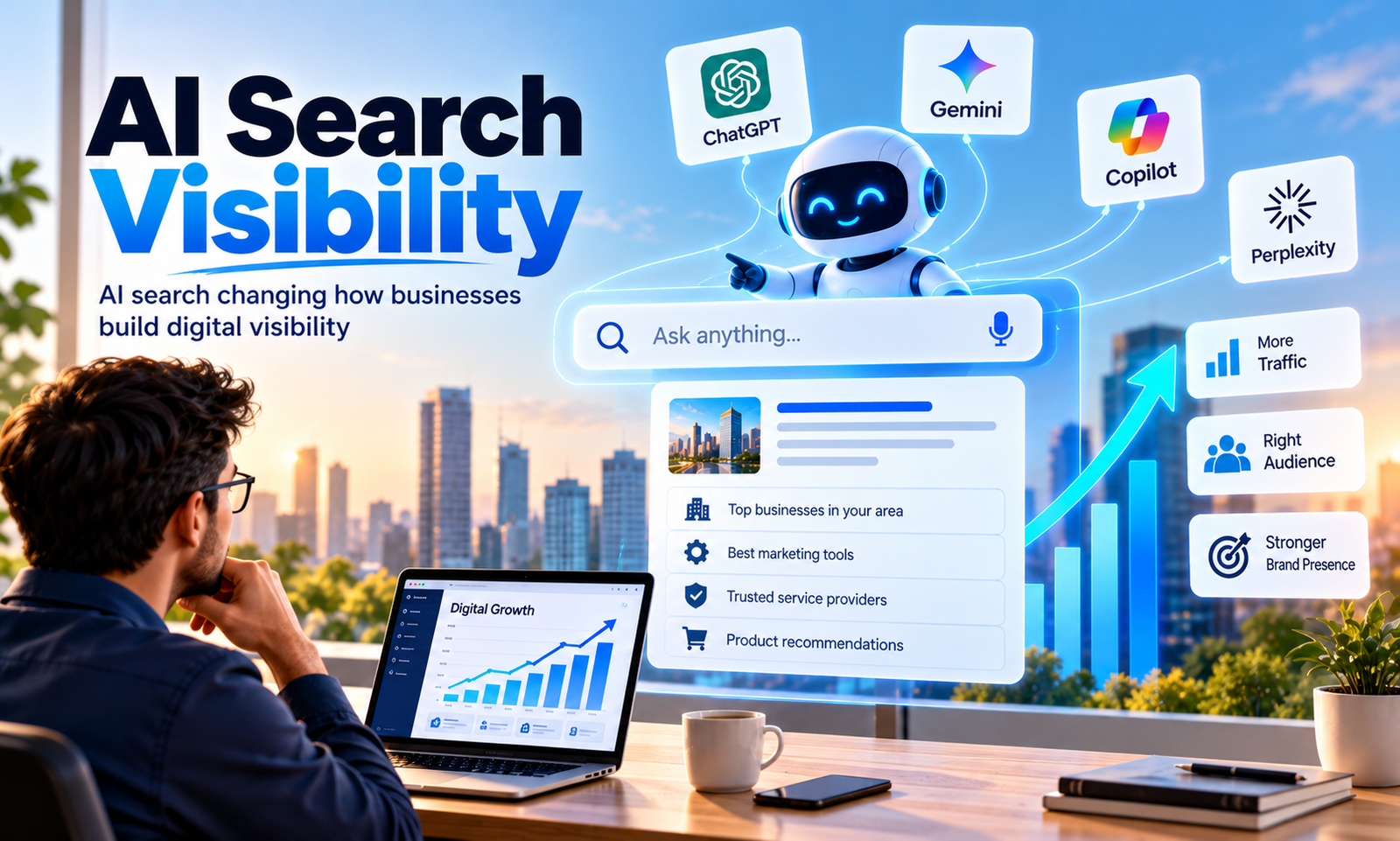
Search is changing the way that it appears on a list of blue links. With the power of AI, search experiences can now understand questions, synthesize data from various sources, provide summaries and even facilitate guided topic exploration by having conversations. This is shifting the thinking of businesses with regard to digital visibility.
In the past, it was primarily a webpage ranking strategy to get increased visibility in search results.In the past, ranking webpages per the keywords was a major way of getting increased visibility in search engines. But it’s not just businesses that need to make their information accessible, accurate, and helpful; it’s also businesses that need to be found in the answers and conversations generated by AI today. But it doesn’t mean that traditional SEO is not relevant. Rather, it broadens up the definition of visibility.
From Keyword Rankings to Being Part of the Answer
There is a growing competition for businesses to be visible in the various discovery methods such as search results, AI-generated summaries, conversational interfaces, and more. The focus is shifting to information that is clear and directly relevant to users’ needs and that can be comprehended in context.
- Relevancy has become a more important part of search visibility than single keywords.
- Clear information enables AI systems to understand business knowledge and context.
- Clear source signals can assist visibility in both traditional and AI-fueled discovery.
- The comprehensive content provides search systems with added context to topics.
- Having the same information on all digital channels can help support overall discoverability.
It is more important to consider user intent than exact queries.
The traditional approach to keyword research is normally geared toward discovering phrases with a search volume. With long, query-like questions, the intent behind the question is more important than an exact match of keywords, AI search can understand it.When users ask longer questions that embody a certain intent, AI search can understand that intent rather than an exact match of keywords.
For businesses, it’s about creating content that’s able to respond to the questions that customers have before, during and after they make a business decision. A software page can contain other words and phrases in addition to one single keyword, such as; use cases, compatibility, setup, limitations, common questions, etc.
Context Gives Content Greater Search Value
It is important for AI systems to have context in order to grasp the relationships between specific facts and the subject matter in general. If a page has only one or two keywords, it is unlikely to be as useful as if it contained several keywords and focused on a topic from a number of relevant perspectives.
This context can be reinforced through linking similar pages, providing explanations of key terms, clarifying processes and providing consistent information. This will help to build a more comprehensible digital “knowledge base” of the brand and its specialties.
Original Information Can Enhance Digital Visibility
With the rise in AI-driven answers, the original information can serve as a crucial means for companies to offer distinctive worth. Observations, expertise, original data and articles, customer feedback, case studies and other sources of content can provide information that is hard to find elsewhere.
This also aids in the distinction of a business from pages that just summarize information that’s currently available online. The original material can provide more information for search systems to use to reference their answers for specific questions.
Creating content that performs well in search experiences.
However, businesses must go beyond creating SEO articles and consider the next level of visibility – digital. Content must function within an integrated information environment to service a growing more complex search engine, as well as humans.
- Important information is easier to find and comprehend on structured pages.
- Content that’s written by an expert can build topical authority over time.
- The information is updated regularly to ensure accuracy in view of subject change.
- The effective use of factual language minimises confusion of products and services.
- Connected content streams out further from key business subjects.
Structure Helps Machines Interpret Important Information
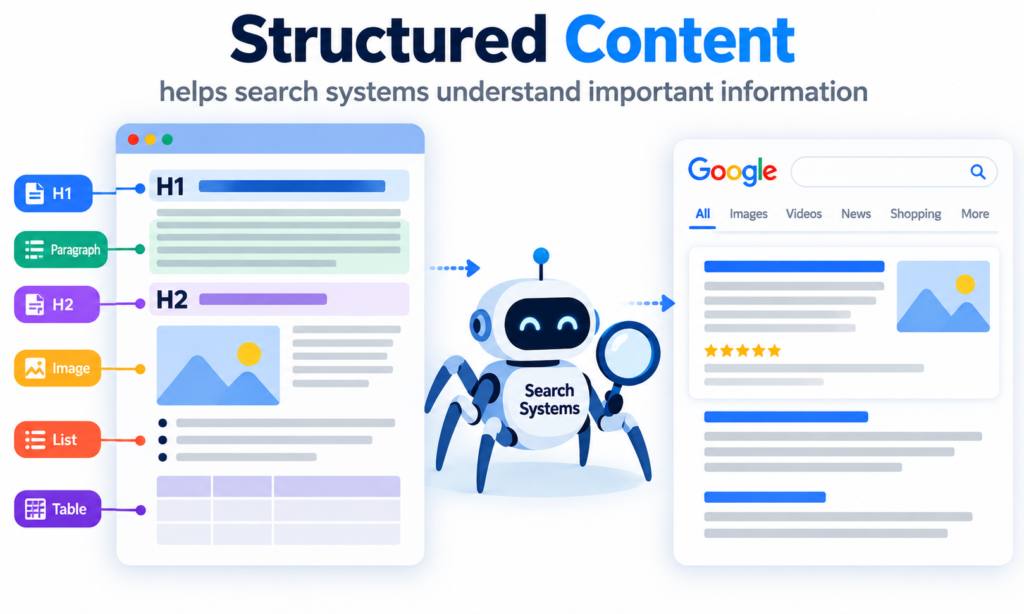
Headings, descriptive sections, explanations, lists, tables (where applicable) and page layout are neat and organized, making content easier for readers to understand and easier for search technology to do the same.
Important facts should be easily accessible and not hidden within the long promotions. When necessary, the information should be clearly and consistently presented including pricing conditions, product specifications, service areas, policies, processes and qualifications.
Expertise is based upon evidence.
Just stating that you know a lot does not mean that you do. Author information, trustworthy references, explanations, original research, experience and supporting information are methods that businesses can use to convey expertise.
This is especially relevant when users should know the facts, especially when making a decision, in a subject. Your content should aim to appeal to the reader’s emotions—it should make him or her feel, understand, and appreciate an issue, rather than just trying to convince him or her to make a choice about a business.
Digital Visibility is getting more distributed.
Now, a business can be found in one of these ways: in a traditional search result, an artificial intelligence summary, a question to the business, a review from a customer, an article from an industry publication, or a business’s information being mentioned by other websites. The link is less reliant on only one page, hence visibility is becoming less of a one-page affair.
That’s why it is more important than ever to be consistent digitally. Relevant online properties should have accurate names and descriptions of businesses, their expertise and products/services, and other facts. The wider and more secure digital image provides more context for the users and search systems.
Conclusion
AI search is morphing digital visibility from a narrow focus on ranking for keywords, to providing a useful and understandable source of information. While businesses are always going to require basic SEO skills, they must also have structural clarity, context, original content, expertise and digital consistency.
The best way to do this is to develop engaging content that meets the needs of its audience, and also easy to be understood by contemporary search engines. With a growing trend towards “conversational search” and answers, businesses that develop valuable information ecosystems can find more opportunities to be found in various kinds of search experiences.
FAQs
1. How is AI search different from traditional search?
AI search can derive meaning from questions that are in a conversational format, gather information from a variety of sources, and deliver a synthesized answer. In the traditional search, the user is generally given a list of Web pages to explore, in a rank-ordered list.
2. Will AI search replace the need for SEO?
No, traditional SEO is still relevant as various other factors like crawlability, relevant content, technical performance, authority and search intent still affect the discoverability. AI search is an additional component in the entire search landscape.
3. What can be used to enhance AI search visibility?
Content that directly answers the question, offers context, shows expertise, additional information and is easily structured can be useful. So it’s not like the search interface shouldn’t matter for any search, accuracy and relevance are still important.
4. Why is original content important for businesses?
Information that is not easily reproduced can be gained from original research, insight of experts, the first-hand experiences, data and unique analyses. When you can get people to think of your content before they think of other content that’s available on a wide variety of sites, that can be a great way to get them to keep you in mind.