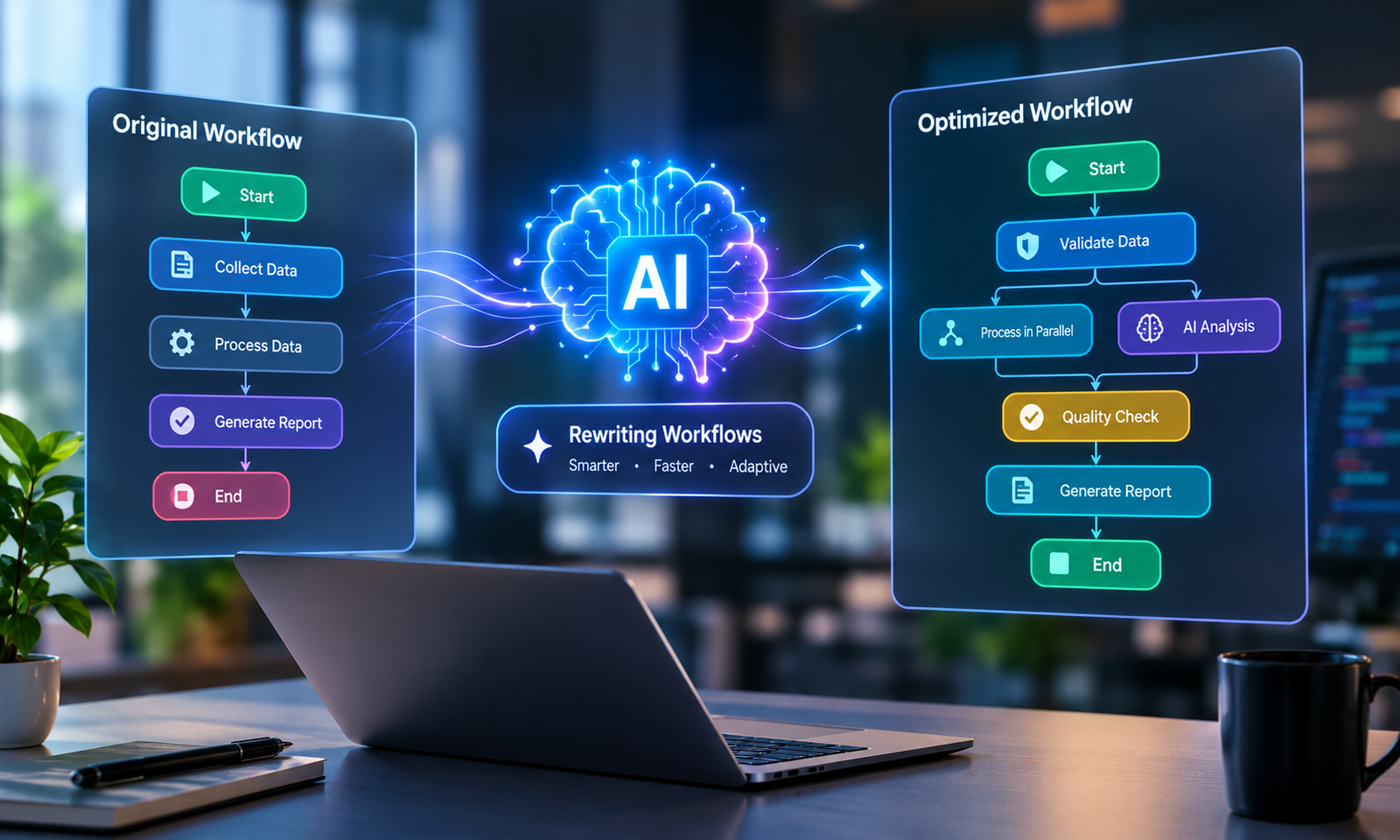
Traditionally, software has been developed along the lines of developers writing code, outlining the workflow, testing it, and then rolling it out to a finished system. If the business needs change, developers make the changes to the software and publish the new version. But as with many things, the introduction of artificial intelligence is threatening to upset this pattern by developing systems that are able to assess themselves and modify their working.
This change is making way for a new type of software, which doesn’t have workflows that are set in stone. On the contrary, AI systems can monitor the results, pinpoint inefficient parts of the processes, and rearrange the logic of these processes. This means that software has more of a life of its own and can be considered more of a digital system.
The software sector is getting beyond fixed instructions.
RULES are key to traditional applications. In the absence of manual redesign of the workflow steps, if the workflow needs 5 steps, they tend to stay the same. Another option is available with AI-powered systems: They can decide if these steps are still relevant.
Workflows are able to be adaptive.
An adaptive system of AI might review the activities that are undertaken and contrast what outcomes were achieved with the intended results. The system may be able to find an alternative sequence if there is a step that is constantly causing delays, extra costs, or bad results.
This isn’t always the case, but it does mean that the AI will be responsible for writing a portion of the application. More realistically, it may tweak the logic of workflows, alter which tasks the workflow routes to, alter the sequence of decisions, or suggest changes to the process, given certain permissions.
Making feedback a component of software design.
Feedback is now seen as an operational input as well as one that is gathered post deployment. Performance signals, user interactions, error patterns, and completion rates can be used to identify if a workflow is effective or not by using AI systems.
This forms a feedback loop that results in continual improvement. The system takes an action, assesses the resulting data, adapts to the information, and may modify the way that the next action will be executed.
Five Signals That Can Trigger Workflow Changes
AI-based workflow systems require solid metrics and indications before making any changes. These signals will help to identify if there is sufficient change in a process or if intervention is needed.
- Frequent errors may indicate a workflow that is not efficient and needs to be reviewed immediately.
- Any workflows may exhibit unneeded process steps that may result in longer completion time.
- Changing customer preferences can be identified in the way they interact with your business online.
- Increased operating expenses may be a result of improper assignment of tasks.
- Successful outcomes can be used to refine systems to work on the most effective workflow paths.
Self-Rewriting Is Not a Form of Unlimited Autonomy
It may seem like the term “self-rewriting software” is more sensational than the current software is. In many real-world scenarios, AI is constrained within the walls set by the developer, security, and business.
It may allow an AI system to shuffle in-house workflow steps around, but not alter financial authorization steps, for instance. A different system could try out different task sequences in a test system before any changes are made in production.
Five Areas Where Dynamic Workflows May Transform Software.
The most dramatic changes may be seen in the environments that have a high frequency of process changes. Software that would be able to adapt its workflow could decrease the amount of redesigning that is always done in a manual fashion.
- Customer support services can automatically adapt routing according to demand.
- Changing a purchase behavior can be incorporated into the e-commerce system, and the tasks can be reorganized.
- Logistics platforms can adapt the fulfillment processes in the event of unexpected disruptions.
- Performance feedback can be used to work out optimized repetitive processes with enterprise tools.
- Marketing systems can customize the course of events in the marketing campaigns based on the responses received.
Developers May Be Moving from Builders to System Designers
With more adaptive software, the amount of time that may be spent in manually coding each flow variation may be reduced. They increasingly may be responsible for creating boundaries, assessment systems, permissions, test areas, and feedback systems.
This gives rise to an alternate engineering problem. Developers need to be aware not only of the functionality of software but also of its safety to change in the future. Version control, serviceability, rollback capabilities, and testing and human approval can be even more critical.
Governance is incorporated into the architecture.
It’s important to have robust governance on a system that is able to change its own processes. Organizations need to understand what changed, why it had changed, what data will have been used to drive the change, and whether or not the change would have improved performance.
Hence, audit trails are now found to be very important. Ideal adjustments to meaningful work processes are traceable, measurable, and reversible. If these controllers weren’t there, an adaptive system might slowly converge to the wrong goal and seem like it was successful, as it appeared to be performing well.
The Transforming Shift is from Statics Software to Living Systems.
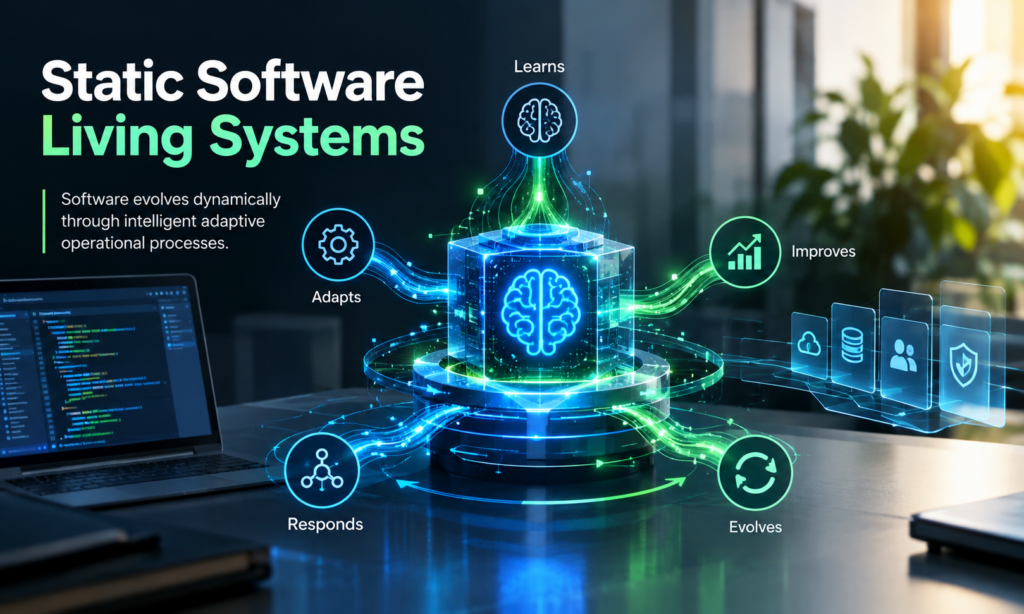
Conceptual change is a deeper type of change. Historically software is considered to be something that is designed by humans and then run by machines. AI brings in a system that machines can be a part of enhancing software.
This isn’t to say that traditional development is no longer used. It extends, however, the scope of software engineering. The next generation of the systems will be a blend of permanent structures and layers that can be adjusted by AI, which continuously learns from evidence.
Conclusion
AI is developing new software that allows for workflows to adapt and evolve, instead of being set in stone. Systems can evaluate performance, receive feedback, and adapt their processes and/or task organization accordingly.
The most crucial advancement is not software that continually evolves without any end. It is software, which can enhance its performance guided by a certain scope. With the increased capabilities of AI, the winning edge could be with companies that can quickly adapt to changes, ensure transparency and security, and have human oversight.
FAQs
1. How to use self-rewriting software?
Self-rewriting software is software that can adjust some aspects of their functioning or operation depending on feedback, performance, or changing conditions.
2. Can AI completely rewrite an application by itself?
Not necessarily. In most real-world systems, there are per-established permissions and restrictions that limit what processes AI can affect.
3. What’s different about adaptive software and automation?
In traditional automation, the process is automated according to certain rules. Adaptive software can assess and adapt how the tasks are carried out and/or the sequence in which they are performed.
4. Which is the reason for the importance of audit trails in adaptive AI systems?
The audit trail provides information to the organization on changes made, their reasons, and whether a change resulted in the desired outcome.
5. In an adaptive software world, will developers lose their roles?
While developers continue to be key, their roles may evolve to creating protection measures, assessment tools, access controls, building, and establishing dependable AI-driven enhancement processes.