
AI agents are now going beyond mere question answering and simple tasks. They are becoming more and more knowledgeable about products, comparing and contrasting their choices, understanding policies, making recommendations, initiating workflows, and making decisions for others. All of those activities can lead to a series of decisions that may never be apparent to a business.
This new type of activity is generating what can be described as “invisible decision trails.” They are often not evident in website analytics, CRM systems, or regular transaction data like sales orders, as they are in traditional customer journeys. The AI agent may consider dozens of signals before taking an action that can impact the business, and the business may only see the action.
The New Customer Journey is Taking Place between Machines.
Traditional digital analytics are geared towards visible interactions. Businesses would be able to track the number of page visits, searches, clicks, shopping cart abandonment, purchases, and customer-service conversations. Agentic systems add another layer in which software can do research and reasoning prior to a visible action of the customer.
Decision Signals May Fail to Appear Before Conversion
An AI agent could look at the pricing, delivery terms, product features, ratings, return policy, availability, and brand reputation. An AI agent can review the price, delivery terms, product features, ratings, return policy, availability, and brand reputation. It may only be the merchant that sees the final sale or referral.
This results in an information gap. The business understands what has occurred but is not necessarily aware as to the trigger(s) for what has occurred. Using traditional analytics, it could be a long time before you see that a product is consistently getting no recommendations due to its shipping information being unclear.
Agent Activity Creates A Different Kind Of Data
Business information can be carried by invisible decision trails that provide valuable information on how the automated system interprets business information. These trials can contain the data taken into consideration, the rules that were fired, the possibilities that were eliminated, the level of confidence, the permissions that were asked for, and the action(s) that were performed.
Businesses need to consider alternative methods of event tracking, however. Just the fact that a transaction was recorded does not contain the reason, as that could be crucial for troubleshooting and being held accountable.
Five Signals Businesses Should Start Capturing
With the increasing role of AI agents in commercial processes, it becomes crucial for organizations to gain actionable insights into their actions. The more AI agents engage with commercial processes, the more practical visibility organizations need into the actions of those agents. Recording of all internal model thoughts does not have to be included in tracking. Rather, we can concentrate on the observable events of the decision-making process, as well as on evidence of operations.
- Monitor and document actions, inputs, outputs, permissions, times, and results regularly.
- Relate automated decisions to business transactions and customer journeys.
- Keep evidence of what information impacted key actions by agents.
- Observe and track repeated agent behavior for occasional errors, oddities, and inconsistencies.
- Ensure that there is clear ownership in cases of automatic decision-making impacting customers, revenue, and compliance.
Observability must go beyond the Web.
Agent APIs, product feeds, payment services, customer-service platforms, and external data sources can obscure the whole picture using website analytics.
An observability layer that can tie together these different events may be needed for businesses. For instance, one system may provide a product data source, which could be compared with data from another source, and then an agent could ask for purchasing permission and then place an order.
The businesses need evidence and don’t need to collect everything.
You don’t have to store all the information available for visibility. Too much data collection can result in privacy, security, and compliance issues.
Selective logging is a better alternative. The companies can be able to discover the activities of their agents that can make a significant difference and document all the information they have to go back to investigate them in the future.
For instance, an organization could have a focus on determining whether a payment is accepted, the price of the product or service, whether a customer is eligible for it, or whether a refund is available, whether an account can be opened or closed, or whether a process is regulated. Less intensive monitoring can be given to lower-risk activities.
Five Operational Changes for Making Agent Trails Visible
Traceability isn’t a matter of just putting another analytics tool into place. Business processes should be in place that link technology, governance, security, and business operations.
- Put in place responsible decision makers for automated decisions for each and every critical workflow.
- Develop consistent event IDs for agents, systems, actions, and results.
- Establish operational risk-based decision record retention rules.
- The test agent periodically logs to maintain the ability to reconstruct important events.
- Regularly review automated decision trails during incidents/disputes, audits, and investigations.
Decision trails can enhance agent performance.
There’s more to visibility than just meeting standards. It can also be used to enhance the performance of automatic systems.
Imagine that a product feed from a retailer lacks information about delivery, so an agent working for an e-commerce company always suggests alternatives. Assume that all the time an agent working for an e-commerce company suggests alternatives because of an absence of delivery information in the product feed from a retailer. Using a decision trail can help to identify exactly what information gap this is.
Similarly, when some requests are continually escalated by a support agent, a business can look at its policies to see if they are unclear or check if the support player does not have the context he needs.
Governance is put into action with traceability.
As agents are allowed to undertake more and more significant work, businesses will require proof that this work took place in acceptable (and potentially controlled) limits.
A record with a traceable will help answer practical questions: What is the role of the agent? From what system did you get the information? What do you think was the permission that was given for this action? What happened afterward? Has the action worked?
The Competitive Advantage of Knowing What Agents Do
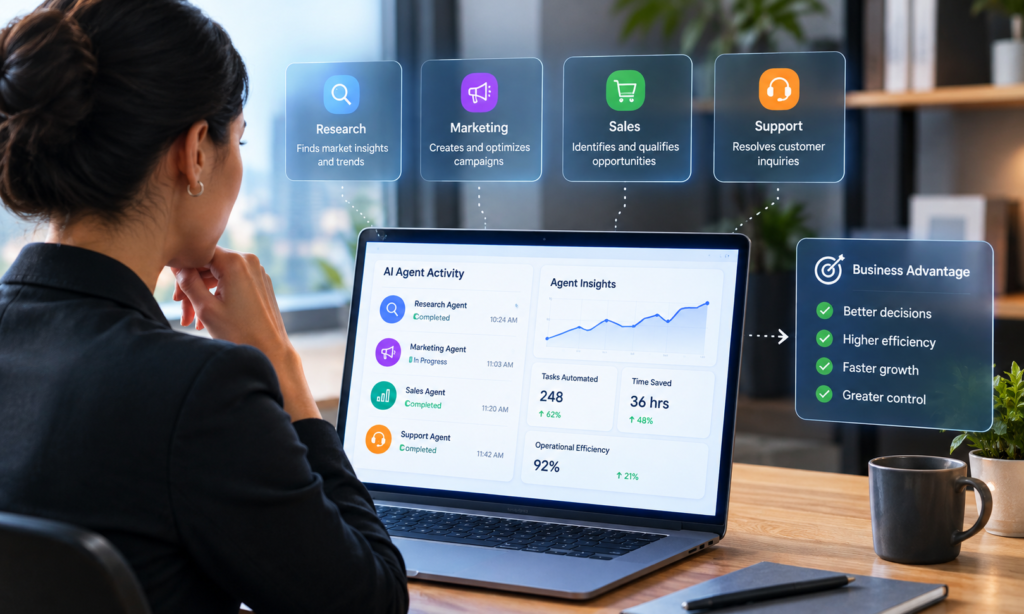
Businesses that are aware of invisible decision trails may be ahead of the businesses using agents as mere automation.
Agent visibility can help uncover locations for product information gaps, workflow bottlenecks, friction points for customers, and where the automated systems are repeatedly making poor decisions. It can also support businesses to create superior APIs, product data that’s easier to understand, permissions that are more robust, and better agent experiences.
The more significant change has to do with the concept. Indeed, businesses have always aimed to deliver the best user experience when it comes to interacting with screens. They will also increasingly have to optimize the information environment for software agents to make decisions.
Conclusion
Traditional analytics have never been able to track the new layer of digital activity that AI agents are building. They may take a series of actions, have multiple permissions and access to information, and impact multiple systems, and end up with a visible customer outcome.
This can be solved without businesses having to document all internal model processes. They require a clear and tangible tracking of key actions, inputs, permissions, results, and interactions with the system.
FAQs
What are invisible decision trails?
Decision trails are records of the automated decisions and actions that might not be evident in the traditional business analytics and are invisible.
What is causing AI agents to pose fresh tracking problems?
Before businesses can see the finished product, AI agents can gather information, do comparisons, access a range of systems, and perform independently.
Should businesses log each and every decision made by AI agents?
No. For businesses it is essential to focus on key decisions and keep the necessary operational records, while keeping in mind privacy, security, and compliance concerns.
How to make AI agent activity more easily trackable?
Standardized event identifiers, times, logs, permissions, and linked observability systems can be employed throughout key workflows within companies.