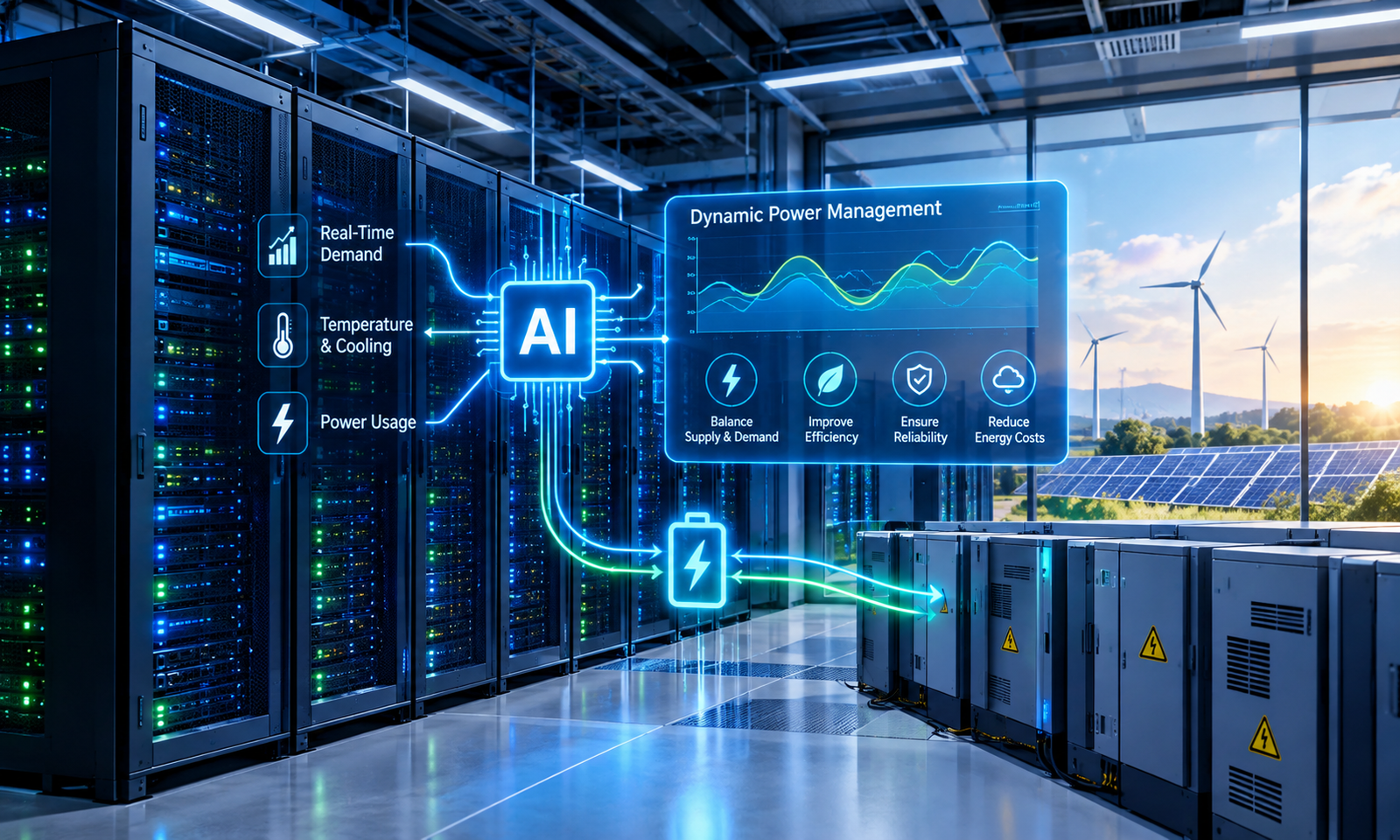
The data center power consumption is transforming with AI. AI systems can generate sudden, heavy workloads, which is why traditional data centers, built for more predictable workloads, need to be reconfigured. AI systems can generate sudden, heavy workloads, requiring a reconfiguration of the traditional data center designed for more predictable workloads. It’s possible for large models to be trained, inference to be done, and complex workloads to be processed in a matter of moments that consume an immense amount of power in the process.
With the rise of AI’s use, data center operators are becoming more interested in ways to be more flexible with electricity use. New systems are now able to forecast workloads, optimize computing timings, optimize cooling, and react to variations in grid circumstances instead of drawing the power that is available.
AI Workloads Are Making Electricity a Dynamic Resource.
Electricity consumption in AI data centers is not uniform but fluctuates over the course of the day. Older approaches of planning with fixed energy requirements are less useful when there are different workloads, which may lead to different energy requirements.
Computing Demand Can Change Within Minutes
Large AI workloads for training could be continuous for extended periods, and inference workloads can vary depending on how much the users are using the system. Rapid scaling of AI usage can thus lead to a rapid surge in electric power usage.
Using software, operators can now be alerted to the computing demands and when they are nearing power limits. Intelligent systems can predict demand and dynamically allocate computing resources, rather than wait for a heavy demand.
This will make the workload scheduling more connected with the electricity handling. The computing resources used can be viewed as a resource that could be shifted, optimized, or temporarily decreased if needed.
Five Signals Help Predict Data Center Power Demand
- AI workload intensity reveals upcoming changes in computing requirements.
- Server utilization is a measure of the efficiency of the computing capacity of a server.
- Cooling demand helps indicate an increasing use of electricity.
- Some grinds will have a greater impact on the cost of more power.
- Past workload patterns aid in estimating future energy needs.
Intelligent Scheduling Is Emerging into AI Infrastructure.
The next wave in power management is to directly integrate workload orchestration with energy. With this, the data center can not only determine what kinds of computing they should allow but also when they should allow certain workloads.
AI Training Can Become More Flexible
There are some tasks that don’t have to start at a certain minute for them to be part of the AI training. When it’s possible to move a workload to a time when it won’t impact important deadlines, operators can schedule it at times when electricity is more readily available.
This can be particularly beneficial in a situation where the production of renewable energy sources varies over the course of a day. For instance, computer jobs could be scheduled during times when solar or wind energy is available and the demand for computers is low enough and the service contracts are not fulfilled so that the shift can be made.
The Five Ways Intelligent Scheduling Can Balance Demand
- Move flexible computing activities out of peak usage times.
- Minimize server workload when there is a limited power supply.
- Schedule tasks with renewable and energy supply.
- When capacity is temporarily constrained, focus on critical services.
- Predict demand in advance of unplanned power surges due to big workloads.
Cooling Systems Are Becoming Another Energy Control Point
Electric power is just one aspect of a data center’s demand. Additionally, cooling infrastructure may also end up consuming significant amounts of energy, especially when there is high utilization of the AI accelerators.
In today’s age, it is common for facilities to employ more complex monitoring systems to gain insight into the relationships between workload intensity, temperature, air flow, and cooling demand.
Workload Decisions Can Influence Cooling Requirements
If hardware is going to generate more heat when the activity increases, it will emit extra heat when you increase its activity. These changes can be tracked by intelligent management systems, and the cooling resources used can be changed accordingly.
The cooling system can operate at variable capacity instead of operating at a constant capacity, allowing it to operate based on real-time information identifying cooling requirements. This can help to lower any unnecessary electric use and temperature that will allow safe operations to occur.
Data Centers Are Moving Toward Grid-Aware Operations
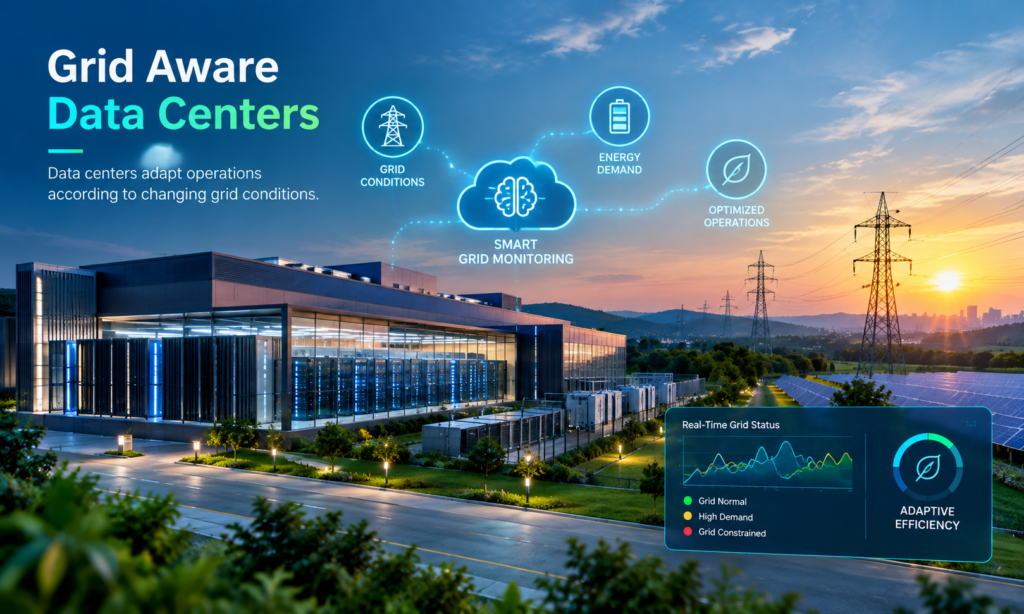
The electricity consumption of AI data centers is growing in importance, and these centers are becoming more important consumers of the local power grid. Sketchy infrastructure can lead to pressure on electrical systems in areas of sudden growth in demand.
With grid-aware data centers, there is the potential that they can respond to an external signal to change the configuration of certain workloads or temporarily curb other nonessential consumption.
The Data Center Could Become More Responsive
An AI facility does not have to be a completely passive electricity consumer but can instead respond to information on the condition of the grid, electricity prices, renewable electricity generation, or available electricity capacity.
This doesn’t imply that you can just turn off any workload. Critical services demand reliability.
ability, and a lot of AI operations have stringent performance standards. But, when workloads are more flexible, it can offer a good opportunity for demand management.
The changing nature of power consumption to power intelligence.
But the real leap forward with AI data centers is the improvement in their energy efficiency. They are moving towards being energy conscious.
In the future, the management of workloads, cooling, battery storage, renewable energy generation, and grid signals can all be implemented within a single operational system. These systems might be able to determine the operation of computing resources (workload) both in terms of the business need and the energy conditions.
This gives rise to another paradigm of data center infrastructure. The problem of power management becomes a “real” computational problem; the software is used to decide where and when electricity would be used.
Conclusion
Electricity is no longer the only aspect of AI data centers that are being monitored; they are now taking a more intelligent approach to power demand management. Operating this way, operators can have more control over the use of energy by their infrastructure, as they are able to predict workloads, redirect flexible computing tasks, optimize cooling, and adjust to the grid.
FAQs
1. Why do AI data centers consume so much electricity?
AI data centers employ high-end processors and accelerators where model training and inference demand a high amount of power. Using these systems to cool the systems is also a use of energy.
2. How can AI data centers manage their power demand?
They are able to foresee workloads, alter computing resources, optimize cooling, and schedule flexible tasks based on the electricity availability and the grid.
3. Is it possible to offload AI workloads to alleviate electricity strain?
For some workloads, shifting can be done when the workloads are flexible and have no strict execution deadlines. This provides operators the opportunity to shave off some peaks from the demand.
4. How much is the power consumption reduced if the data center is cooled?
Yes. AI systems, particularly those with high performance, produce significant heat and need highly engineered cooling systems that can be a significant energy consumption in the facility.