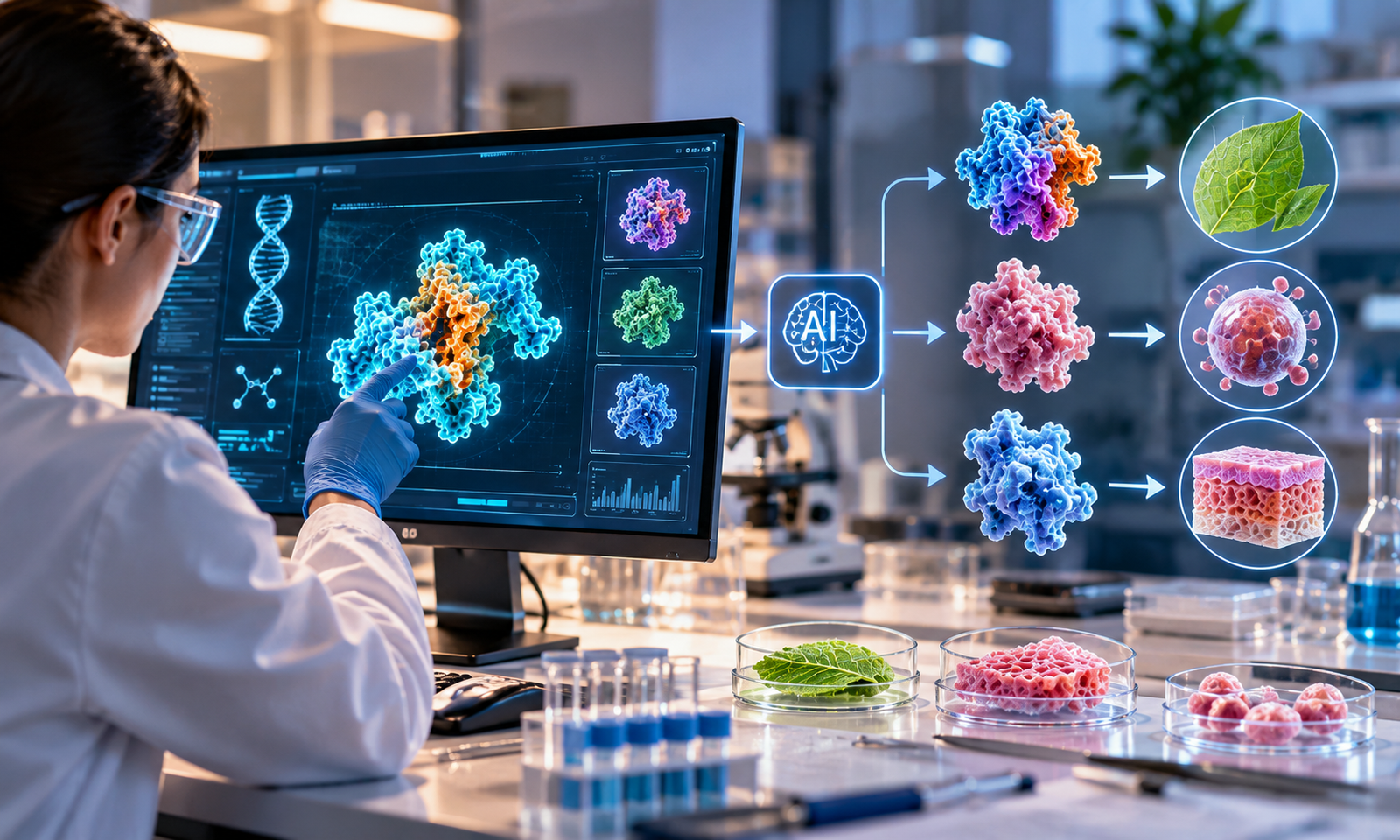
In most of the history of science, a fixed library was available to scientists for them to use.Until the very recent past, biology has provided scientists with a “library” they could use. Researchers could examine the structure of proteins, genes, enzymes and proteins evolved through evolution and then tweak their structure so that they have a particular function. AI is now making a difference to that equation.
More and more, modern AI systems propose not just biological components that are simple copies of naturally occurring ones, but also other components. Computational modelling can be used to investigate new protein sequence, structure and function designs that have not been realised by natural evolution. This new area of generative biology has the potential to increase the design possibilities for medicine, biotechnology, materials science and industrial research.
The Development of a Searchable Design Space for Biology
Nature has given rise to amazing biological machines, but evolution tests all possible molecules or protein structures to a lesser extent. There are significantly more sequences of amino-acids possible, than there are known sequences in known organisms.
AI offers scientists an innovative approach to traversing this vast possibilities space. Computational models can learn relationships between biological sequences, structures and functions, which are then used to suggest promising candidates, in lieu of manual testing of a large number of combinations.
- Completely designing of new protein sequences based on computational models
- Predicting the folding of designed sequences into three dimensional structures
- Optimisation of molecules around targeted biological/bio-chemical functions.
- Testing many candidates prior to conducting experiments in the lab
- Finding designs that are not in the evolutionarily known evolution.
The design of proteins is coming out of the natural template.
Typically, the protein engineering process starts with a naturally-occurring protein. Its sequence is altered under research conditions and it is determined if the alteration results in increased stability, binding or some other desired property.
Generative AI can take a different perspective to solve the problem. A model can be provided with structural and/or functional restrictions and then required to provide sequences that meet the restrictions. This enables scientists to study proteins that are a lot different from natural proteins, instead of tinkering with variations of natural proteins.
The Starting Point has been changed in Structure Prediction.
Predictions of protein structure led to an important link between structure and amino-acid sequence, which was made possible by the latest advances in the prediction of protein structure. Generative systems take the concept of reverse engineering one step further: given a desired structure or interaction, one can look for sequences that could result in this structure or interaction.
The change changes the biological research design process to become a more iterative one that relies on computing, synthesis, lab testing, and model refinement.
The Laboratory Makes the Decision about the AI Design
A computationally convincing biological design is not automatically functional in a real cell or laboratory environment. Molecules operate inside complicated systems where folding, temperature, chemical conditions, interactions, and cellular processes can affect performance.
- Defining the biological function researchers want to achieve
- Generating candidate sequences or molecular structures computationally
- Ranking candidates according to predicted properties and constraints
- Synthesizing selected designs and testing them experimentally
- Feeding experimental results into another optimization cycle
Designs that Fail can Improve the Next Generation
Laboratory failures are data that are helpful. There can be a misfolding of the protein, loss of stability, weak binding or more complex changes in behavior of a protein, compared to that predicted by computation. Such results can be used to gain insights into the limitations of a model.
With further experimental data, the AI system could also be improved to better differentiate between designs that are just as likely to work out in simulations and those likely to work well in the real world.
Novel Proteins Could Open Unfamiliar Engineering Routes
De novo biological design could influence areas where naturally occurring molecules do not provide an ideal solution. The scientists may look for proteins that have a specific shape, surface to bind to other molecules, catalytic activity or resistance to extreme conditions.
Medicine Could Gain More Precisely Shaped Molecules
Proteins are frequently involved in very specific molecular interactions that are crucial to the activity of protein-based drugs. Computational design can aid researchers in their exploration of proteins that recognize specific molecular targets, or can be used to design proteins around therapeutic needs.
While AI produced candidates have the potential to cut down on development time, they still need a long time in the laboratory, safety evaluation and clinical trials. The key difference lies at the discovery stage where scientists can explore more molecular structures, and then choose those they want to work on for further development.
Industrial Biology Can Demand Properties Evolution Never Needed
Organisms are optimised not for manufacture, but for survival and reproduction. Conditions in the industrial world can be very hot, or have unusual solvents, high pH or chemical reactions that are not typically found in nature.
It is possible to then optimize designed enzymes for the engineering needs, instead of evolutionary history. This may be useful for various aspects of biotechnology such as the manufacturing, chemical synthesis, waste processing, biomaterials, and others.
Firmer safeguards needed for powerful biological design.
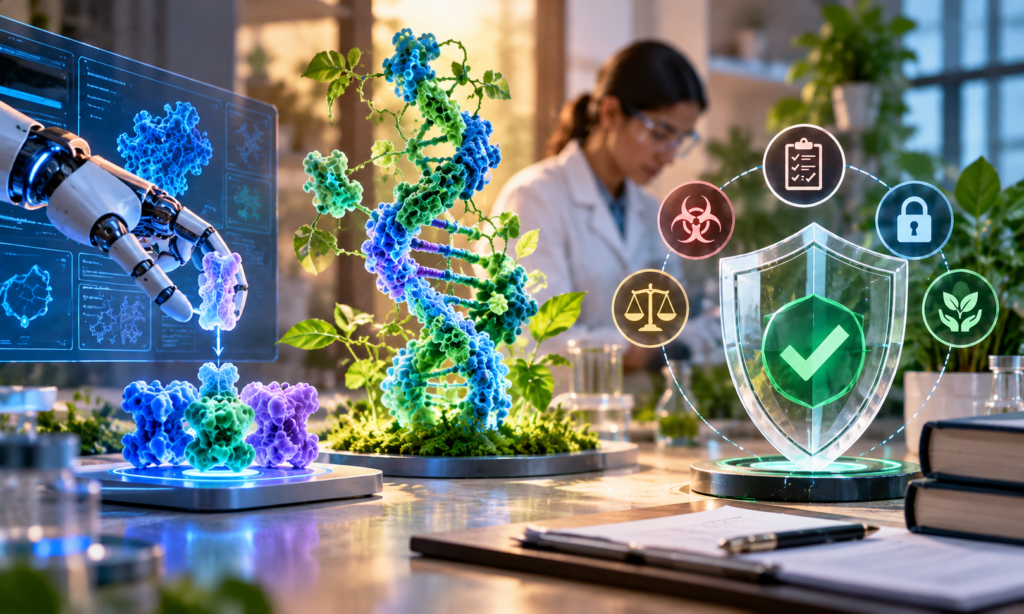
Creating new biological parts raises questions around responsibly accessing, overseeing and keeping them safe. As design tools evolve in capabilities, there is a need for appropriate screening, validation, biosafety practices and governance of the researchers and institutions.
The crux of the matter is not just about being able to create a sequence of any sort. The scientific community also needs to know how this sequence works, if there are unintended interactions that can occur and when experiments should be conducted. To achieve responsible biological design it is essential to have computational power to develop in parallel with experimental controls and risk assessment.
Conclusion
AI is advancing the field of biology, as it moves from studying and modifying the components that already exist in nature to the design of new ones in the computer. Generative systems can perform a much greater number of iterations on protein/molecule design than evolution could have done, providing a much larger design space for researchers.
However, AI generation is just the first of its kind. Validation, knowledge of the biological effects, safety measures, and trial and retrial are still necessary. The more profound change is that biology is becoming a more and more “computable” field, so that scientists can design before they construct and test it.
FAQs
1. Can AI really create proteins that do not exist in nature?
Yes. Generative models can suggest new amino-acid sequences and protein structures that are not known in natural proteins. They are yet to be proven experimentally to have their actual functions.
2. How does AI design a new biological component?
Models develop a relationship between the biological sequences, structures and functions. The system can be used by researchers to specify desired properties or constraints, and then automatically return a candidate design that can be tested in the lab, for comparison.
3. Are AI-designed proteins immediately usable?
NO. You can’t validate it in the computer, it has to be done in the physical lab. Scientists typically have to make promising candidates and examine how it folds and the stability, interactions and function of the resulting folds.
4. Where could AI-designed biological components be useful?
Therapeutics, enzymes, biomaterials, chemical manufacturing, molecular diagnostics and synthetic biology are some of the possible fields of research.