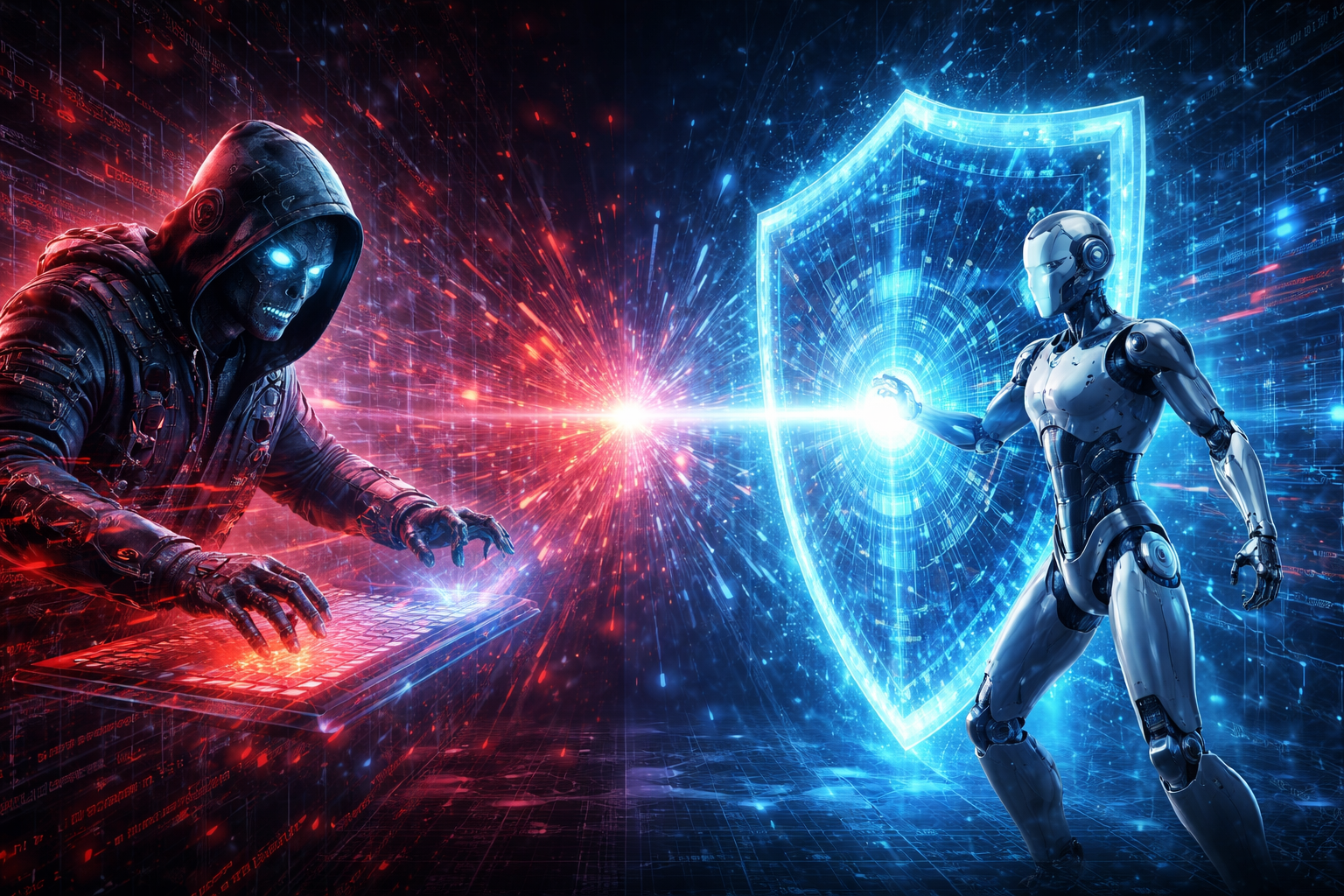
The digital battlefield is changing at an amazing pace, and the most effective weapon and the most efficient shield is now the Artificial Intelligence (AI). As organizations are becoming more dependent on AI to automate, analyze data, and make decisions, cybercriminals are also utilizing the same technology to conduct more intelligent, faster, and destructive attacks. This constant battle between AI-driven cybersecurity threats and AI-driven cybersecurity protection has given rise to what is today being referred to as the New Digital War.
In this war, there is always shifting of the advantage. Attackers are utilizing AI as a means of realizing vulnerabilities on a large scale, whereas defenders are utilizing AI as a means of anticipating, identifying, and eliminating threats in real time. Learning to live together is a vital thing that businesses, governments, and individuals should learn in order to remain safe in an ever-globalized world.
The AI-Powered Cyber Attacks.
AI has made cybercriminals much more effective. Old fashioned attacks were time-consuming, manual, and technical. Today, AI tools have the potential to streamline these processes and make attacks more productive and difficult to trace.
Important Properties of AI-Driven Attacks.
Cyber attacks based on AI are characterized by velocity, flexibility, and accuracy. Machine learning algorithms can be used by attackers to analyze large amounts of data and detect vulnerabilities more quickly than ever before. As an illustration, AI has the ability to scan networks, identify vulnerable points, and conduct targeted attacks in several seconds.
Another major development is the use of AI in phishing. The current-day phishing attacks are no longer generic. The analysis of social media activity, emails and online behavior will allow AI to develop very personalized messages. This enhances the possibility of victims becoming victims of scams.
Another threatening technology is Deepfake technology. Hackers are able to imitate voices and faces posing as executives or trusted persons, or commit financial fraud or data breaches. Such attacks are very hard to detect through the traditional means.
AI as a Weapon of Cyber Defense.
Attackers are becoming more intelligent but so are the defenders. The other area in which AI is transforming cybersecurity is through proactive and real-time threat detection.
The Strengthening AI in Cybersecurity.
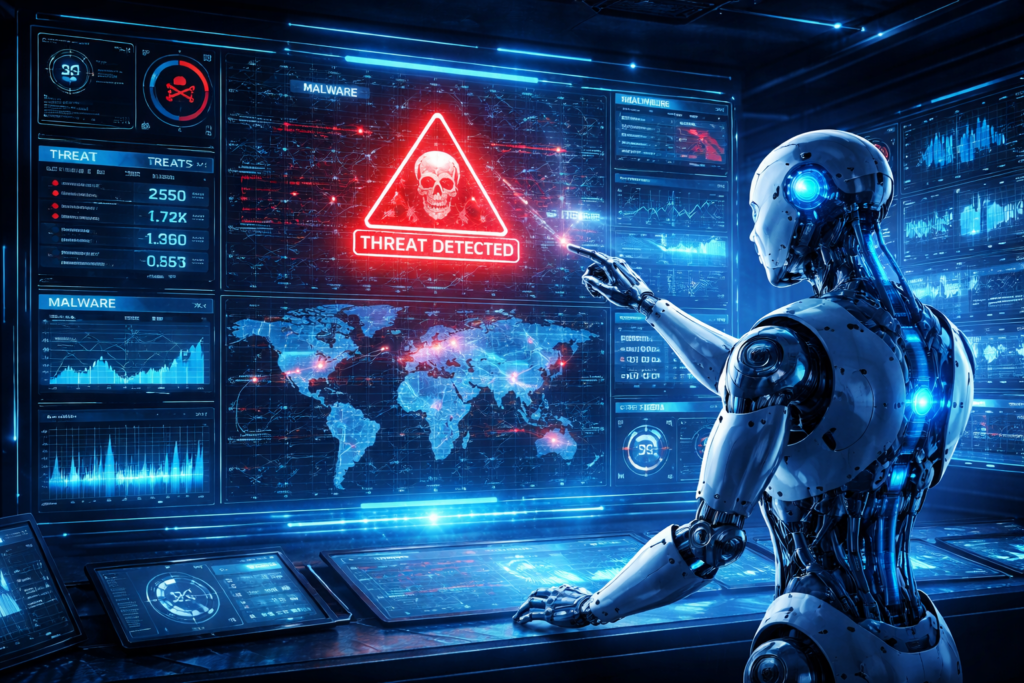
AI-informed defence mechanisms have the capacity to patrol the network 24/7, detect suspicious activity, and act immediately. The AI systems improve their accuracy as they get to know new rules and modify their behavior, unlike conventional security systems which are based on predefined rules.
As an example, AI can identify aberrations like unusual logins, unusual transfer of data, or suspicious user activity. The signals aid in the detection of threats by the security teams before they can damage them.
Another important benefit is automation. The repetitive work, such as vulnerability scanning, system patching, and log analysis, can be performed by AI. This enables cybersecurity experts to concentrate on more difficult tasks.
Moreover, AI can identify any possible threats using historical data. This forecasting ability aids organizations to be a step ahead of the attackers.
The Battle on Going: The Attack vs Defense.
The war between the AI-based attacks and the AI defenses is dynamic and ever-changing. Attackers respond to such measures by changing to evade them.
Digital War challenges.
The speed of AI-driven attacks is one of the largest issues. Thousands of attacks can be made at the same time by cybercriminals, which is beyond the capacity of traditional defense systems. AI defenses need to also keep up with the changes.
The other problem is the availability of AI tools. The level of AI technologies is getting more accessible, and it reduces the resistance of cybercriminals. It implies that less-skilled attackers can also make complex attacks.
Privacy of data is also an issue. AI systems need extensive data to be able to work. The key challenge to organizations is ensuring that such data is safe and that it is used ethically.
In addition, AI systems have false positives that cause confusion. When an AI defense system falsely identifies a normal activity as a threat, it may cause system disruption and decrease confidence in the system.
Future of AI in Cybersecurity.
AI innovation will play a significant role in the future of cybersecurity. The digital war is going to be sophisticated as attackers and defenders keep using AI.
What Lies Ahead
It is possible to foresee the further development of AI systems, which can be self-sufficient and make decisions without human control. This will enhance the response times but will also increase ethical and control related issues.
Cooperation between organizations will be necessary. Threat intelligence and AI models can be shared to create a more effective defense against international cyber threats.
Regulation will also be very important. To ensure responsible AI development, governments can implement more stringent laws to regulate the use of AI in cybercrime.
In the future, combining artificial intelligence with other technologies, like blockchain and quantum computing, could significantly change how we approach cybersecurity.
Conclusion
The future of digital security will be determined by the ongoing conflict between AI-driven cyber attacks and AI-based defense systems. While AI has given cybercriminals new, advanced tools, it has also provided defenders with powerful new resources to counter these threats.
To succeed in this evolving digital landscape, continuous innovation, constant awareness, and the ability to adapt are essential.
Organizations should invest in AI-based cybersecurity solutions as well as provide training to their staff on how to identify and act against the threats.
In the end, it does not depend on technology but rather on the efficiency with which it is employed that will decide who will win this battle.
FAQs
1. What are cyber attacks powered by AI?
AI-controlled cyber attacks involve automation and optimization of hacking methods with the use of artificial intelligence, which speeds up and improves them.
2. What is the role of AI in cybersecurity?
AI is useful in real-time detection of threats, pattern analysis, and automation of responses to block attacks.
3. Are attacks using AI more threatening than traditional attacks?
Yes, because they are quicker, more focused, and able to evolve to circumvent the conventional security systems.
4. Does AI eliminate cyber attacks?
No, however, it greatly minimises risks because it enhances detection and response.
5. How can AI be used to improve cybersecurity?
AI will grow smarter, self-reliant, and will be combined with other technologies to offer better defense mechanisms.