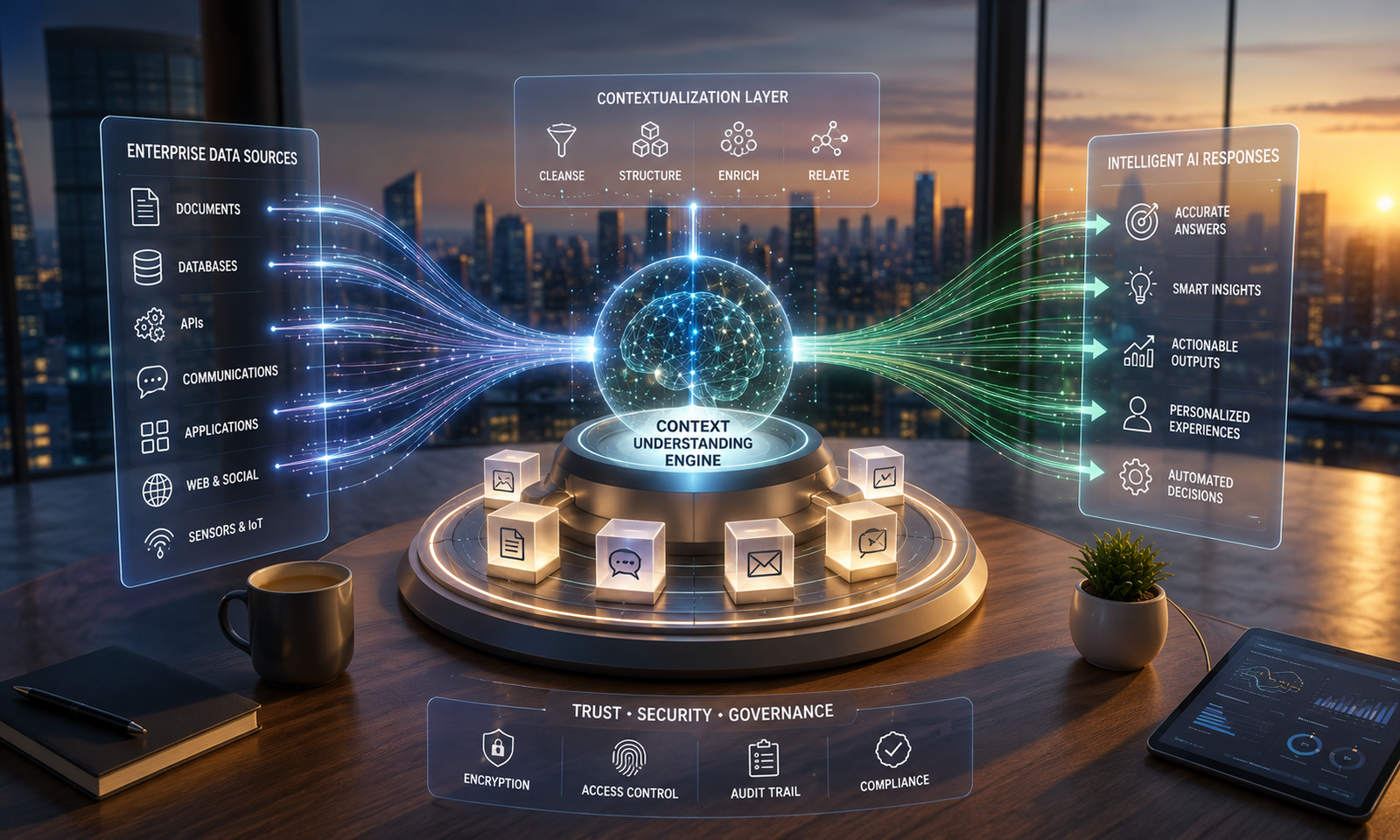
Artificial intelligence has transformed what businesses do with information from search to analysis to generation. But it is a fallacy that the intelligence of an AI model is determined solely by its size or the amount of training data it has had. What makes for high quality AI response is a background system which presents the relevant info at the right time thus kicking off the model’s answer. This system we call the AI Context Supply Chain. It is made up of many technologies which collect, organize, retrieve and manage context which in turn allows AI to reply faster, more accurately and in a more personal way. As companies put in place AI assistants, copilots and autonomous agents into their work flows this invisible infrastructure is becoming a very precious part of what makes up modern AI architecture.
What is at the base of AI intelligence?
During inference an AI model only uses info that is present at the time of the interaction. Upon a user’s input the system goes out to gather relevant history from the conversation up to that point, internal company documents, APIs, databases, and external knowledge repositories which is then put to the language model. Thus this process sees to it that the AI is not only responding to the question at hand but also taking into account the business or user context.
Without this additional layer of info AI responses may go out of date, out of scope or out of touch. A robust context supply chain which we have designed improves hallucinations, increases factual accuracy and enables AI to put forth more relevant responses in the real world business settings.
Begins with what the user wants.
In each interaction we start by determining what the user is really after. AI systems we use look at the prompt, past conversations, and related info to determine intent which in turn helps us find support in knowledge. This in turn produces more relevant responses as opposed to falling back to general training data.
Sure and certain data creates better responses.
Once we identify a user’s intent the system pulls in from within our documents in the cloud, from our enterprise databases and which is also connected to external applications. We use verified sources which in turn presents better quality responses and also gains the user’s trust in the results put forth by the AI.
The behind the scenes Workflow that powers every AI response.
Modern AI systems use a chain of related technologies that work as one to bring out a response. We begin with the collection, then cleansing, structuring, and ordering, and finally pass that which is at once the best suited product of that process to the language model in the most useful format. This structured approach we see to be a key to not only get the job done but also to do so in a more efficient way and out of the gate reduce what is non essential processing.
Organizations are putting great resources into retrieval systems, vector databases, AI memory, and orchestration platforms which we see as the fields that will improve response quality. Also instead of putting all their eggs in the basket of large language models, companies are working on what they can put forward to better frame the issue for the models.
Semantic Search improves Accuracy.
Unlike that which is done in traditional keyword search, semantic retrieval grasps the intent behind a query. Vector databases compare concepts as opposed to exact words which in turn allows AI to find very relevant info even when the documentation uses different terminology.
Memory Enhances the Personal Touch of AI.
Today AI assistants have access to past conversations, user preferences, and present tasks. We have implemented a form of long term memory which allows the system to have natural flow in our discussions and also to personalise responses which the user has already provided.
Security for Enterprises Context.
Enterprise AI has a responsibility to handle sensitive info in a proper way. We put in place permission controls, encryption, governance policies and audit logs which in turn protect confidential business info at the same time that they enable AI to access what is meant for it.
What the AI Context Supply Chain will do for the Future of Enterprise AI.

As technology grows into a core part of everyday business operations what is going to be key is the quality of the context which the AI has rather than the size of the model itself. What we are seeing is that companies which develop solid context infrastructure are the ones which see better decision making, improved customer support, better results from workflow automation, and better performance in knowledge management without at the same time having to constantly change out their AI models. Also what we are finding is that a strong context supply chain which the AI has access to makes these systems more scalable, more trusted and also easier to put in place in different departments.
Conclusion
The AI Context Supply Chain is the background which brings to life each instance of intelligent AI response. From interpretation of user intent to the retrieval of accurate info and the protection of enterprise data, each step plays a role in achieving greater accuracy and reliability. Companies that put in the work today to develop context infrastructure will be in a better position to create smarter AI assistants, to improve customer experience, and to support the growth of autonomous AI systems with confidence.
FAQs
Q1. What is an AI powered supply chain?
It is the full suite of processes which puts together, structures, retrieves and presents relevant info to an AI model before it responds.
Q2. What role does context play in AI?
Context is a key to which AI is able to determine user intent, access present info, and put forth more accurate and personal responses.
Q3. Which tech solutions power the AI Context Supply Chain?
Key technologies are the like that of Retrieval-Augmented Generation (RAG), vector databases, semantic search, AI memory, orchestration platforms, and enterprise APIs.
Q4. Does the AI in Supply Chain reduce hallucinations?
Yes. Through provision of accurate and relevant info we see great reduction in fake AI responses.
Q5. Which sectors see the most from this technology?
Healthcare, finance, education, legal services, retail, manufacturing, and customer support all see benefits from better AI context management.