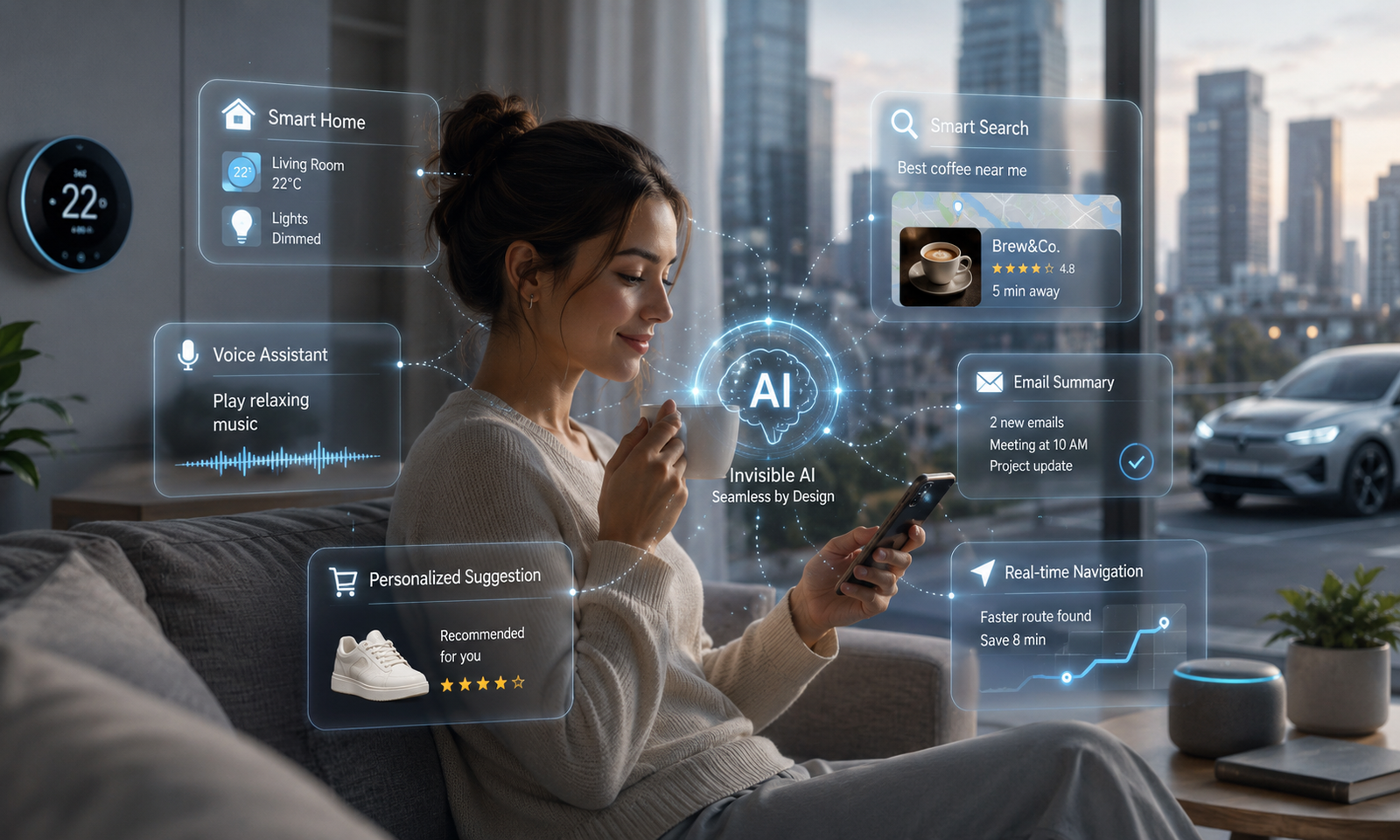
AI is on a new stage of its evolution where the concept of standalone AI apps is gradually being replaced by more powerful and robust AI solutions. Previously, users were required to log into a specific AI application, enter prompts, etc., and then take the results and paste them into their work. However, modern times are changing the course of technology altogether. AI is not only being used to “open” but it’s all but invading every application you use.
How Invisible AI is Replacing Traditional AI Apps
1. AI Embedded in Operating Systems
The new basis for the integration of AI is operating systems. AI has become a part of the system layer, rather than relying on separate applications. The functions such as search, file organization, voice assistance, notifications and device optimization are all aiding with AI.
This eliminates the need for users to rely on external AI apps, and enables intelligence to be an integral part of the device’s functionality.
2. Everyday applications of AI.
Today’s media tools, from email to word processors and spreadsheets, messaging, etc. are quickly changing. Users aren’t required to use a distinct AI chatbot, but are instead able to benefit from AI features within the very tools that they’re already using.
Emails can be automatically generated and/ or tone suggestions added to improve tone. Documents can be summarized and/or expanded and rewritten in no time at all. Spreadsheets can be used to analyse complex data by using formulas. The messaging apps can propose answers, based on what’s being discussed in the chat.
This integration is profound and eliminates the need to open any external AI application, so that people can remain with their work.
3. The browsers are becoming intelligent assistants
Web Browsers are Becoming AI Powered Assistants. These are not mere websites, but rather they interpret, analyse and summarise the content of the websites while they are being displayed.
Users can read and digest long articles in an abridged form, and compare several sources simultaneously and instantly, not to mention having the answers right on the page without tabbing off. Browsers are also able to anticipate the user’s intentions and suggest the user for a search before the user is done.
This transformation makes the browser a key AI platform instead of having to use different AI applications.
4. Background AI via APIs
One of the primary factors behind the success of Invisible AI is the ability to use APIs to power multiple applications – a trend that is becoming more and more common. Rather than an AI system within each app, a shared AI model allows for the use of a single model across multiple platforms.A shared AI model runs in the background, serving multiple platforms instead of having one AI system per app.
This layer is not directly used by the user, but rather by the underlying layers. Rather, it is felt via more savvy applications, quicker reactions, and tailored suggestions.
This gives rise to a single intelligence system and AI that is omnipresent, but not separated out as an individual product.
5. Predictive and Proactive AI Systems.
AI is no longer at the service of man. It’s moving towards being predictive, proactive. AI systems can predict user needs based on their actions, routines, and patterns, and consider the context in which they are using the device.
For instance, it can say to reply to the messages before you open them up, automatically set up meetings according to your schedule, or give you ideas of what to do based on your daily schedule.
This degree of automation allows to minimize human involvement in the form of AI interaction and move closer to an invisible way of using AI.
Why the World is Moving Toward Invisible AI
1. The most extreme version of minimizing effort by users.
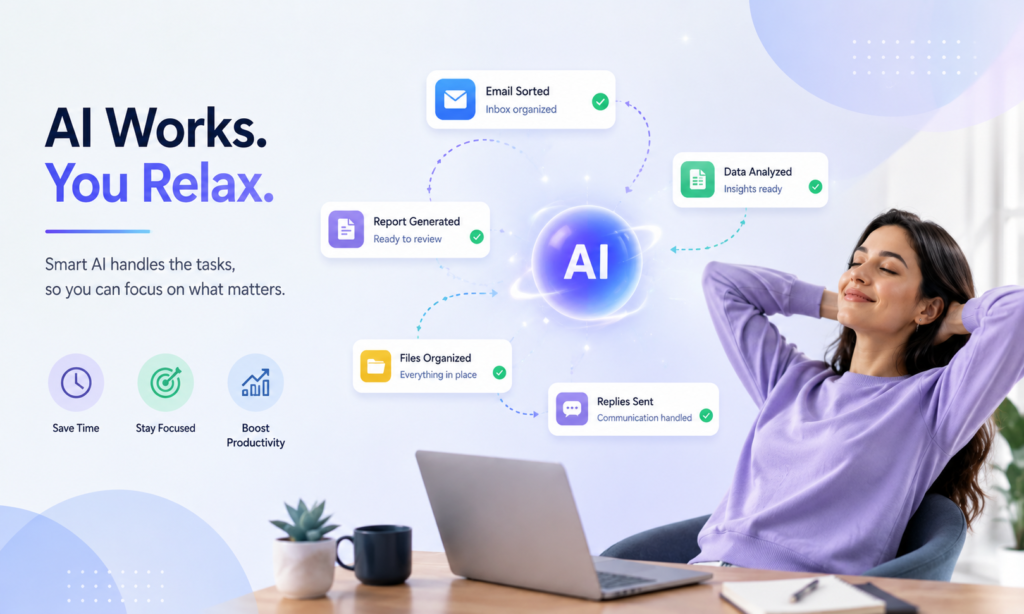
Convenience is one of the largest factors that has contributed to this change. Users don’t want to be shown new tools, or to have to switch between apps. With AI that’s integrated into the workflow, Invisible AI eliminates this friction altogether.
The system helps to identify the right AI tool for the user, rather than the user having to ask, thus saving time.
This will result in a more seamless, quicker and natural digital experience.
2. Expertise and knowledge about the context and personalization.
The key to invisible AI’s power is its ability to comprehend context. It knows all your deeds, past and future, and what you are going to do.
This enables it to be extremely focused on as personal output. The AI can be customized as you write, design, shop or plan.
As time goes on, the system will become more accurate, and online experiences will appear personalised for each individual.
3. Service and efficiency without any delays.
AI when embedded into workflows can bring about a significant boost in productivity. Apps are not required to be opened separately, content is not needed to be copied, nor are there delays for responses.
All the actions are immediate and in the same context. Writing becomes continuous rather than broken up into tasks and writing is analyzed, communicated and planned.
One of the best features of Invisible AI is this ability to seamlessly flow between each.
4. Because it is important for Unified Intelligence to be Across Devices.
Not only can you use Invisible AI in one app or device, you can use it on multiple. It can be implemented on mobile phones, laptop, tablet and cloud systems.
This implies that users will enjoy the same intelligence, anywhere they go. AI behaviour is always linked and synced in either device or platform.
Conclusion
What’s unfolding is a paradigm shift between human and tech – and it’s called Invisible AI. AI is no longer an independent application that must be accessed, launched and powered on. Rather, it’s turning from a subtle, omnipresent shield that is slippery to engage with, slippery to manage, and slippery to use.Rather, it’s becoming a subtle, ever-present shield that’s slippery to engage with, slippery to manage, and slippery to use.
As this change is happening, there will be a gradual diminishing of the significance of the traditional AI app and systems in which intelligence is omnipresent but invisible will take their place. Interactions are not the future of AI, it is all about the integration, automation and absence of friction.
We are going towards a world that does not use AI but lives in.
FAQs
Q1: What is Invisible AI?
Invisible AI – AI systems embedded in applications and operating systems without having to have their own interface or app.
Q2: Are AI apps going to come to an end in the future?
Most of the standalone AI apps will get less significant as AI becomes a part of the existing software and platforms.
Q3. What makes Invisible AI different from conventional AI applications?
With regular AI apps, the user needs to open the app and interact with it, whereas with Invisible AI, it functions without the need of user attention.
Q4: What is the current, real world, use of Invisible AI?
It’s already available in predictive text, intelligent responses, suggestions, navigation and browser helpers.
Q5: Is there an issue with regard to safety for Invisible AI?
This is subject to implementation. It makes things convenient but it also has privacy, transparency and control issues.