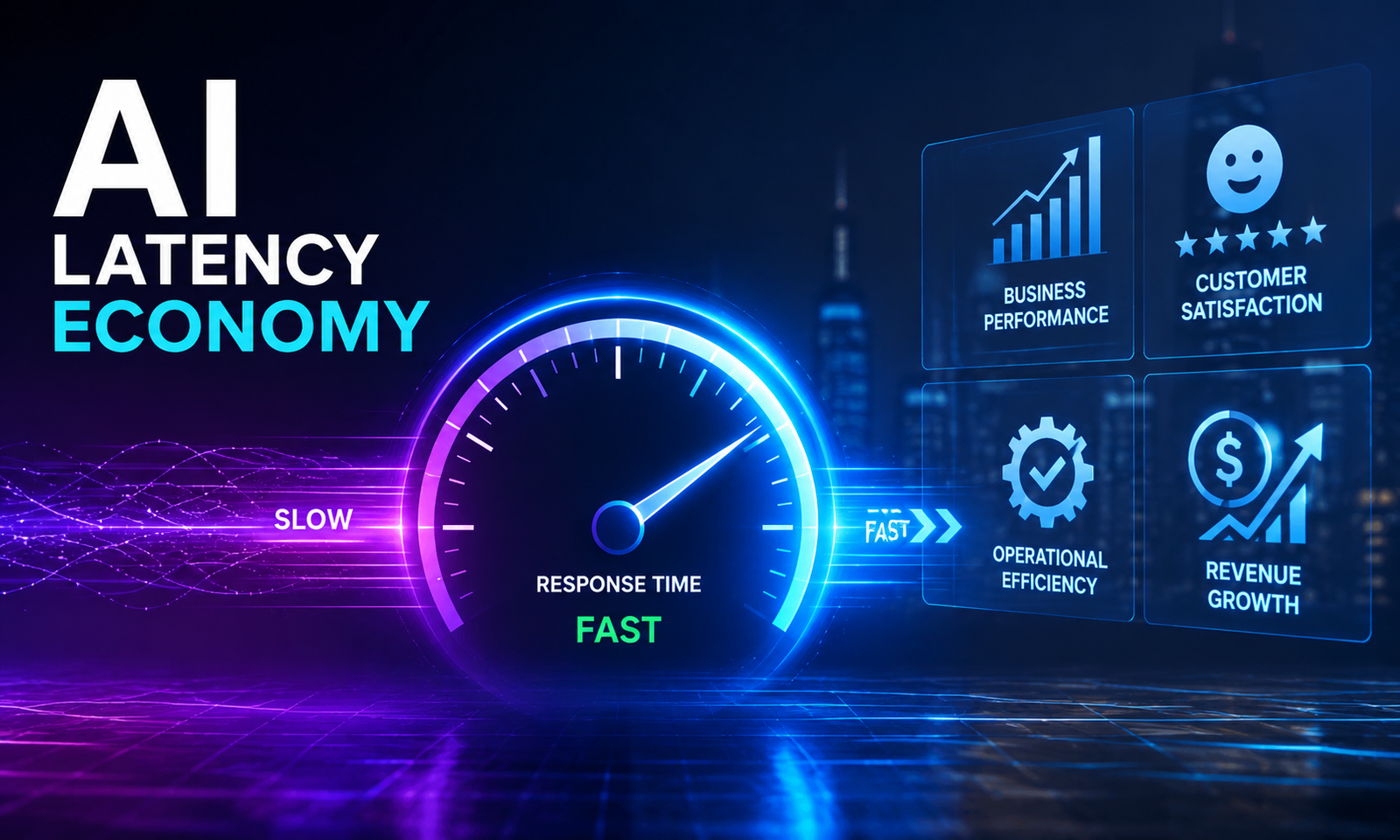
Artificial intelligence has hit a stage where businesses are no longer competing only on model accuracy or complex features. The next field of battle is speed. As it stands today in terms of AI’s role whether it is in replying to a customer query, writing code, putting forward a product recommendation, or in the support of an employee what we see is which system which delivers a reliable response the fastest is what is winning out. In today’s digital economy we see that even a few extra seconds of wait time reduces user engagement, increases bounce rates, and weakens customer trust.
This we have seen to introduce the AI Latency Economy which is a thing where response time is the key to business performance. Companies are rethinking their AI infrastructure, tuning inference engines, and putting models closer to the user to0 reduce wait times. Those that dominate in AI speed are improving customer experience, increasing productivity and are seeing a measurable competitive benefit.
When Every Millisecond Shapes Customer Decisions
Today’s digital users expect AI to have the same responsiveness as a human conversation. Slow responses break workflows and introduce friction which in turn causes users to leave a platform.
- Businesses are reporting that for AI which delivers near instant results they are seeing:.
- Increases customer engagement across digital platforms.
- Reduces waiting time during critical interactions.
- Improves conversion rates and purchasing confidence.
- Creates smoother experiences across AI-powered applications.
Develops long term trust with consistent response.
Immediate Responses Build Confidence.
In today’s world be it an AI chatbot, shopping assistant, or search engine speed is what customers notice first. Quick responses in turn make for more natural conversations which in term keep users engaged at every step of their journey. Also businesses which have responsive AI see greater customer loyalty as users get the help they need right away without delay.
Small delays create large business costs.
Latency may be out of notice but in a total of many thousands of daily interactions even small delays add up to great efficiency loss. Also longer response times see customers go to competitors’ products which in turn slow down employee’s work and also reduce what companies see as value in their AI investments.
Inside the Technology Making AI Faster
Deliberating intelligent responses within milliseconds is a result of more than just strong AI models. Today’s organizations are using a mix of technologies to improve speed while still preserving accuracy.
- Lightweight AI models reduce processing overhead.
- Edge computing minimizes network travel time.
- GPU acceleration speeds up inference operations.
- Intelligent caching eliminates repetitive calculations.
- Distributed cloud systems see to it that the global response is consistent.
Specialised Models for Specific Tasks.
Instead of using one large scale model for all tasks we see companies deploy many different small AI models which are purpose trained. These which are narrow in focus perform better in terms of speed of response and also in terms of resource use and we are seeing them used in customer care, document review, and enterprise wide automation.
Edge Computing Transforms the Speed Equation.
Processing of AI at the edge for users’ proximity greatly reduces network latency. Edge AI which is used by factories, hospitals, retail stores, and autonomous systems allows for real time insights without the full dependency on remote cloud servers. Also this approach improves reliability in which performance is key.
Wiser Inference Engines.
In which trained AI models put out their responses is what we call inference. Also we see that with the use of advanced optimization techniques like quantization, parallel execution, and tensor optimization we are able to reduce computational complexity which in turn allows companies to serve large scale audiences at lower infrastructure costs and with faster response times.
Why are companies retooling their AI infrastructure?

The push for better performing AI is what is making businesses reevaluate how they structure their tech environments. Also we are seeing that traditional cloud only solutions don’t scale for very real time AI applications.
Organizations today are putting into play regional AI solutions which also includes high performance GPUs, intelligent networking, and scalable inference platforms. We see that these changes are in turn to have the users report the same level of performance no matter where they are located which also we are seeing to be true in high demand situations.
Modern AI is transforming into a business asset which traditional IT investments can’t compare to. Which companies are able to put out fast and reliable AI solutions they are in turn presenting better digital experiences which competitors are having trouble to replicate.
Measuring AI Success Beyond Accuracy
For many years organizations used accuracy scores to determine AI performance. Although accuracy is still important, what we see now is that speed is of equal importance.
In certain fields which AI has broken into like customer service, finance, health care, manufacturing, and enterprise software — what is putting out great results in a few seconds may not be as valuable as those which provide very accurate results immediately. As AI grows in its role within these fields latency is becoming a key performance indicator along with reliability, scale, and operational cost.
Businesses are now using response time as a key performance indicator which in turn affects customer satisfaction, employee efficiency, and revenue.
Conclusion
The AI Speed Economy is playing a transformational role in how companies think about AI. While large models are still important we have seen a shift towards speed which determines how well these models perform in a business setting. Customers want instant responses, employees are turning to real time AI support, and we see organizations which are able to get faster insights thus make better decisions. Firms which put into play optimized AI infrastructure, efficient inference engines, edge computing, and specialized models are in the best position to give great user experiences and outperform the competition. As AI grows in adoption we see that reducing latency is no longer a nice to have — it is a basic requirement for all AI based businesses.
Frequently Asked Questions (FAQs)
What is AI lag?
AI response time is the time which AI systems take to process a request and return a response.
What’s the value of low AI latency?
It improves the experience for users, also we see that which in turn increases productivity and we support a lot of better business decision making.
How do businesses reduce AI latency?
Through the use of edge computing, improved AI models, GPU acceleration, and efficient infrastructure.
Which sectors see the most?
Ecommerce, health care, finance, manufacturing, and customer support see the greatest benefits.
Will AI performance time become a focus in business?
Yes. Along with accuracy and dependability response speed is a key AI performance issue.