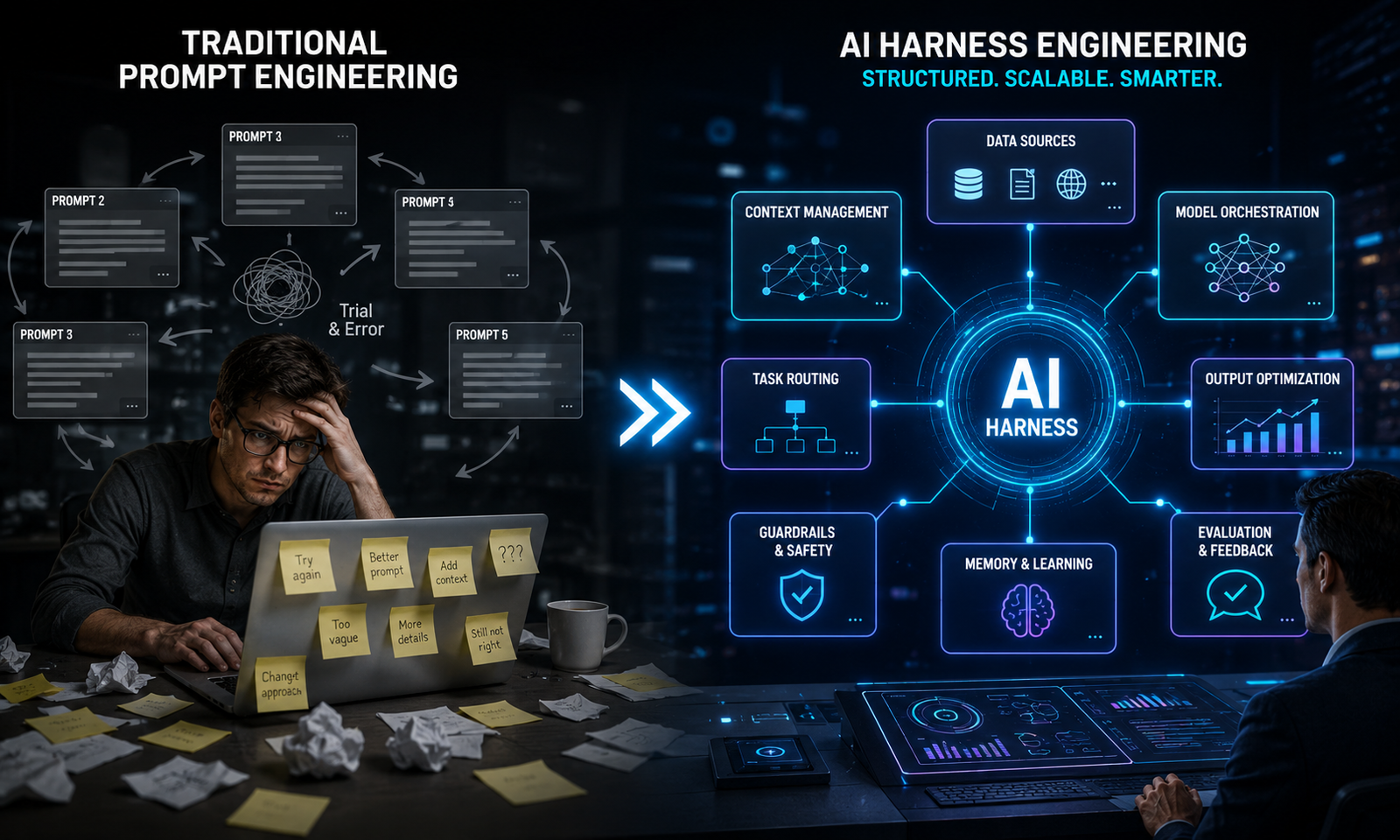
The era where AI systems are merely built by prompting well is over, as AI is now in a new stage where more is needed than just well-crafted prompts to establish credible, intelligent and scalable AI systems. Prompt engineering was one of the greatest skills to become valuable in the past few years, as it enables users to get better answers from LLM’s. But with the introduction of AI agents able to plan, remember, access external tools and interact with other systems, it is now time for organizations to move beyond the use of just prompts.
This new paradigm has enabled the introduction of a new and growing field, AI Harness Engineering, which deals with controlling, connecting, monitoring and optimizing the AI execution environment (not just the conversation). Rather than asking how they should word the prompt, businesses are now asking how they can create an AI system that will always provide accurate, secure and contextually relevant results.
AI Harness Engineering is an orchestration, memory management, retrieval systems, governance, tool integration, evaluation and workflow automating suite of tools in one neat package. It is increasingly being used as the backbone of enterprise AI implementations in various sectors including healthcare, finance, eCommerce, software development, customer support and digital marketing in 2026.
From Prompt Writing to AI System Orchestration
Prompt engineering was centered around developing prompts which would lead to improved responses from the AI. It works well for simple tasks, but can fall short if AI is required to perform more detailed tasks, retain information over time, or access real-time data, that is, when the work requires multiple tools, real-time data and/or memory.
Modern uses of AI are far from being a Chatbot, they’re more like employees. They are expected to retrieve documents, check facts, access APIs, access previous conversations without having to talk to humans, adhere to the company’s policies, and complete multi-step processes without human interaction.
AI Harness Engineering is the people, process and technology to coordinate all these capabilities.
How AI Harness Engineering Changes AI Workflows
AI doesn’t rely on a single prompt, it works in an environment with management of all interactions.
- Develops a multi-agent system for interacting with each other
- Enables external data bases and APIs to be connected
- Maintains context information and remembers it over a long time.
- Implements security and compliance rules, automatically
- Regularly assesses the performance of AI regularly and continuously
This orchestration allows the AI systems to be run consistently in any task, of any complexity.
Why Traditional Prompt Engineering is Limited
No matter how well you write your prompt, if you lack information, out-of-date knowledge, disconnected tools, or inconsistent work flow, you won’t have a successful outcome.
AI systems must now be capable of:
- Be aware of, and conscious of, past business interactions.
- Get up-to-the-minute information about a company.
- Double check outputs prior to answering
- Select the correct tools without having to analyze the problem.Make correct tool selections automatically.
- Utilize responses when they are in a live context
These are some of the capabilities that go way beyond prompt design – it takes a full engineering framework to achieve these.
Core Building Blocks Behind AI Harness Engineering
AI Harness Engineering brings together multiple technologies that are all needed to build reliable AI systems to support enterprise scale operations.
Context Management becomes the new Intelligence Layer.
In today’s world of AI, it is crucial for the context to be included, rather than individual instructions.
Context covers conversations, the history of previous interactions with the customer, documentation, company policies, project history and real-time information. This context can be managed to enable AI to respond appropriately, avoiding repetition from the user, and generating personalized responses.
Memory Systems Enable Continuous Learning
Persistent memory makes it easy for AI assistants to remember what users like, ongoing projects, and past interactions between the user and AI, across sessions.
Whereas, AI continuously learns and builds knowledge to enhance personalization, productivity and decision making, without having to start all conversations again.
Tool Integration Enables AI Capabilities.
It is now becoming common to see large language models (LLMs) used as a component of other applications, instead of standing alone.
AI technology can be integrated and accesses:
- CRM platforms
- Inventory systems
- Analytics dashboards
- Internal databases
- Business automation tools
This enables AI to work with real, rather than just textual tasks.
Evaluation and Monitoring Improve Reliability
It is essential to have continuous quality control in Enterprise AI.
Measurements of evaluation systems are accuracy of the response, hallucination rate, latency, compliance and user satisfaction. Monitoring on an ongoing basis can be beneficial for organizations to find out the weaknesses before they impact their customers.
Industries Already Adopting AI Harness Engineering
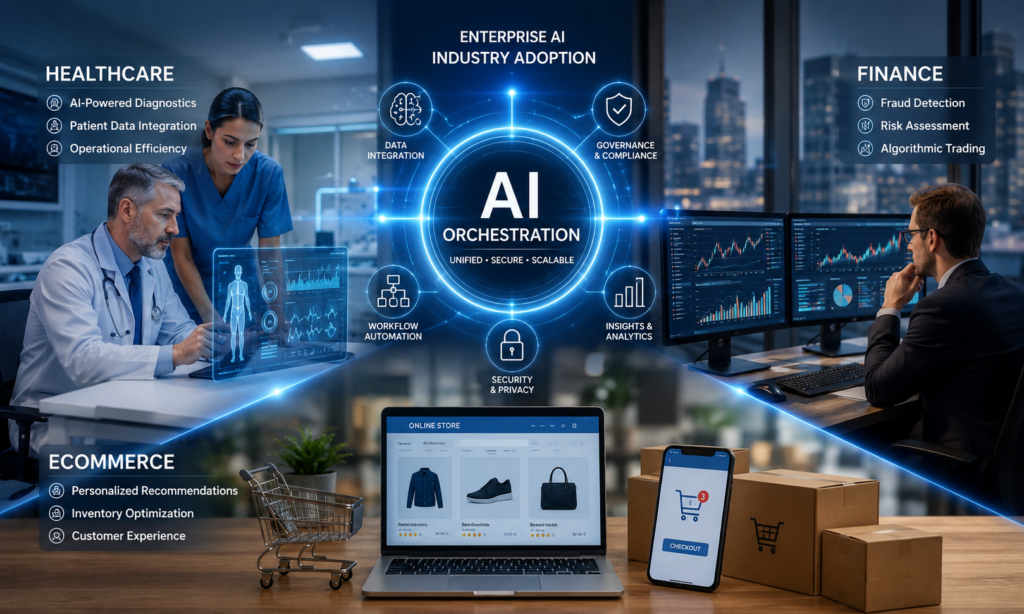
In an era where automation is vital and has to be precise, secure, and scalable in industries, AI Harness Engineering is proving to be a game-changer.
eCommerce Operations
With AI-powered harvester tools, online retailers can make sure their stock is always up to date, suggest items, customize the client experience, automate assistance tickets, and ensure seamless fulfillment while delivering a uniform customer experience.
Healthcare Decision Support
AI’s ability to analyze vast amounts of data in seconds enables healthcare organizations to implement AI-powered diagnostics, decision support systems, and predictive analytics.By leveraging AI and medical databases, patient records, clinical guidelines, and even diagnostic workflows, healthcare organizations can make informed decisions and provide effective patient care while also complying with regulatory standards.
Financial Services
AI Harness Engineering provides secure multi-system workflows for banks and financial institutions to combat fraud, process documents, provide customer assistance, verify compliance and analyze risk.
Software Development
AI coding assistants, AI-powered repositories, AI testing tools, AI deployment pipelines, and AI documentation tools come together in the development teams to automate more of the software development process.
Conclusion
Adding prompt engineering to the first generation of generative AI catapulted the technology and enabled effective interaction with the language model. But, in 2026, enterprise AI calls for much more than meticulously written instructions. AI Harness Engineering provides a complete solution for a sophisticated context management, persistent memory, workflow orchestration, external tool integration, governance and continuous evaluation framework that is part of one intelligent ecosystem. By doing so, AI can be developed more accurately, can scale effortlessly, is secure, and can provide consistent value for the business. With the emergence of AI from conversational assistants to AI collaborators, AI Harness Engineering is emerging as one of the most crucial disciplines of the future of AI.
FAQs
1. What is AI Harness Engineering?
The implementation of AI engineering is the management of the entire AI execution environment, such as memory, orchestration, tool integration, governance, monitoring and contextual intelligence.
2. Will prompt engineering be replaced by other technologies?
No, prompt engineering is still valuable, but this is now a part of a much more extensive AI infrastructure.
3. What are the best industries for AI Harness Engineering?
Leading adopters are in the healthcare, financial, eCommerce, software development, education, manufacturing, customer service and enterprise automation sectors.
4. How does AI Harness Engineering reduce hallucinations?
It enhances the accuracy by bringing AI and the verified data sources together with the contextual memory, evaluation system, and automatic validation process before delivering responses.
5. Why is AI Harness Engineering important in 2026?
Businesses must find ways to control and secure their complex workflows and the performance of their autonomous AI systems, which requires reliable orchestration, governance and context management.