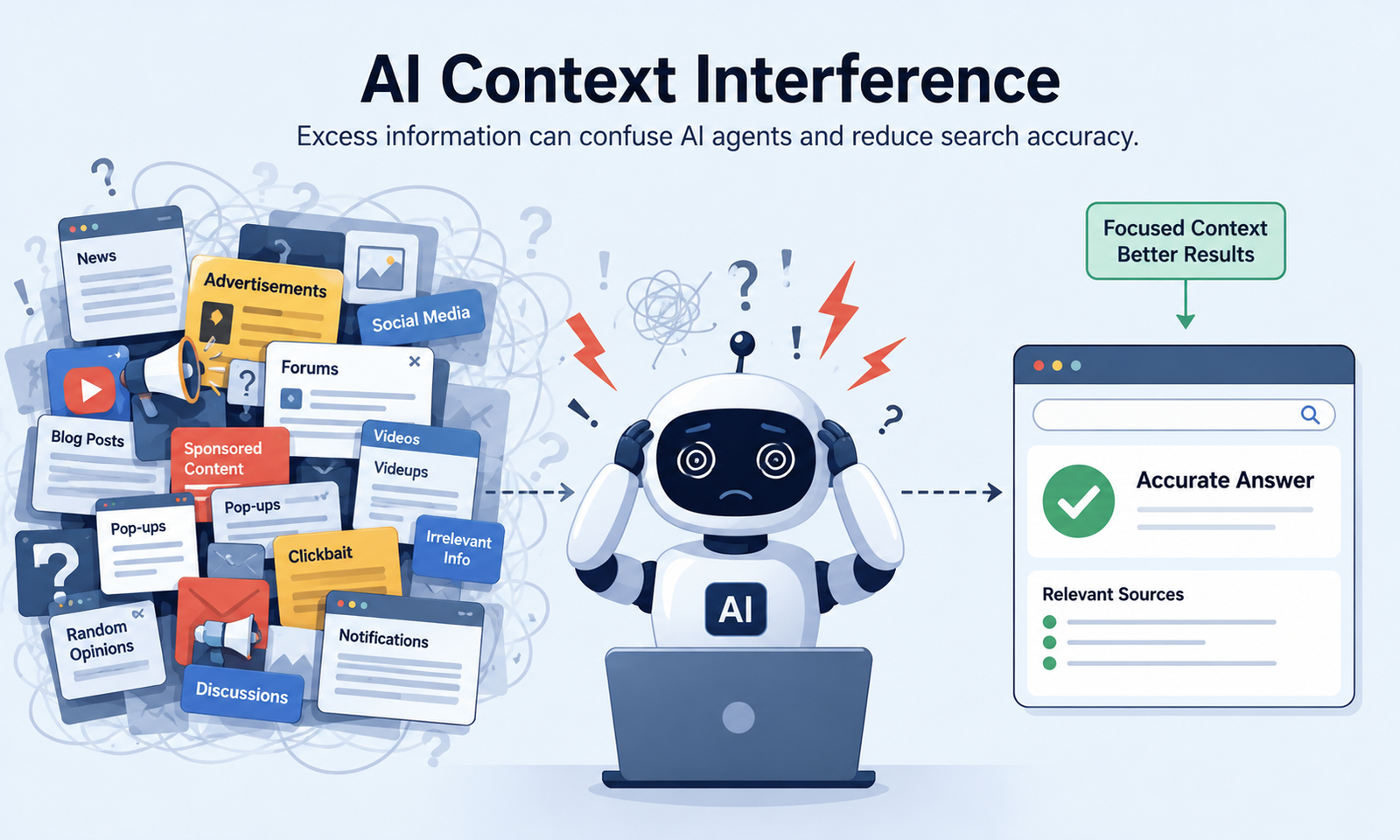
New and more complex stage of the AI Search. The rest of the time, AI agents can be used more than just for locating any given webpage and summarising it. They can make use of a variety of sources, analyze documents, compare products, search on databases, make use of tools, memorize previous instructions and synthesize information to produce an answer.
Unfortunately, enough with additional information does not equal better AI – this poses an extra challenge. Difficulties occur if the additional irrelevant, duplicated, outdated, and contradictory information comes into an agent’s working context, making it more difficult to determine what information is useful. This new problem could be termed as “AI context interference.”
AI Search Is Entering the Context Interference Era
Overload Can Distort the Correct Information
It becomes essential for AI agents to decide what information is relevant and pertinent to a particular task. With hundreds of search results, documents, instructions, reviews, and/or previous conversations, important items can join the competition for attention with less relevant information.
This is not to imply that they would simply possess a big database. The problem arises when information is activated in the agent’s reasoning processes, and makes a difference on the agent’s understanding of the task. When conflicting and irrelevant information surrounds a very accurate fact, it loses influence in the brain.When a very accurate fact is surrounded by suggestive or irrelevant information it will lose its influence in the brain.
Context Overload Affects Agents’ Reasoning.
A modern agent can get information from search engines, websites, APIs, their own databases, conversations with their customers and third-party documents. Each and every extra source yields another signal in which the system need to evaluate.
So, the “information retrieval challenge” becomes “information prioritization challenge”. The agents should determine what to look for and what should be ignored, and what should be verified prior to influencing an answer/decision.
Search Volume Doesn’t Equal Search Quality.
The idea is that with traditional search, a larger set of top hits might be useful – users know how to pick which works to examine. AI agents operate differently as they may not just present retrieved information, but it can be a part of their reasoning process as well.
Then, an AI “shopping agent” that’s able to do a side-by-side comparison of smartphones can be given smartphone specifications from the manufacturer, a price from a retailer, reviews from publishers, and opinions from forums. If sources’ statements depend on each other, rather than providing further certainty to the recommendation, adding more pages adds to the uncertainty.
The Context Window will be a strategic layer in the future.
The context window is one of the truest aspects of agentic AI growing into a significant part. It determines what instructions, evidence, memory and information is retrieved during the model’s reasoning for a task.
It is not only the quality and capability of the AI model, but also the right information that reaches the AI model at the right time that will make a difference in AI performance. So better matching up of context may lead to better results that aren’t just a result of providing more information.
Why Context Quality is the Next AI ‘Advantage’ for you
AI Agents Need an Information Hierarchy
A good AI agent should be able to filter out information from high-level instructions, authoritative information, supporting details and background noise. If there is no hierarchy and if the information that is available is weak, or obsolete, it has a chance to be undermined by the more powerful information.
This means there’s a new issue to think about for businesses.This leads to another business visibility concern for AI. The first step in becoming more visible to AI-powered search is being mentioned, but that’s just the beginning. Data needs to be packaged in a manner that enables AI systems to both comprehend and characterise the information in terms of its relevance, credentials, timeliness and connection to other information.
There are 5 controls which can reduce context interference.
- Generally, go for information that is most relevant to the task (context ranking).
- Trust sources: Deem influential credible sources as more important.
- Freshening up: Minimize out-of-date information.
- Context compression: eliminate extraneous material without loss of content, idea or meaning.
- Conflict detection: Identify contradictory information prior to making decisions.
Poor Context Can Produce Confidently Wrong Decisions
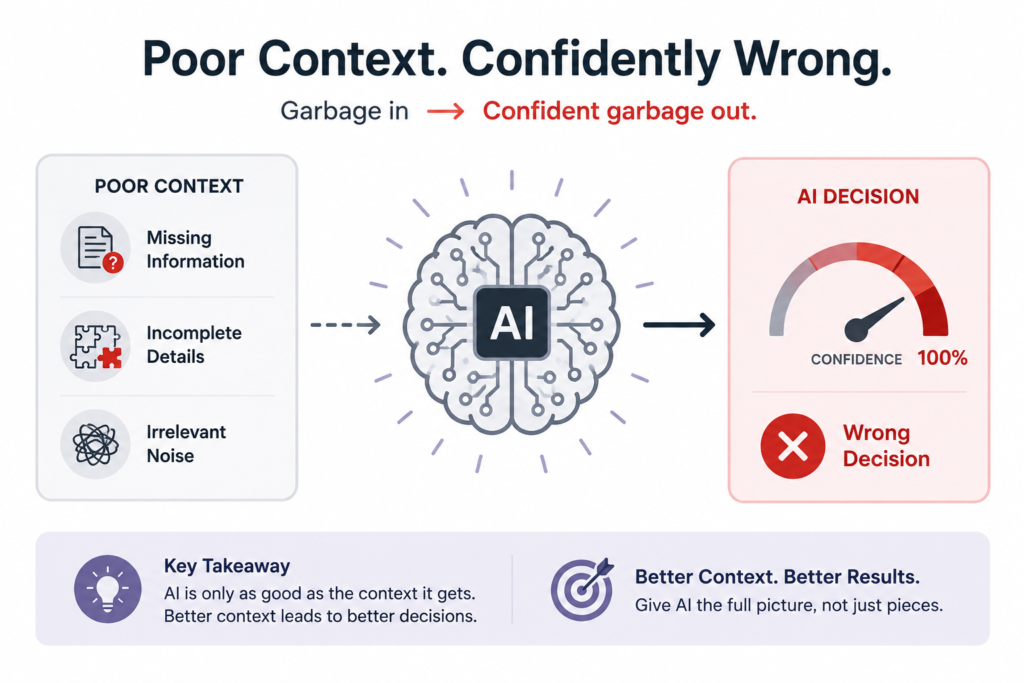
Factual answers aren’t the only thing that may be impacted by context interference. AI agents play an ever-growing role in operations whose outcomes relate to business decisions, including recommendations, purchases, customer support, research, and more.
A company policy might not be up to date and be the fault of an enterprise agent. Information provided in a customer service system could be a mixture of information from various product versions. The specifications entered into a shopping assistant could be in conflict, and thus suggest using a substandard product. The answer(s) might sound strong although the context was not well structured.
Retrieval Visibility is Different from Decision Visibility
It is possible for a company to see in an AI system’s retrieved info even though it does not affect the conclusion. Other sources might have more authority, be more recent or more pertinent to the project.
This makes an interesting difference between the retrieval visibility and decision visibility. When it comes to information being retrieved, the visibility means that it can be found by the AI systems. Decision visibility is making sure there’s information of a quality that will affect the agent’s ultimate decision.
Brands will need to clean up their information signals.
To anticipate this transition, businesses should strive to ensure that all pages are well-updated, that all terms (and objects) are consistently referenced, and that the information on the pages is both structured and well-referenced with clear relationships between its entities. These are helpful in making it easier for the AI system to pick out the relevant information from confusing and outdated content.
Conclusion
AI context interference studentifies a big shift in the approach to AI Search. The issue now is not just how much information an agent has, but if he does have it to begin with. The difference is that it’s the agent’s ability to find what data of all the information it accesses it needs to find.
By extension, the quality of context data will grow from being as crucial as the availability of information to become as important as the information itself, as AI agents amass richer contextual information in the process of making recommendations, purchases and customer service interactions, and even more so when they take independent actions. Websites that are authoritative, up-to-date, consistent, structured and with clear information architecture are what businesses should concentrate on.
FAQs
1. What is AI context interference?
AI context interference occurs when irrelevant, duplicate, outdated or conflicting information is brought into the context of an AI system and makes it harder to locate the most relevant information.
2. Does increased information lead to more accuracyless answers on AI?
Yes. Audit accessory information can sometimes lead to conflicting information, distraction, duplicating and invalid facts which may hinder the system to prioritize the use of reliable information.
3. What is the difference between context interference and conventional AI search problems?
Typical AI search problems are some sort of low quality retrieval (data or wrong information). When the information available to the agent becomes difficult to prioritize, due to a lot of competing information, it is called ‘context interference’.
4. What are ways that businesses can minimize the context of AI?
Organizations can ensure that they have up-to-date and relevant information, eliminate stale data, use a uniform terminology, improve the content structure, post authoritative sources and ensure that vital information is easily found by AI systems.