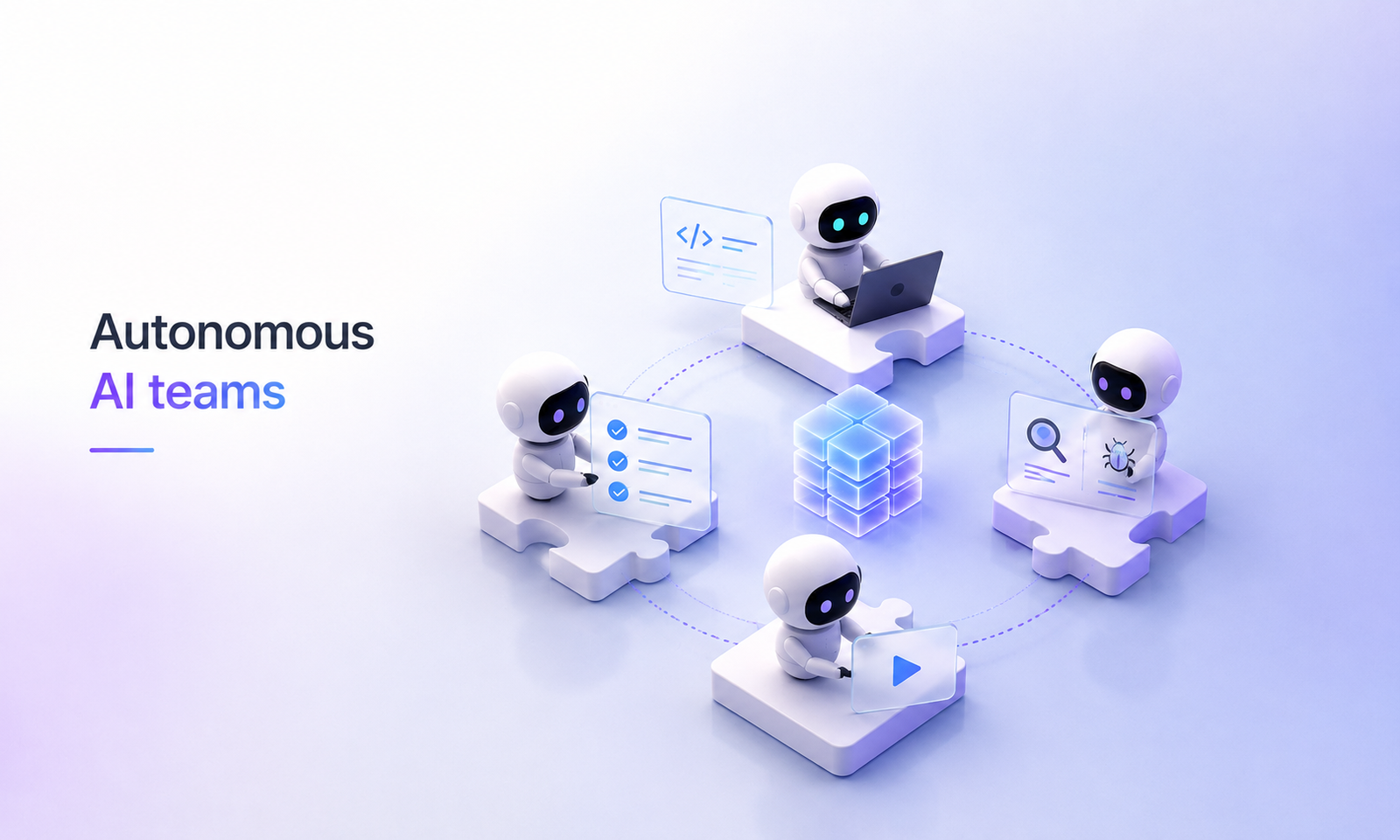
As artificial intelligence (AI) agents take over a greater proportion of the software development process, from basic code suggestions to assisting with larger segments of development, the industry is going through a significant shift. Today, AI systems are capable of comprehending requirements, creating code, executing tests, locating bugs, fixing them and rerunning tests, among other tasks, with minimal human involvement.
This shift is generating a new model: autonomous software teams – teams of AI agents conducting specialized software development tasks, while human engineers give direction, design and architecture, and oversight and final approval. Companies are taking a first step towards using AI as an intelligent software production workflow, rather than just a coding assistant.
AI Agents are becoming Digital Members of Software Teams
AI coding agents are now able to handle a greater number of connected tasks, instead of just programming in response to individual tasks. The development goal can be broken down into smaller activities which can be acted out, tested, reviewed and refined by AI systems.
- AI agents can convert the software requirements into development tasks.
- Coding agents can produce the elements of the application and ancillary elements.
- The testing agents are able to develop and run automated software tests.
- An error corrector can find the errors in it and suggest corrections
- Review agents can check the code for quality and consistency that is generated
From Coding Assistance to Goal-Based Development
What’s important to note is that AI agents can now start to perform actions towards a goal, rather than needing instructions for each and every action. A developer may want to develop a customer dashboard with authentication and reporting capabilities to be managed by an agent.
The agent has the opportunity to review the current project, identify those files which need changes, make the change, execute any tests that are available, review the failure(s), and update the project. As AI becomes more involved in execution, developers will focus on decisions that necessitate more technical insight, thereby creating a development cycle with AI taking on more jobs.
Continuous Testing Can Follow Each Development Step
Testing is now closely intertwined with coding using AI generated software, as there is a need for instant validation of the software. The agent can perform a feature, unit and integration test, review the test results, and see what needs to be done to improve.
In case of test failure, the agent can go back and investigate the failure and try again an implementation. The iterative development/testing cycle can cut down the time from discovering a problem to fixing it, especially when the software is well-defined and has a high level of automated test coverage.
Multiple AI Roles Are Reshaping the Engineering Workflow
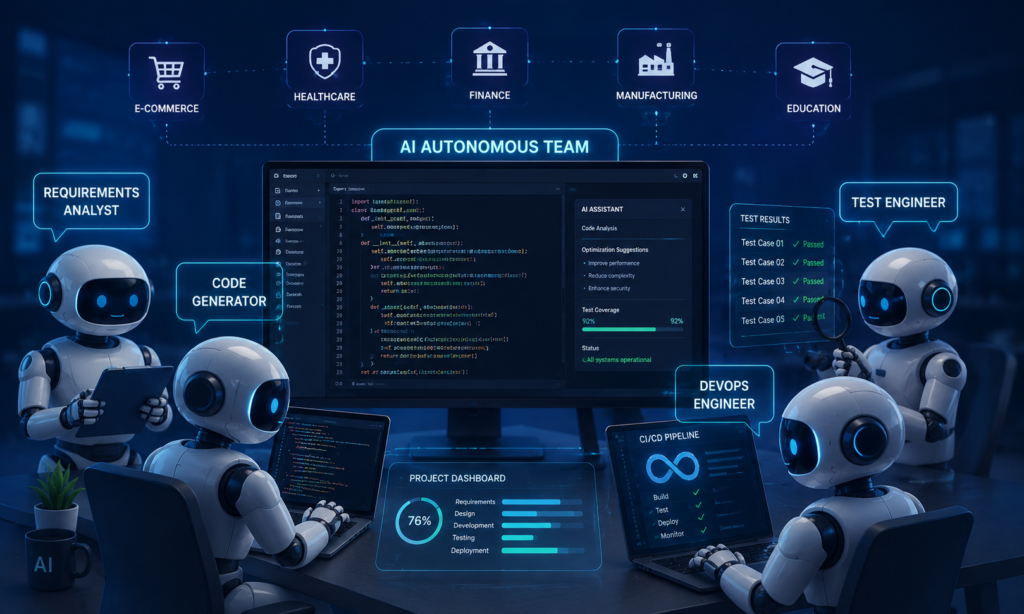
An autonomous software development doesn’t require that one AI agent do all of the work. Rather, individual agents can have individual responsibilities and orchestrate via an orchestration system.
- When planning agents have to tackle large requirements, they can dissect them into smaller technical requirements.
- Development agents are able to deal with the implementation on the front-end and back-end.
- As a testing agent, you can test some features and find out whether there are regressions.
- Review agents are able to check changes prior to their acceptance.
- DevOps agents will be able to help in the deployment and infrastructure processes.
Specialized Agents Can Work on Different Parts of One Project
A single AI worker can process a large application, if needed, by using multiple AI workers. One agent could write some of the interface components, another one can write the services components for the backend, and another one can write the automated test.
All of these activities can be coordinated by an orchestration system, and agents can get the context of the project from the orchestration system. This forms a process that is similar to that of a digital engineering team with various AI systems working towards a common software goal.
Human Engineers Still Control the Important Decisions
More and more autonomy of AI does not mean that there is a lack of need for experienced software engineers. Where there are complex or trade-offs to make, and/or technical standards, product requirements, security and system architecture, human expertise is needed.
Engineers can define the scope for what AI agents can access and/or alter, and observe key changes prior to going to production. This is a man-to-man (also called hands-on) method which offers a compromise between independent performance and effective software development.
Where Autonomous Software Teams Can Make a Difference.
Autonomous development is particularly convenient if software work is repetitive, verifiable, and there are trustworthy software testing processes. AI agents can help companies move towards faster development without the need for engineers to take care of all the mundane tasks.
- Structured requirements can be used to develop internal business applications.
- SaaS businesses can speed up the process of typical feature development.
- With the help of rapid prototyping, startups can make their product ideas a reality in less time.
- Automated support is available for legacy systems to help modernize them.
- Maintenance workflows are able to pinpoint and fix smaller software problems.
Why Fully Autonomous Engineering has Limitations
Even though the software is created with AI, it could still have security vulnerabilities, logical errors, wrong assumptions or architectural choices that might not be identified with standard testing procedures. Human intervention is especially crucial in systems where sensitive information, financial transactions, security measures, or other important business operations are involved.
Secure development environments, access controls, automated testing, version control, monitoring and accountability for AI-generated changes are also essential elements that organizations must have. Autonomous agents who have free rein to move about the production systems may introduce unneeded operational and security issues.
Conclusion
This trend of creating applications with autonomous software teams is a major change in the approach to creating apps today. In addition to helping with coding, AI agents are now capable of engaging in planning, implementation, testing, debugging, review and more in the development process.
The most feasible option is probably autonomous software development by humans, which involves setting goals, design, security requirements and quality requirements by human engineers, and then allowing AI agents to do a growing percentage of the repetitive tasks.
FAQs
1. What are autonomous software teams?
AI-powered development systems of autonomous software teams are collections of agents where specific agents can plan, code, test, debug, review and deploy software with little human participation.
2. Can AI agents develop full applications?
With AI agents, it is possible to build vast applications and functional prototypes already. But, there is still a need for human oversight in complex production systems for architecture, security, business requirements, testing standards and approval.
3.What is the role of AI in helping to develop software testing strategies?
As part of an iterative development process, AI agents can create test cases, run automated tests, dissect test failures, brainstorm potential causes, tweak implementations, and repeat tests.
4. Will autonomous software teams take the place of developers?
More often than not, autonomous software teams are more inclined to modify developers’ roles, rather than supplanting them. Human engineers are still very crucial in building the architecture, making strategic choices, securing, complex reasoning, and quality control.