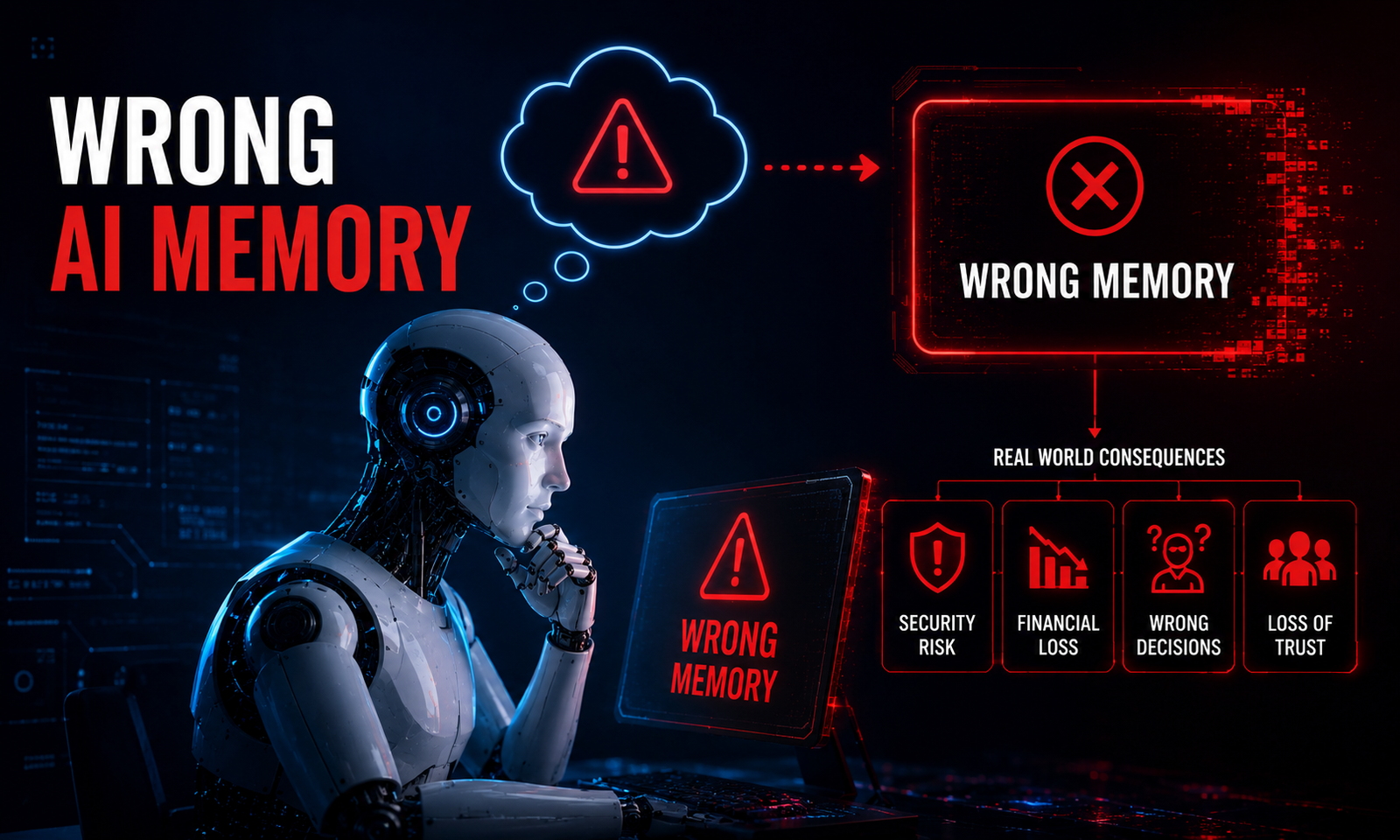
AI agents are increasingly able to recall past conversations, users’ preferences, business instructions, decisions, and operational context. This memory can give an AI assistant a lot of smarts, as they won’t have to begin any interaction from scratch.
Most errors can be fixed if it is an incorrect response. The wrong recollection can have far more dire consequences since the agent might rely on this information for future decisions. Even if an AI agent has an outdated instruction, makes a mistake on the user’s preference, or takes the information it generates as true, the error can be incorporated into its decision-making process.
How the Failing of AI Today Becomes the Learning of Tomorrow
AI Memory: Transforming the user and AI agent dynamic. The agent does not have to process each conversation as a stand-alone event but can also carry information forward to influence future actions, based on the previous experiences.
Five risks related to memory are emerging as significant:
- Wrong information can be learned as fact and affect future AI decision-making.
- Old instructions can still be active despite the changes of circumstances.
- A little bad information can seep into an agent’s future decision-making process.
- Over time details from various users or tasks may get mixed up.
- Users might not be aware of the information that is still kept within an AI agent.
It takes a small mistake to turn into a big decision.
The traditional software operates on pre-defined rules, and AI agents can react to situations dynamically. This is definitely useful for persistent memory and can be unpredictable.
Now imagine the AI business assistant getting it wrong when it comes to recalling a customer’s approval of a pricing model. Now, see the AI business assistant getting the pricing model wrong because he thinks a client approved it. This recalled information was used by the agent when he was making a proposal, weeks later. There might have been just one mistake to make, but it can affect you multiple times.
The risk is greater when agents can make recommendations instead of actually allowing them to carry out recommendations. Other automated processes, such as emails, orders, appointments, customer interactions, and more, could be affected by a false memory.
Memory is not necessarily the same as truth
An AI agent can recollect something it heard, read, or received in an email or conversation or created via a response to it. This doesn’t always indicate that the information has been verified.
To distinguish facts from assumptions, from preferences, from temporary instructions, or from unverified claims, it is essential that a reliable memory system be able to do this. If not, an agent might start to create a false impression of things.
Securing Memory – the New Security Layer
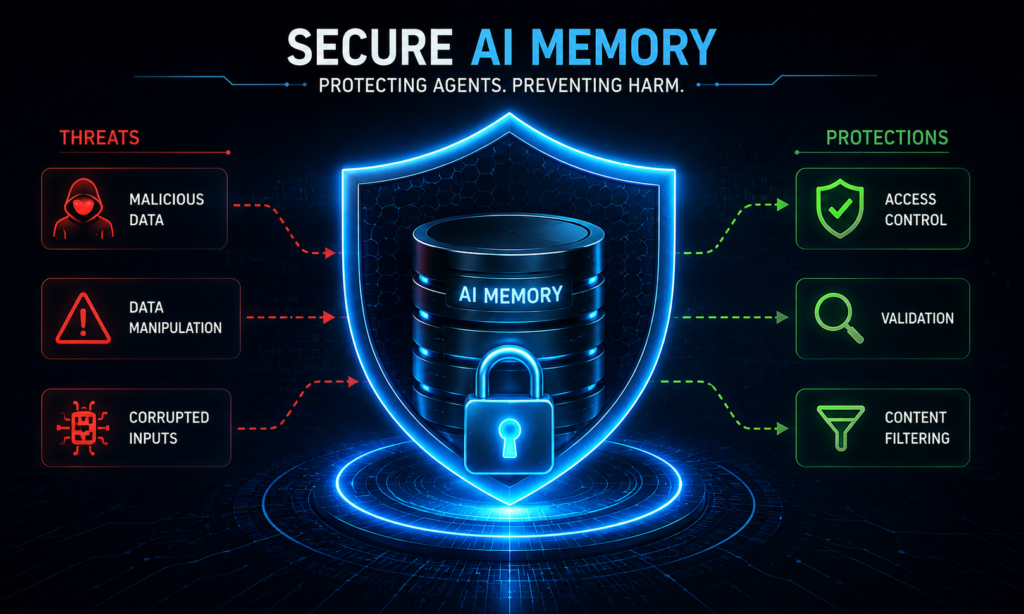
The primary areas of AI security are usually model attacks, prompt injection, data privacy, and unauthorized access. Persistent memory is another layer because the data that an agent can store can have an impact on the agent’s actions for a period of time after it was interacted with.
There are five controls that can help manage this risk:
- It is crucial that the important information be checked before it is permanently stored by an AI agent.
- Information that is temporary should expire on its own at the end of its usefulness.
- Some memories should have a memory of their own source and time of creation.
- Users should have access to examining, editing, or deleting information collected on them.
- Sensitive memories should only affect those tasks that had proper authorization.
Agents need Memory Provenance, not just memory storage.
The most significant advances will be related to memory provenance. Ideally the agent should be able to tell where the fact was remembered from, when it was made, and if it was a reliable source.
For instance, if a customer preference comes from an approved system of business, it would have a higher level of confidence than a customer preference that has originated in an informal conversation.
This would enable AI systems to use memory as evidence and assign varying degrees of confidence to each piece of the evidence.
Memory Loss May Be a Protection Mechanism.
Often people think of intelligence as the ability to remember more, but AI agents are safer if they’re aware of what to forget.
Short-term passwords, old project directions, momentary choices, and outmoded business choices shouldn’t have a long-lasting effect. If information is automatically expiring, then it won’t be able to slowly influence new behaviors.
Intelligent forgetting could be as crucial as intelligent remembering in this regard.
The most dangerous memory may be the one you aren’t aware of.
If one gives an incorrect answer, the user is normally aware of it since he or she sees it. May not be able to identify the wrong memory since the agent could use it later on without their knowledge.
Transparency is important, that’s why. Future AI interfaces could include explanations of why an agent made a decision, memories that they used, and whether those memories were confirmed.
Memory security will be a part of AI governance.
A policy needs to be developed for the autonomous AI agents that will be deployed. These policies could specify what an agent is permitted to remember, how much time the information will remain active, who will be able to alter the information, and which memories will be able to influence the decisions that are made that carry high consequences.
Conclusion
Next-generation AI agents will go beyond their intelligence to be evaluated. They will also be evaluated concerning their memory, forgetfulness, and reveal of stored knowledge.
If a student answers incorrectly, they can correct their answer. The false memory can remain a factor in a person’s decision-making well after the error has been forgotten.
FAQs
1. What is the AI memory integrity crisis?
The AI memory integrity crisis is the danger of incorrectly remembering, holding onto outdated information, providing misleading information, or unverified information by AI agents and using them to make decisions.
2. What are some risks of having wrong AI memory?
Misremembering can occur as a matter of what happened in the last conversation and can impact future actions. The longer an agent carries a false assumption, the more likely that it will have an impact on decisions in the future.
3. Do AI agents have memory?
Yes. Memory deletion, memory expiration, memory correction, and memory retention controls are ways in which AI systems can be created. These behaviors can be useful in limiting the impact of out-of-date information on future communications.
4. What are the means of securing an AI agent’s memory?
Source tracking, verification, access control, expiration policies, memory auditing, and user control of corrections and deletion can all be used by companies.
5. Will AI memory become a cybersecurity problem?
Yes. With a growingly autonomous and increased access to business systems, ensuring persistent memory is not corrupted, contaminated, accessed by unauthorized parties, or manipulated with incorrect information will likely be a crucial component of AI security.