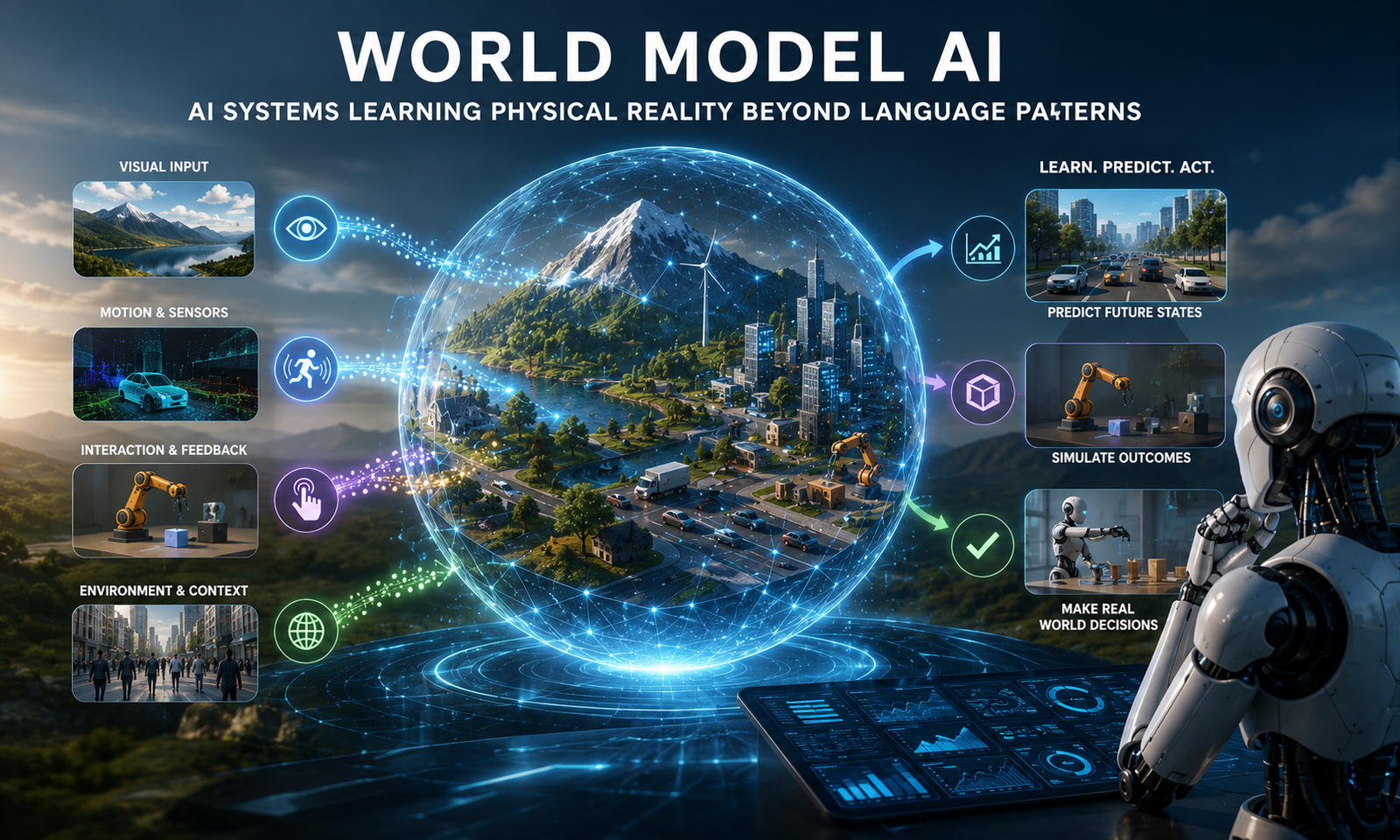
The world of Artificial Intelligence is coming to a new era with the awareness of the world becoming as crucial as learning language. The scaling up of the use of large language models has led to a change in the usage of text and how machines operate with it to respond to questions, create content, and do other tasks. However, language is just another aspect of reality. AI systems of the future will require more and more to comprehend objects, environments, physical relationships, actions, time and consequences.
AI Starts to Develop a Mental Model of Reality
Traditional AI systems are typically geared towards analysing patterns in a limited data set. A world model is a more general model, which tries to explain how the various elements interact in an environment. Can merge visual, linguistic, physical, sensor and past experiences to form a more useful representation of reality.
- AI relates the visual to the object, space, motions and connections to the environment.
- Predictive systems predict the potential change of environment(s) following certain actions.
- The ability to simulate inside the system helps in testing out choices prior to taking action.
- Continuous learning helps models to update their knowledge with new experiences in the environment.
Understanding of Space, Time and Movement
Understanding the evolution of either situations or the movement of stuff, and precisely where it can be found, is an integral aspect of an AI capable of being truly effective. For instance, knowledge of a ball being recognized from knowledge of the ball moving towards a person and having the potential of colliding with another ball.
The juxtaposition of spatial and temporal reasoning enables AI to transcend mere recognition and adopt a more effective role in various fields.Such spatial and temporal thinking opens the door for AI to go beyond simple recognition and effectively function in other realms. May be able to follow and predict events.
Prediction is an integral part of intelligence.
The key element of a world-model system is the ability to forecast what will happen. AI could develop different scenarios, and consider the likely results before taking an action. This may be used to figure out if moving a certain object could cause another object to fall, which could enable an autonomous robot to decide if it should move an object or not.
4 Industries where Reality-Aware AI can make a difference.
Applying world-model technology to various sectors where knowledge about changing environments is critical could be a possibility. It’s more than just about creating content and conversing with an AI helper; its implication ramps up to the physical systems and the intricate decision-making process.
- Robotic engineering may be able to be adaptive in future so that robots work in non-controlled environments.
- The automated cars can forecast pedestrian, vehicle, bicyclist, and roadway conditions which could alter.
- Intelligent simulations could take into account manufacturing system failures, optimize manufacturing systems and enhance production.
- Interactive games may generate dynamic environments, which will behave naturally, depending on the player’s decision.
Smarter Robots Through Environmental Understanding
One of the most blatant ways of world-model AI is in the field of robotics. A robot within a factory environment with well-defined procedures and tasks may be able to successfully complete a task, but in reality, the environment is far from predictable.
World models might enable robots to recognize new objects, perceive their movement, predict their environment and plan paths to avoid obstructions and modify their actions when things change. This may help to make robots more useful in a wide variety of complex contexts – such as warehouses, manufacturing, homes, laboratories – and which will also account for an increasing number of industrial projects.
The Technology of Reality-Aware Machines
There are multiple AI capabilities that are needed to develop world models. Environment interpretation can be achieved by computer vision, semantic knowledge can be provided by language models, environment changes can be captured by sensors, and reinforcement learning can be used to learn by interacting with the environment.
There are changes in the training data too. Video, simulations, robotic demonstrations, streams of sensor data and interactive environments are the sources of learning that we can look forward to for future systems, rather than Instructors/Schools who rely heavily on written works. These sources give information regarding moving and physical action and modification of environmental factors that can’t be completely expressed in text.
From Conversational Systems Toward Autonomous Intelligence
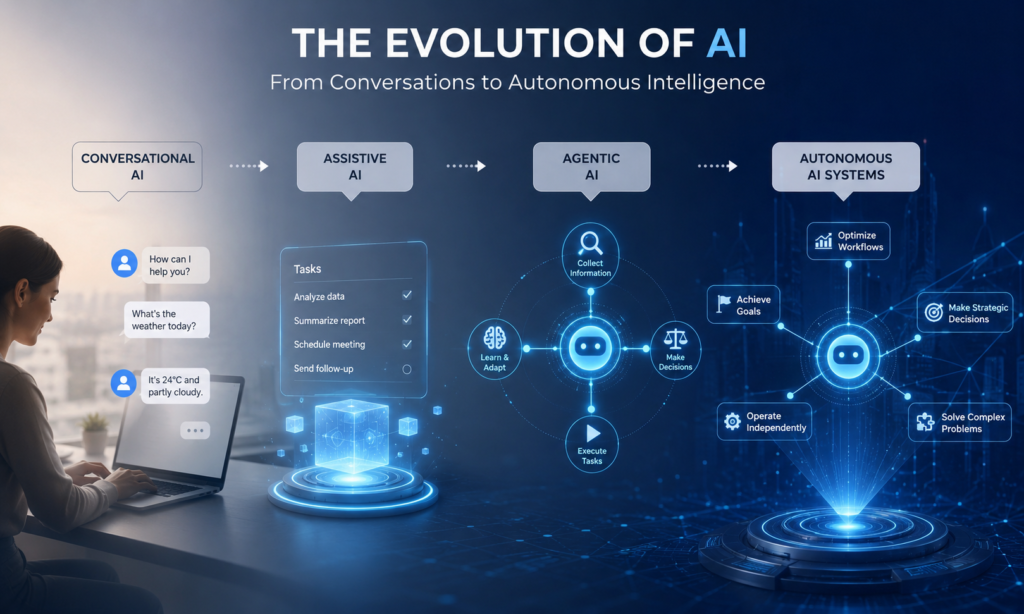
Understanding the impact of world-model AI is more clear when looking at how AI agents have evolved:When studying the evolution of AI agents, it is obvious why world-model AI is relevant: A conversational system can respond to a question, and an autonomous system must not only be able to interpret a goal, but also perform a search and action selection, and then have to evaluate the outcome.
World-models might give access to an internal plan making when executing this process. An AI agent could try out a few actions, estimate the results of each action, and then choose one that has the best chance of meeting the user’s goal and/or working with the environment.
Simulation Could Reduce Costly Real-World Experiments
It’s a very costly process, and even sometimes dangerous, to directly train intelligent systems in the real world. AI can be given a safe environment to experiment and learn from its mistakes with simulated environments.
If the world model is able to handle quite complex experimentation with a system, then systems could run full experiments on their own “world” without having to interact with the real world. Reducing development costs and better planning and decision making through this approach may be possible.
Reality Will Still Remain Difficult to Predict
There is no such thing as a model that will be 100% accurate in predicting reality. There are scenarios that arise in a training situation that are not covered by the training and that can be caused by the weather, human behavior, mechanical failure, unexpected barrier and/or incomplete information.
Why World Models Could Define the Next AI Era
The next level of Artificial Intelligence will not rely on language that conveys more and more convincing messages rather it will focus more on the art of grounded intelligence. It’s necessary to link in the what-ifs and how-tos of AI with what you know.
This move could be supported by the use of World Models. They are able to link the perception, memory, prediction, reasoning and action into a whole system. If research continues to be successful, then AI devices may be better able to deal with the ‘unusual’ rather than following the pattern of what has been learned from previous data.
Conclusion
The world-model AI revolution is a big change in the way that AI can develop. While a machine can process and produce complex language, the environments in which human beings live and work have to be understood better in the future in order for a machine to build a more sophisticated AI language.
World models could serve as a way for AI to comprehend space, time, and motion; causes and effects; and what could happen next. The ability to predict situations and choose actions, beyond just a response, could be possible with these capabilities alongside language, vision, sensors and learning systems, in the future, as AI agents.
FAQs
1. What do you mean by world-model AI?
World-model AI are AI systems that develop internal models of the environments, objects, actions, relations and outcomes.
2.What are the differences between language models and world-models?
Patterns in language are mainly the domain of the language model, whereas world models are supposed to model the world and forecast its subsequent state when performing actions.
3.Does World-Model AI have the potential to enhance Robotics?
Yes, a world model can be useful to robots that want to learn about their world, understand movement and predict what will happen, plan what they want to do, and deal with obstacles and even physical situations that they can’t expect.
4.Will the world models do away with large language models?
World models will be more likely to complement language models as they link the language capability to perception, predictions, planning and physical interaction.